
When Games Become Economies: Looking at the Design Logic Behind Pixels
For many years, video games were designed around a simple idea: players spend time inside a virtual world, but everything they build or collect ultimately belongs to the game developer. Items can disappear when servers close, accounts can be banned, and digital property rarely has value outside the game itself. This arrangement was widely accepted for decades, yet the rise of blockchain technology introduced a new question. If digital assets can be owned on-chain, could online game worlds become something closer to open economies rather than closed entertainment systems?
This question sits at the center of many blockchain gaming experiments, including the project known as Pixels. The project does not emerge in isolation. It appears after several earlier attempts to combine gaming with blockchain ownership, many of which struggled to balance financial incentives with actual gameplay. Understanding the context behind Pixels requires first examining why earlier solutions left important problems unresolved.
During the early wave of blockchain games, the dominant idea was often described as “play-to-earn.” Players could perform in-game tasks and receive tokens that carried real market value. In theory, this model aligned the interests of players and developers. In practice, however, many early systems developed fragile economies. Gameplay frequently revolved around repetitive actions designed primarily to generate tokens rather than meaningful experiences. When token rewards declined or market conditions changed, player participation often collapsed as well.
Another limitation was technical infrastructure. Many early blockchain games were built on networks where transaction costs were high or performance was inconsistent. For a game environment where thousands of small interactions occur every minute, even minor transaction friction can make gameplay feel slow or impractical. As a result, developers began searching for infrastructure designed specifically for gaming use cases.
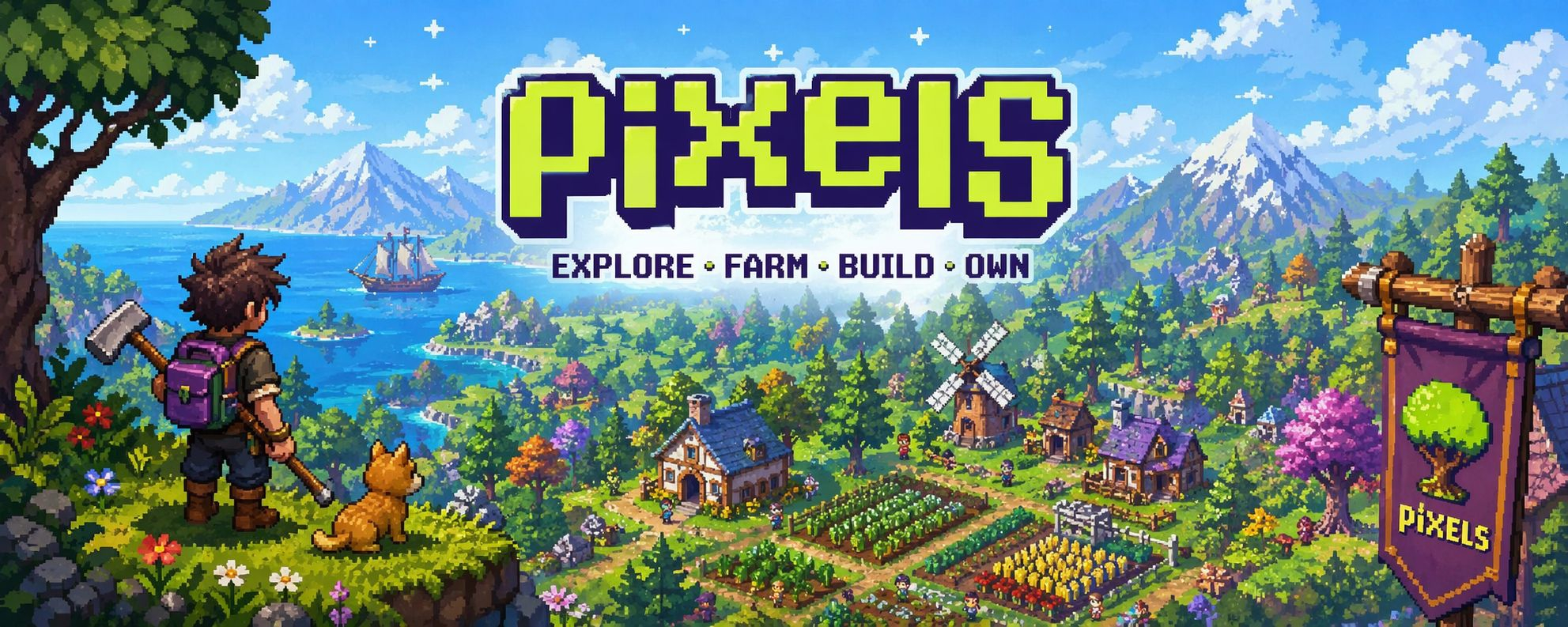
Pixels enters this environment as one possible response to these structural problems. The project presents itself as a social, open-world farming and exploration game that integrates blockchain ownership into everyday gameplay. Instead of focusing solely on financial rewards, the design attempts to build a persistent digital world where players gather resources, cultivate land, craft items, and interact with other players in a shared environment.
The core experience of the game revolves around simple activities such as farming crops, collecting materials, cooking food, and crafting items. These resources form the building blocks of the game’s internal economy. As players progress, they unlock skills, recipes, and tools that allow them to interact with more complex layers of the system.
One of the project’s central claims concerns ownership. Certain in-game assets, particularly land plots, exist as non-fungible tokens. Players who own land can host farming activities or access specific resources tied to their property. In principle, this structure allows in-game assets to exist independently from the developer’s internal database, creating a form of digital property that players can trade or transfer.
Another design decision involves infrastructure. Pixels operates on the Ronin blockchain, an Ethereum-compatible network originally developed to support blockchain games. Ronin was created to address scalability and transaction-cost issues that often affect games built directly on Ethereum. In theory, this allows gameplay interactions to occur quickly and cheaply, making it possible for ordinary in-game actions to interact with blockchain systems without disrupting the player experience.
From a design perspective, the project appears to attempt a subtle shift away from pure financial incentives. The world is structured as a persistent environment where farming, crafting, and social interaction form the primary gameplay loops. Blockchain ownership becomes an underlying layer rather than the sole focus of participation.
Yet these claims invite several important questions. The first concerns economic sustainability. Even when gameplay appears more balanced than earlier play-to-earn systems, a blockchain-based game economy still relies on the relationship between asset supply, player demand, and reward distribution. If too many resources or rewards enter the system, the economy may weaken. If rewards become too scarce, player participation may decline.
Another consideration involves ownership itself. While NFTs allow assets to exist on-chain, practical control over the game environment still depends on the developers who operate the servers, update the rules, and design the gameplay systems. This creates a hybrid model rather than full decentralization. Players may own certain digital objects, but the meaning and usefulness of those objects remain tied to the game’s continued operation.
Accessibility also introduces trade-offs. Pixels allows users to begin playing without owning land, which lowers the barrier to entry. However, land ownership provides certain advantages within the game’s economy, such as access to unique resources or participation in activity on the plot itself. Over time, differences between asset owners and ordinary players may shape how the ecosystem evolves.
The broader significance of the project may lie less in its specific mechanics and more in the questions it raises about digital worlds. If blockchain technology allows game assets to exist independently from centralized databases, the structure of online games could gradually begin to resemble small economies rather than purely entertainment environments.
But even if that possibility exists in theory, it remains uncertain whether players ultimately value ownership as much as developers believe they do. Many players simply want engaging experiences rather than complex economic systems. Others may welcome ownership but resist the financial pressures that sometimes accompany tokenized environments.
In this sense, Pixels represents neither a final answer nor a complete solution. It is better understood as an ongoing experiment in how blockchain infrastructure might reshape the relationship between players, developers, and digital property.
And the deeper question may still be unresolved: if virtual worlds begin to resemble economies, will players continue to see them as games—or will they start to experience them as something entirely different?