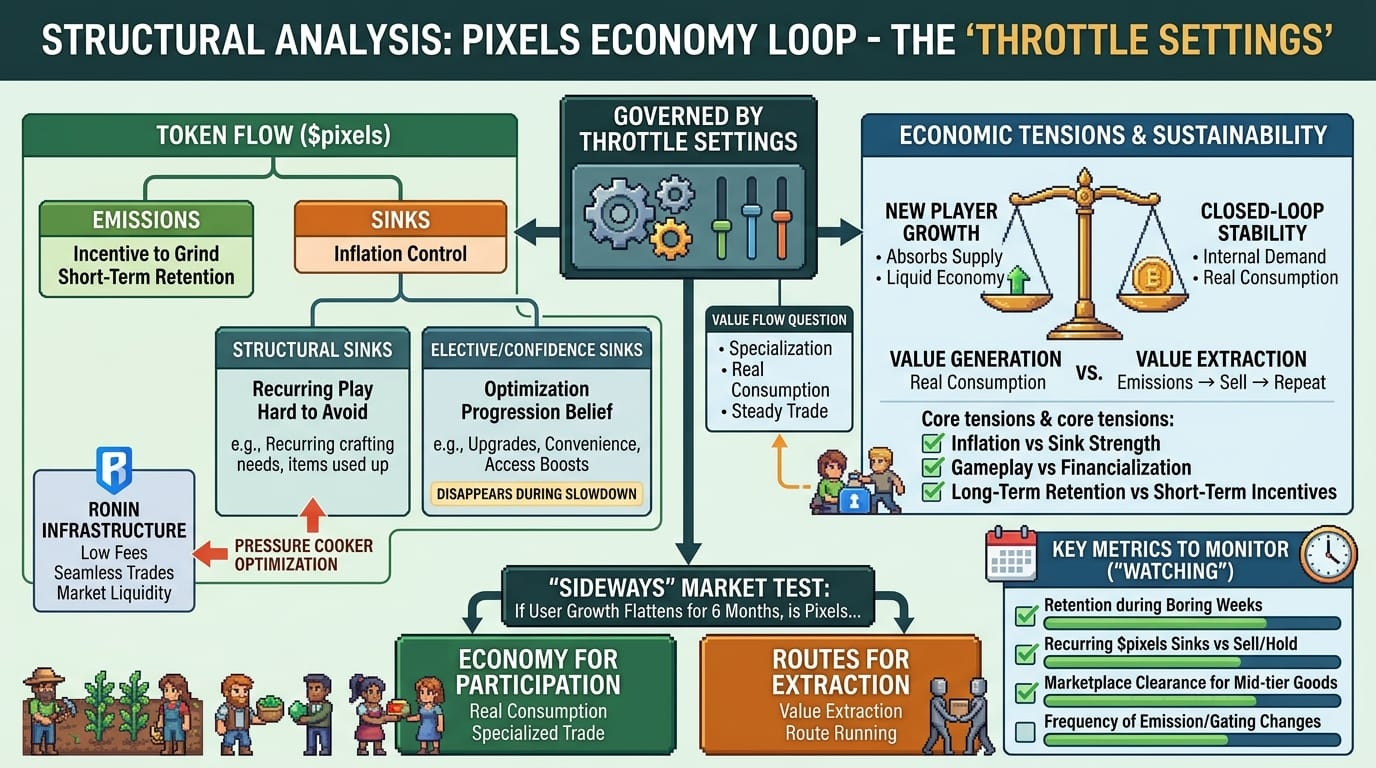
most people talk about pixels like it’s just a farming sim where $pixels pops out if you grind enough. and yeah, you can absolutely play it like that: cozy map, chores, quests, a marketplace, token rewards. but the surface narrative hides the real thing i’m trying to understand: pixels is basically a resource factory with a live market attached, and the devs are constantly deciding how fast the factory runs.
resource generation is the first layer. farming, gathering, crafting the usual pipeline. but what stands out is how much of the economy is enforced through pacing rather than pure scarcity. energy limits, time gates, recipe unlocks, tool tiers, progression requirements, sometimes asset/land access… all of these shape who can produce what, and how quickly supply can hit the market.
a loop i keep using as a mental test: plant + harvest a crop → process it into an ingredient → craft a consumable → sell it to someone who needs it for a quest turn-in or to keep their crafting chain moving. it’s a simple “farm → craft → sell” story, but the stability depends on whether demand is persistent or just scheduled. if the main reason people buy that consumable is “this week’s tasks require it,” demand is kind of being injected by design. it works, but it feels like the economy is being guided more than discovered.
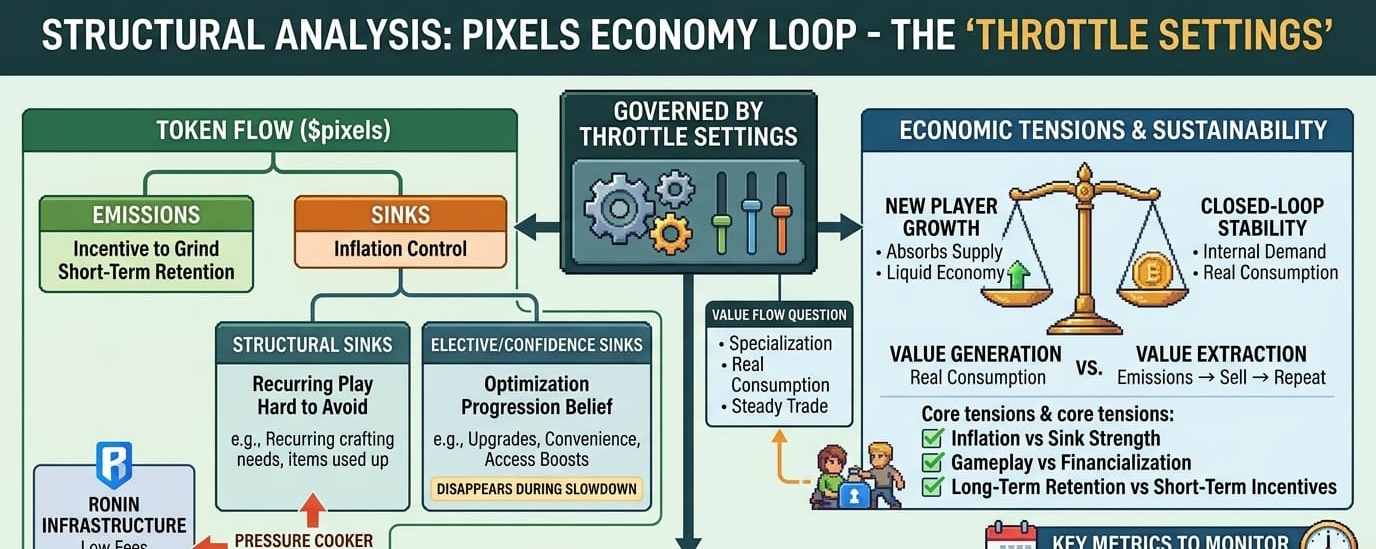
then token flow: $pixels is where the loop either closes or leaks. emissions create the baseline incentive to keep doing the chores, which helps retention in the short term. but emissions also mean constant inflation pressure unless sinks are genuinely doing work. and here’s the part i’m thinking about: in pixels, a lot of sinks feel like they could be “confidence sinks.” upgrades, convenience, access boosts, crafting-related spending players do them when they believe progression is worth it. when that belief weakens (token flat, markets saturated, less excitement), optional spending disappears fast.
so i’m trying to separate sinks that are structural (recurring, hard to avoid, tied to ongoing play) from sinks that are basically elective optimization. the second type can look great during growth phases and then suddenly stop, which is exactly when you’d want sinks to keep absorbing emissions. i don’t know where pixels lands yet. it might have enough real consumption (items being used up, repeatable crafting needs) to keep token demand organic, or it might rely more on rotating content and “reasons to spend.”
infrastructure-wise, ronin is a big deal even if nobody wants to talk about it. low fees and smoother wallet flow make frequent trades viable. pixels’ economy wants lots of small market actions listing stacks of materials, buying ingredients, moving assets so cheap settlement isn’t a nice-to-have, it’s the difference between a living market and a dead one. ronin also brings a userbase that already understands nft assets and marketplace behavior, which helps liquidity early. but it’s also a pressure cooker: people optimize. if there’s an efficient production route or a mispricing between crafted goods and $pixels rewards, it’ll get found and scaled quickly.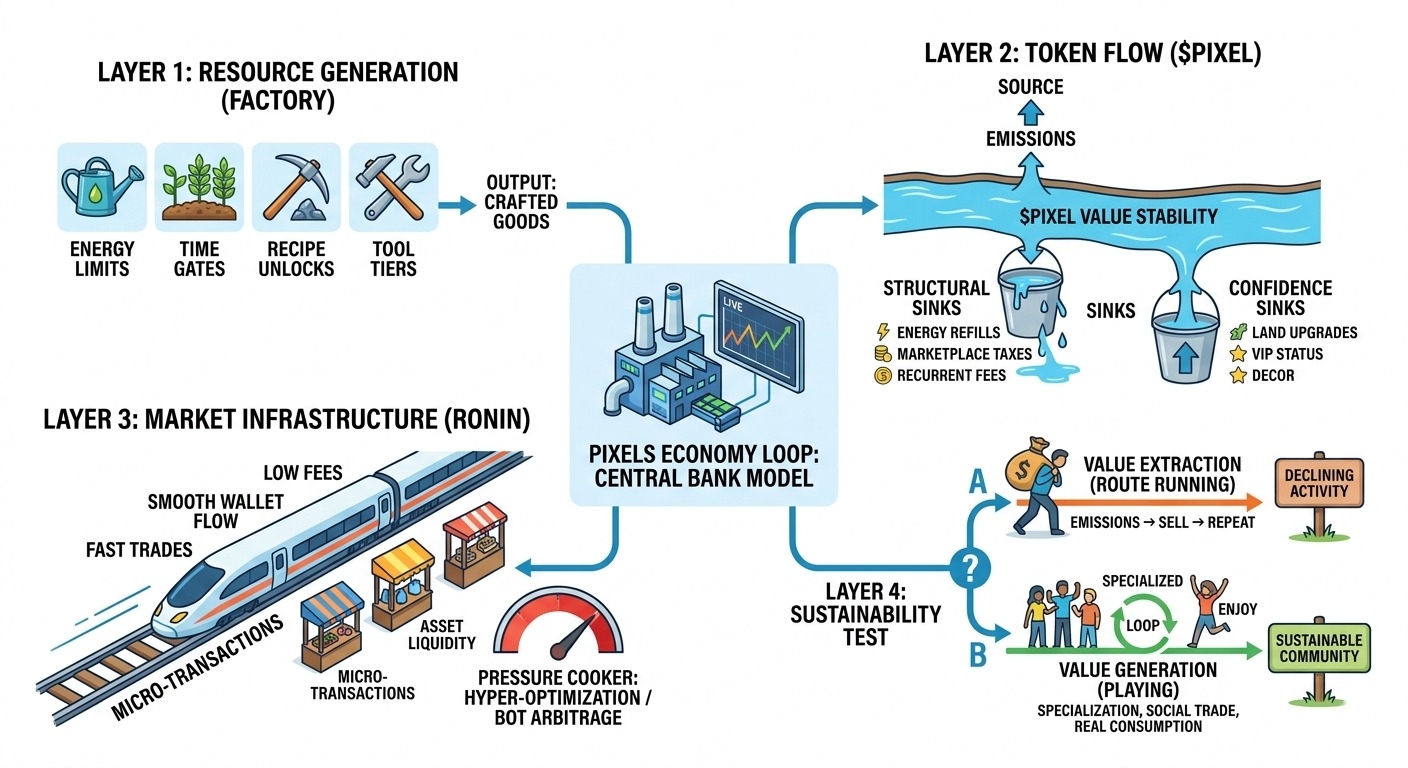
zooming out, i’m stuck on sustainability. are players generating value (specialization, real consumption, steady trade), or mostly extracting value (emissions → sell → repeat)? what depends on continuous user growth is the obvious stuff: new players absorb supply, buy starter assets, keep low-tier goods moving, and make the economy feel liquid. if growth slows, you find out whether the economy has real internal demand or if it was just buoyed by onboarding waves and event-driven spikes.
the tension feels unavoidable:
- reliance on new players vs a stable “closed-loop” economy
- token inflation vs sink strength (and whether sinks feel fun or like taxes)
- gameplay vs financialization (when does “playing” become “running a route”?)
- long-term retention vs short-term incentives (do people stay when rewards normalize?)
i don’t have a clean conclusion. pixels looks competently built, maybe even cautious, but competence can still produce a short-term loop that only holds while things are growing.
watching:
- retention during boring weeks (no big events, token quiet)
- how much $pixels is actually spent in recurring sinks vs sold/held
- marketplace clearance rates for mid-tier crafted goods (not just rare assets)
- frequency of emission/gating changes (balancing, or constantly patching leaks)
if $pixels went sideways for six months and user growth flattened, would pixels still feel like an economy people participate in… or just a set of routes people run until they’re done?