I have watched enough blockchain gaming cycles to recognize the pattern before it finishes.
Token drops. Community gets loud. Team announces fixes. The fixes are always the same new emission schedules, adjusted reward pools, and updated vesting. Token mechanics layered on top of token mechanics.
Nobody goes back to the game.
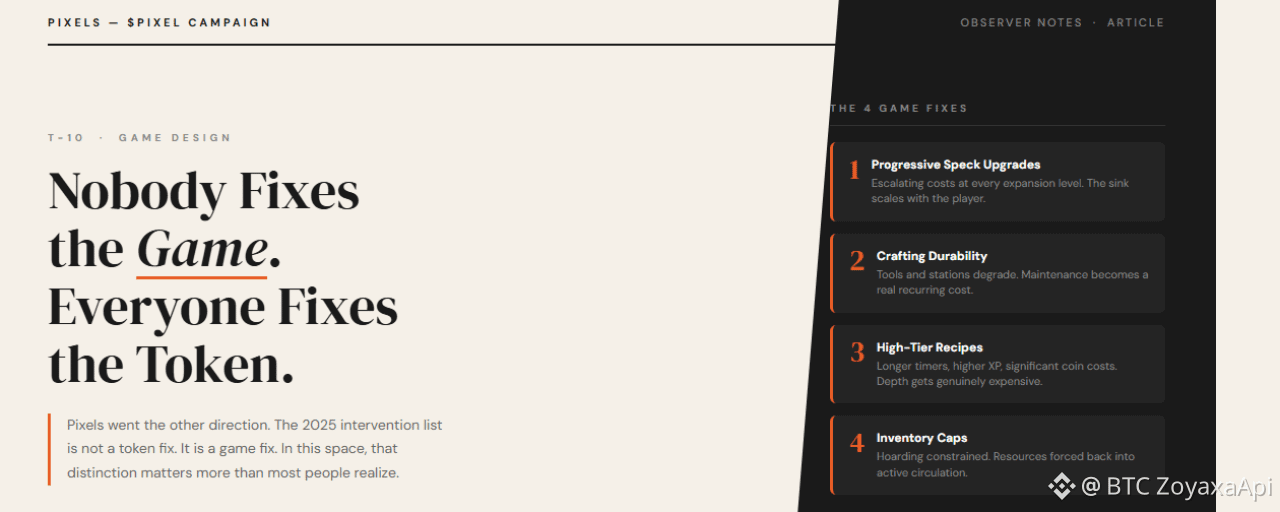
That is what made me stop and look more carefully at what $PIXEL is actually doing in 2025. Because the intervention list they published is not a token fix.
It is a game fix. And in this space, that distinction matters more than most people realize.
Let me explain what I mean.
The core loop problem in Pixels was not complicated. Players were generating coins faster than the game could absorb them. Infinite supply meeting finite sinks. Classic inflation architecture. The obvious move the move every other project makes is to reduce emissions. Tighten the token. Adjust the reward schedule. Paper over the hole.
Pixels went the other direction.
Progressive Speck Upgrades. Farm plots that can expand indefinitely but with escalating coin and resource costs at every level.
The sink scales with the player. The more you progress, the more the game costs you to maintain that progress. Inflation does not disappear. It gets redirected into depth.
Crafting Durability. This one is quieter but more interesting. Stations, tools, consumables they degrade with use. They need replacing. A blacksmith's anvil is not a one-time purchase anymore. It is a recurring cost built into the rhythm of playing seriously.
Think about what that actually does to the economy.
Every serious player now has a floor of ongoing resource consumption just to maintain their operation. Not to grow. Just to stay at the same level. That is not a punishment that is what a real economy feels like. Things wear out. Maintenance costs exist. The game starts behaving less like a crypto project and more like a functioning world.
Enhanced High-Tier Recipes. Longer timers, higher XP requirements, significant coin costs. The progression ceiling gets pushed upward and made genuinely expensive to reach. Players who want the best outputs have to commit real time and real resources — not just log in daily for passive rewards.
Inventory Caps. Soft limits on how much players can hoard. Purchasable expansions available but the default behavior of sitting on infinite resources gets constrained. Hoarding was one of the quieter inflation drivers. Capping it forces resources back into circulation.

Here is the part I keep returning to.
All four of these interventions share something. They are not asking players to spend less. They are asking the game to cost more. That is a fundamentally different design philosophy from what most blockchain games reach for when their economy breaks.
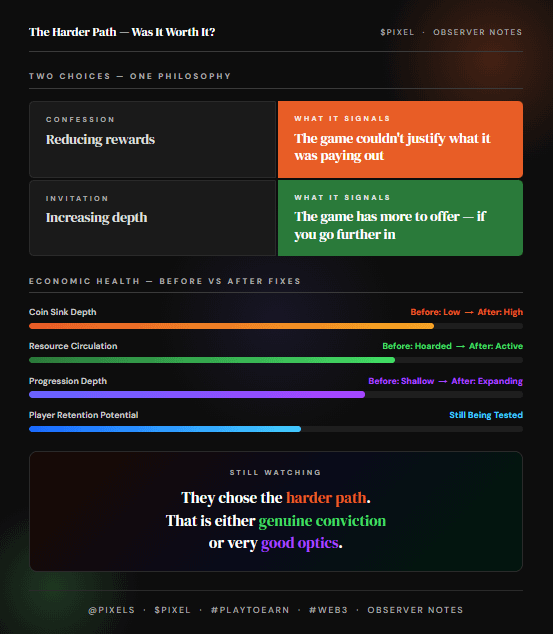
Reducing rewards is a confession. It says the game could not justify what it was paying out.
Increasing depth is an invitation. It says the game has more to offer if you are willing to go further into it.
Whether players respond to that invitation is the real question. A player who came to Pixels for token rewards and found their earnings tightening will leave. A player who came because the game was genuinely interesting will lean in.
Pixels is essentially betting that the second type of player exists in large enough numbers to sustain the economy through the transition.
I am not certain they are right. The 2024 numbers showed massive scale but unclear retention quality. Volume is not the same as attachment.
But I cannot ignore that the fix they chose was harder than the alternative. Token adjustments are easy. Rebuilding game loops takes time, design discipline, and willingness to frustrate some players in the short term.
They chose the harder path. That is either genuine conviction or very good optics.
I am still watching which one it turns out to be.
What would keep you inside a blockchain game after the easy rewards dried up the depth of the game, or nothing?
@Pixels $PIXEL #pixel #blockchain #gaming #Web3 #crypto