
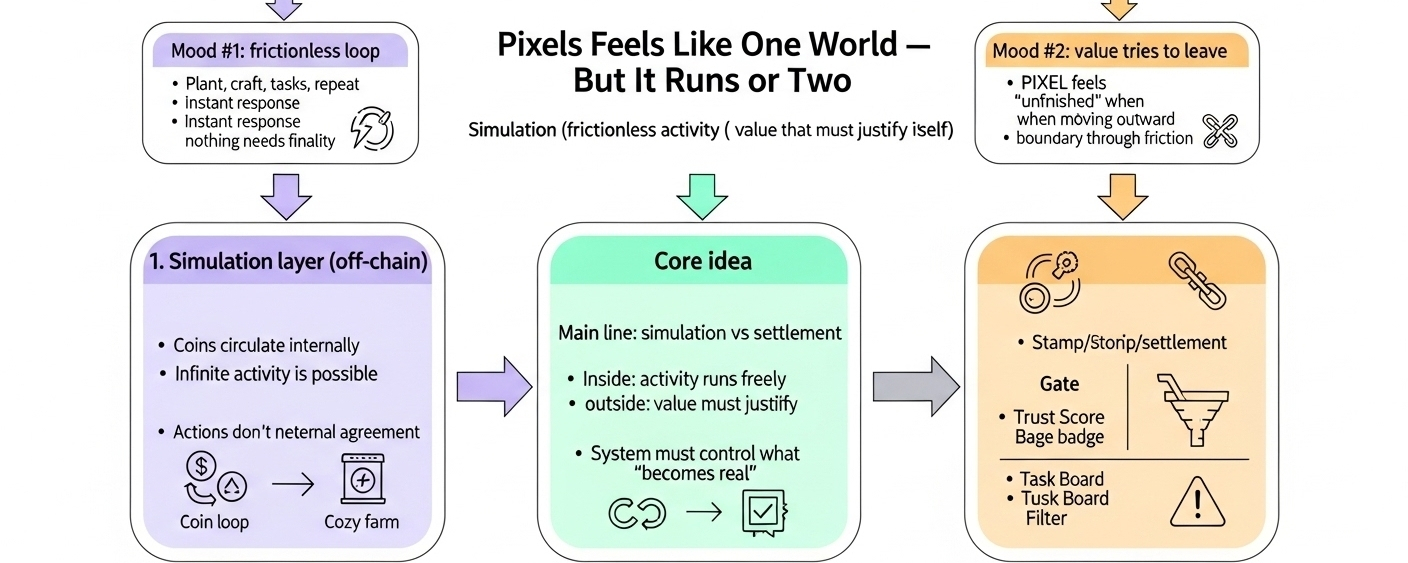


In Pixels, the most important line isn’t drawn on a map and it isn’t announced with a big warning. You feel it only after you’ve been inside the loop long enough to notice that the game has two different “moods” that behave like two different systems.
Most of the time, everything feels frictionless. You plant, craft, run tasks, move around, repeat. The world responds instantly, almost too clean. Nothing pushes back. Nothing asks you to justify what you’re doing. It’s like the system is built to keep activity flowing without interruption. In that space, actions don’t need to be proven to anything outside the game. They don’t need finality. They just happen, and the loop keeps going.
Coins make this easiest to understand. Coins never try to leave. They don’t slow down, they don’t get restricted, and they don’t need permission to exist. They circulate inside the off‑chain loop like they belong there permanently. That tells you something about the environment: it can support infinite activity because nothing in that layer is required to resolve into anything external.
Then PIXEL appears, and the feeling changes. Inside the farm, it can look like just another output of your work, another chain completed, another result earned. But the moment you start thinking about moving that value out toward Ronin, the smoothness stops feeling complete. The same action that felt “done” inside the loop suddenly feels unfinished, like it has to cross a boundary that didn’t matter before.
That’s why the real split starts to look less like “playing versus earning” and more like “simulation versus settlement.” The simulation side is where activity can run freely, where nothing needs to be agreed on by anything outside the system. Settlement is where value has to justify itself. It’s where filtering becomes necessary, because not every path inside the loop can afford to become clean extraction on-chain.
This is where “not everything that happens inside is meant to become real” stops sounding like a philosophical statement and starts sounding like an operational rule. The system can allow endless off‑chain motion, but it must control what escapes that motion.
Trust Score sits at that edge in a way that doesn’t feel accidental. It isn’t part of the cozy farming loop; it waits at the point where off‑chain activity tries to become on‑chain reality. It doesn’t feel like it’s checking only one action in isolation. It feels like it’s reading patterns across sessions, and it behaves like a gate that decides whether something is allowed to leave without breaking the balance behind the loop.
The Task Board starts to feel different under this lens too. It surfaces chains that look like they lead outward, but those chains don’t behave equally when they try to cross. Some move cleanly, others slow down, and the inconsistency doesn’t feel random. It feels like different boards are pulling from different depths of funding, even if they look similar when they appear.
So progress becomes a different question. Are you improving inside the simulation loop, or are you getting closer to consistent settlement? Or are you simply being routed more often into the parts of the system where liquidity was already directed upstream?
The boundary stays blurry. Pixels doesn’t clearly announce where simulation ends and settlement begins. And that blur may be the point. If the boundary were obvious, players would optimize around it too aggressively, push everything toward settlement, and drain the funded paths faster than the system can sustain. So the line remains subtle, felt only through friction, timing, and which value is allowed to become real.
