
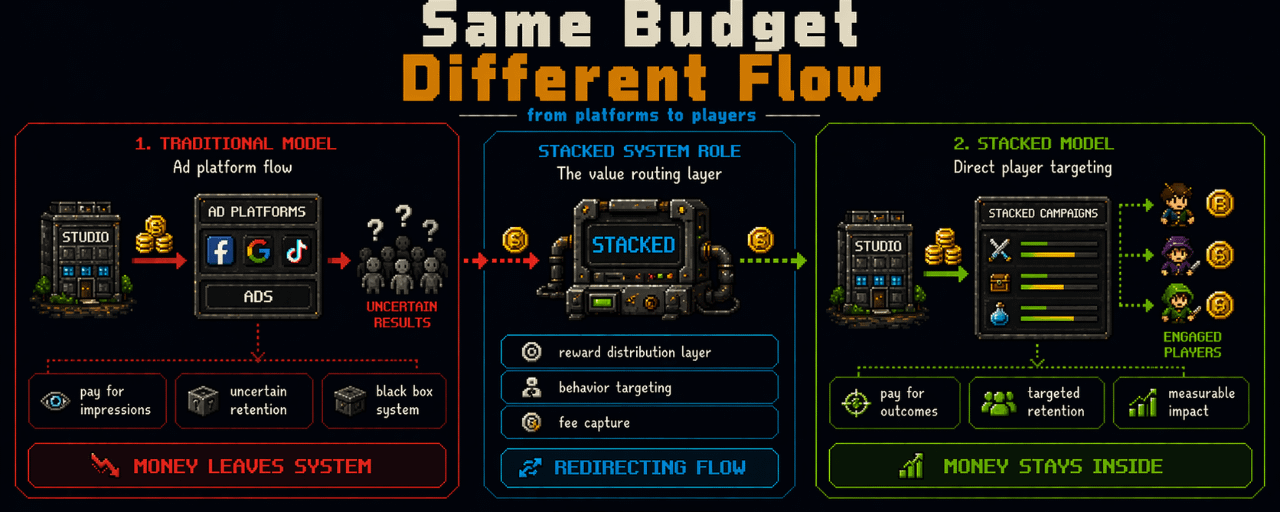
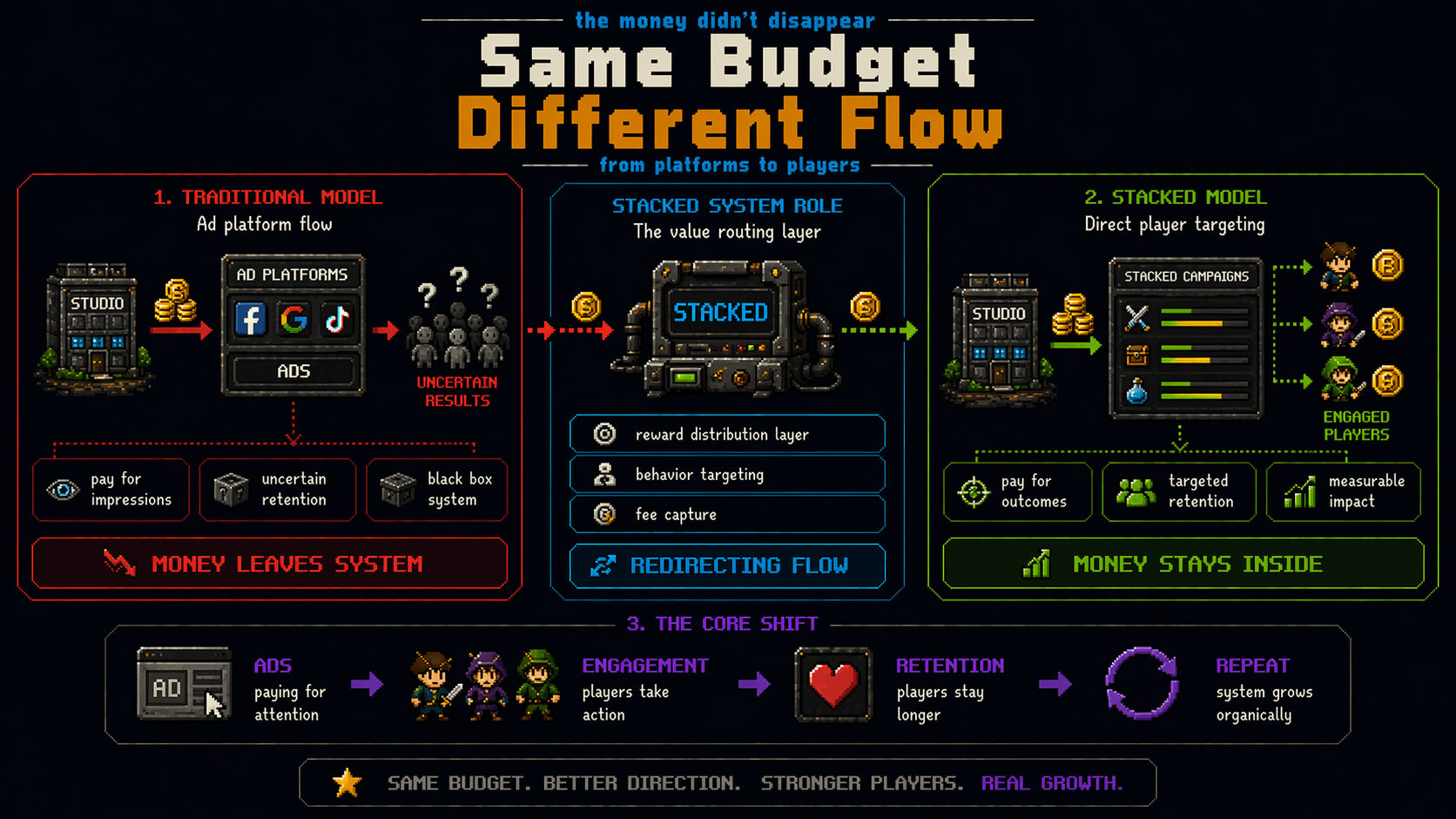
I was going through Stacked again and there’s one line that I had to stop at. Not because it sounded impressive, but because it quietly changes how you look at the whole system. The idea that marketing budgets, the ones studios usually send to ad platforms, are now being redirected straight to players who actually engage.
At first I thought okay, that’s just another way to describe rewards. But the more I sat with it, the more it felt like something else entirely.
Stacked isn’t just adding another layer of quests or incentives. It’s sitting in the middle of a massive flow of money that already exists in gaming, the user acquisition budget, and rerouting it. Instead of paying for impressions and hoping some users stick, studios are effectively paying for outcomes. And Stacked takes a cut from that flow.
That’s a very different position to be in.
Because gaming studios already spend huge amounts on acquisition every year. And most of that process is still kind of a black box. They know how much they spend, but they don’t really know which users will stay, which ones will spend, or which ones will actually contribute to the ecosystem. So they keep buying traffic to replace churn.
What Stacked seems to be doing is turning that into something measurable. Instead of guessing, studios run campaigns that target specific player behaviors, and then track how retention changes. It’s a much simpler pitch than it sounds. You’re not buying users, you’re reinforcing the ones who already matter.
And the interesting part is that this isn’t theoretical. Pixels has already been using this internally, across its own games, processing a huge number of rewards and generating real revenue from that system. So when Stacked talks about redirecting ad spend, it’s not starting from zero.
What I keep thinking about though is how this scales.
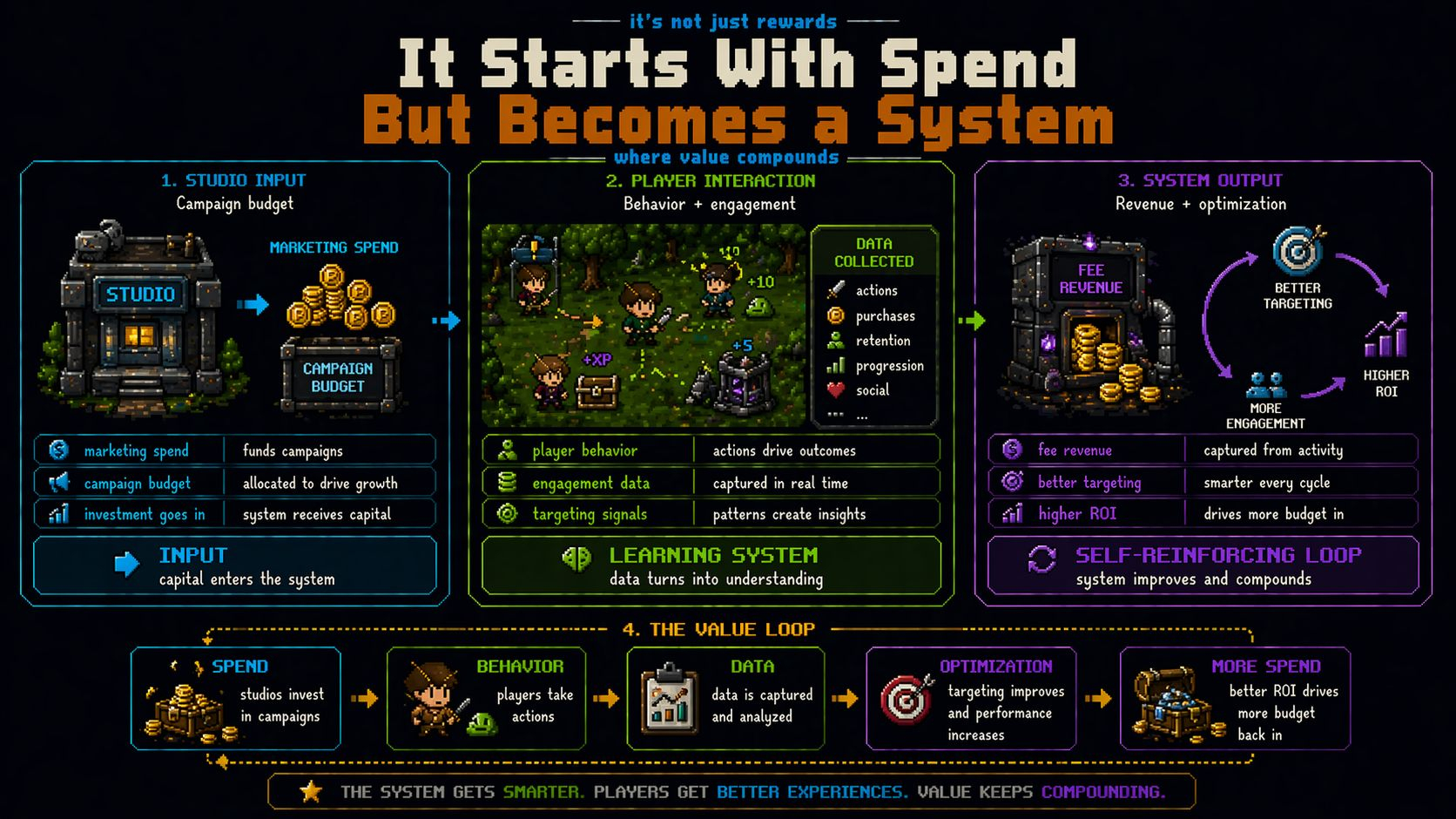
If more studios plug into the same system and start running campaigns, then the volume of rewards increases. More volume means more fees for Stacked, but it also means more demand for PIXEL if that’s the token used across those campaigns. So both sides grow together, not because of market sentiment, but because more studios are actually using the system.
That starts to feel less like a game economy and more like infrastructure sitting under multiple games.
There’s also something subtle here with data. Every campaign run, every reward distributed, adds more behavioral data into the system. Over time, that should make targeting better, which makes campaigns more effective, which gives studios more reason to keep using it. It’s one of those loops that’s hard to replicate quickly because it depends on real usage over time.
Of course, none of this really matters if external studios don’t come in. That’s still the part that hasn’t been fully proven yet. Getting adoption, proving ROI outside of Pixels, that’s a completely different challenge compared to building the system itself.
But still, I can’t really unsee that core idea now. If Stacked is actually sitting between billions in ad spend and the players themselves, then it’s not just building features for a game. It’s trying to reshape how value moves through the entire ecosystem.
And if that works, even partially, it probably changes how people should be looking at PIXEL in the first place.
Right now it still feels like most people are reading it as a game token. Maybe that’s fair for now. But if the flow it’s tapping into is real, then that might not be the full story anymore.