
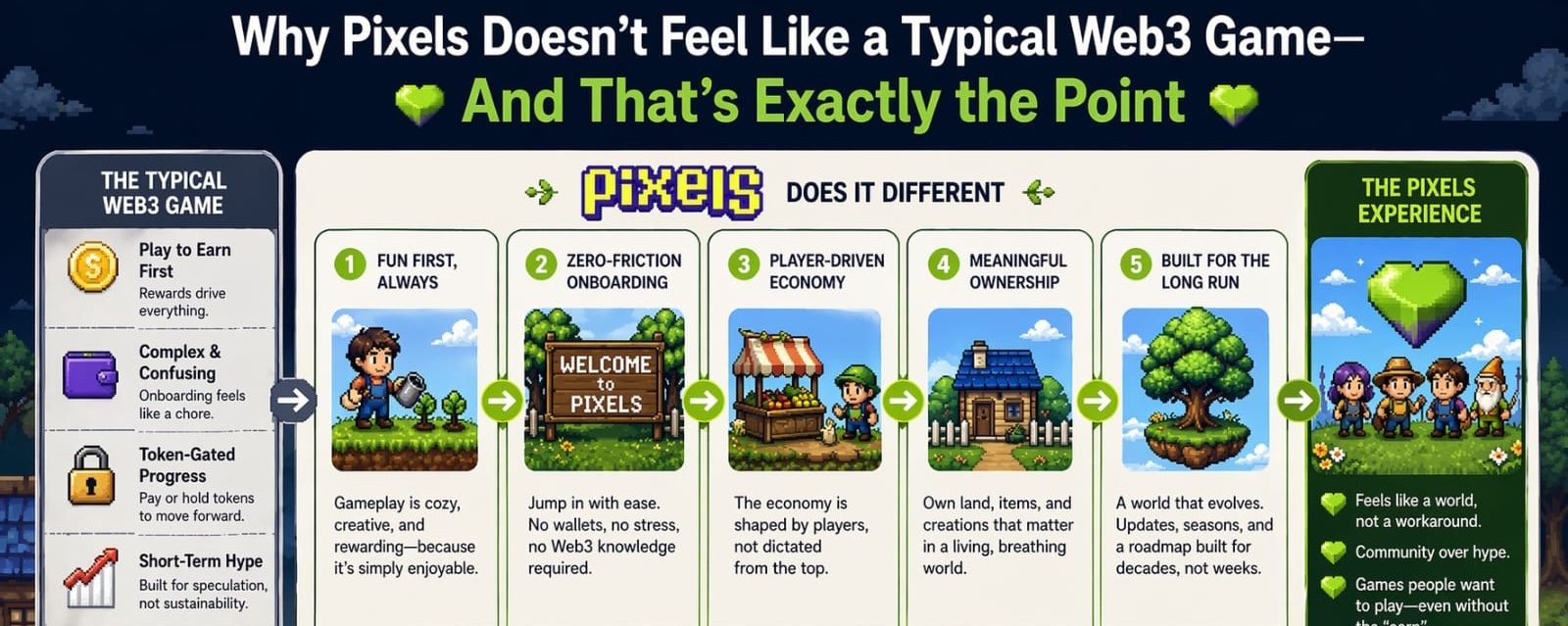
I keep coming back to Pixels, not because it’s loud or revolutionary on the surface, but because it feels strangely… deliberate.
At first glance, it’s easy to reduce it to a familiar shape: a soft, open-world farming game where you plant crops, gather resources, and wander through a pixelated landscape. Built on Ronin Network, it carries all the expected Web3 signals—tokens, NFTs, ownership. But the more I sit with it, the less it feels like a “crypto game” and the more it feels like something quietly trying to solve constraints that don’t usually get discussed out loud.
I thought I understood it… until I didn’t
Initially, I framed it the usual way: gameplay loop + token economy. Farm, earn, upgrade, repeat. The PIXEL token sits at the center—used for crafting, minting assets, joining guilds, unlocking features.
That part is straightforward.
But then there’s this dual-layer structure that kept pulling my attention back: an off-chain currency for casual interaction, and an on-chain token for anything that needs to persist, transfer, or be audited.
At first, I dismissed it as a performance optimization. Lower fees, less congestion. Standard stuff.
But that explanation started to feel incomplete.
Privacy, but not the way I expected
I used to think of privacy in Web3 as something absolute—either everything is transparent, or everything is hidden.
Pixels doesn’t approach it that way.
Instead, it seems to treat privacy as contextual. Most player actions—farming, crafting, experimenting—don’t need to exist permanently on-chain. They don’t need to be audited. They don’t need to be exposed.
But ownership, value transfer, and governance do.
That separation starts to feel less like a technical compromise and more like an operational one. If every action were on-chain, the system would become expensive, slow, and overly exposed. If nothing were on-chain, then nothing could be trusted beyond the game itself.
So it splits the difference—not ideologically, but functionally.
And I realize… that’s probably closer to how real systems work outside of crypto too.
The parts that don’t trend—but matter
What really shifted my perspective wasn’t the game loop or even the token.
It was the small, unglamorous details.
Regular updates. Tooling improvements. Backend stability. The kind of changes that don’t make headlines but quietly reduce friction over time.
Ronin itself is designed around this idea—fast transactions, low-cost execution, simplified onboarding, even sponsored transactions so users don’t feel the weight of infrastructure immediately.
None of that is exciting in isolation. But together, it starts to look like something built under real constraints—where latency, cost, and user drop-off are not theoretical problems.
I start to think less about “innovation” and more about reliability.
Because if people are expected to spend time—and potentially money—inside a system, it has to work consistently under pressure.
Token mechanics, slowly making sense
The more I look at the PIXEL token, the less I see it as a speculative asset and the more I see it as a coordination tool.
It’s used for:
Accessing higher-level features
Minting and interacting with NFTs
Participating in governance decisions
Staking to influence how rewards are distributed
That last part took me a while to understand.
Staking here isn’t just about yield—it’s about signaling. It’s a way of saying: this part of the ecosystem matters, allocate resources here.
Which starts to resemble budgeting more than investing.
And the structure around it—like splitting spent tokens between a treasury and rewards pool—feels less like tokenomics theater and more like resource recycling.
Not perfect. But intentional.
Validators, infrastructure, and quiet accountability
Even though most players won’t think about validators or network structure, it’s there in the background shaping everything.
Ronin operates as a purpose-built chain for games, meaning it prioritizes throughput, cost efficiency, and predictable performance over broad generalization.
That choice comes with trade-offs.
It’s not the most decentralized system in the abstract sense. It doesn’t try to be everything at once. But it’s optimized for a specific environment—one where thousands (or millions) of small actions happen continuously.
And in that context, validator behavior isn’t just about consensus—it’s about uptime, consistency, and trust under load.
Again, not flashy. But necessary.
The compromises I didn’t notice at first
The longer I think about it, the more I see how many compromises are embedded in the design:
EVM compatibility, even if it limits architectural freedom
Migration from other chains, carrying legacy assumptions forward
Partial decentralization instead of absolute purity
Dual currencies instead of a single unified system
None of these feel ideal in isolation.
But they also don’t feel accidental.
They feel like decisions made under constraints—where compatibility, user migration, and operational continuity matter just as much as design elegance.
And that changes how I read the project.
What it’s actually responding to
I started out thinking this was just another Web3 game experimenting with ownership.
Now it feels more like a response to something broader:
Systems that are too opaque to audit
Economies that don’t loop value back to participants
Platforms where user effort disappears without a trace
Infrastructure that breaks under real usage
Pixels doesn’t solve all of that. But it acknowledges those pressures.
And instead of overcorrecting—by making everything on-chain or fully decentralized—it tries to balance usability, accountability, and performance.
Where I’ve landed
I wouldn’t say I’m excited about it.
That’s not the feeling.
It’s more like… the pieces are starting to fit together.
The design choices—some of which initially felt arbitrary or compromised—begin to make sense when viewed through the lens of real-world constraints: audits, user behavior, system load, and long-term maintenance.
It’s not trying to be perfect.
It’s trying to hold up under questioning.
And the more I think about that, the more I find myself returning to it—not for what it promises, but for how it’s been put together.
That quiet consistency is harder to notice.
But it’s also harder to fake.
