
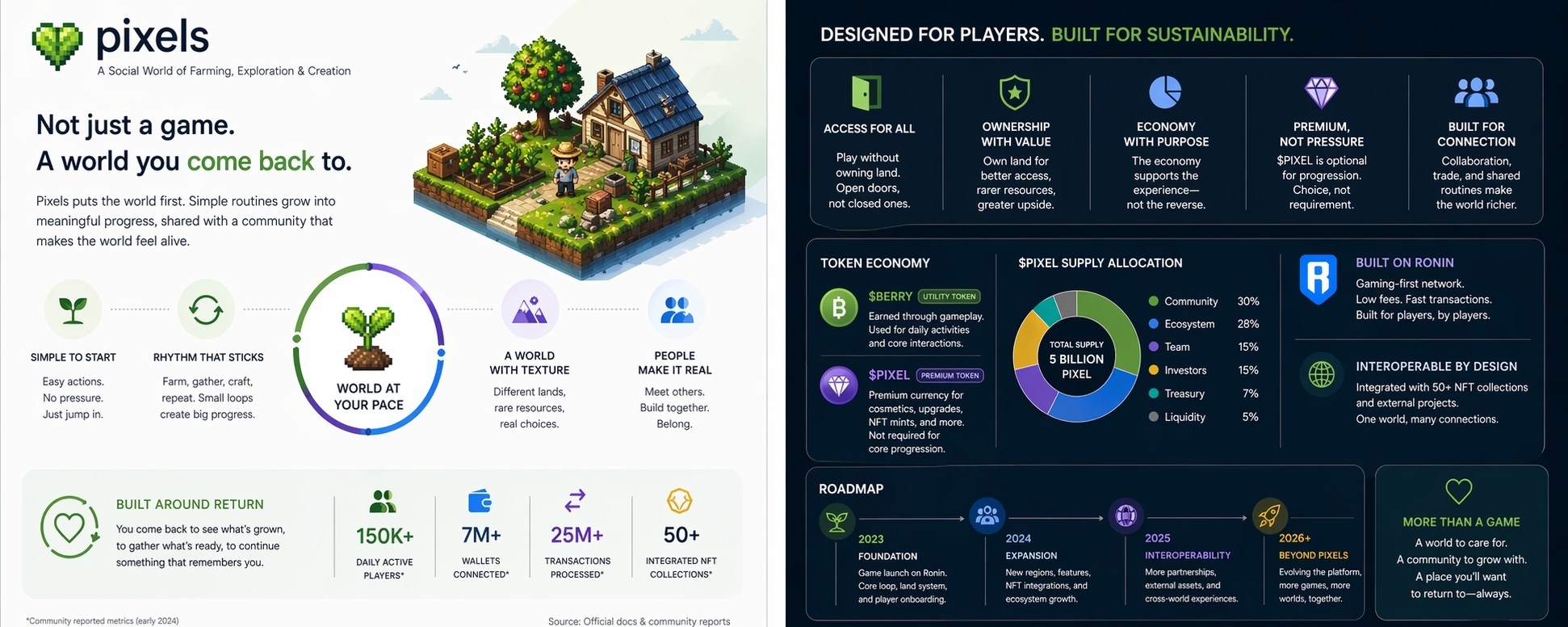
Most people assume a Web3 game will tell you exactly what it wants from you the moment you arrive. Usually it is obvious. The token is front and center. The economy comes first. Everything seems built to remind you that value is being tracked, traded, measured. Pixels does not feel like that. It feels softer when you step into it. Slower. More human, in a strange and unexpected way. Before you start thinking about wallets or ownership or market logic, you notice the world itself. The fields. The movement. The small routines. The sense that this is somewhere you can settle for a while, not just pass through. That changes everything.
There is something quietly comforting about a game that asks you to begin with simple things. Planting crops. Gathering materials. Walking through open space. Meeting people who are doing the same. Pixels is built on those ordinary motions, and that is part of its strength. It does not rush to overwhelm you with complexity. It lets the world introduce itself gradually, almost the way a real place does. You learn by staying. You understand it by returning. That kind of design can seem modest from the outside, but it creates a stronger connection than louder games often manage. People do not always remember the biggest experience. They remember the one that felt lived in.
Farming sits at the heart of that feeling. In many games, farming is treated like background noise, something repetitive you do while waiting for the real action to begin. In Pixels, it carries more weight than that. It shapes your rhythm. It teaches patience. It gives the world its pulse. You plant, wait, harvest, and start again, but the loop does not feel empty because each cycle ties into a larger sense of growth. Over time, those small actions begin to mean something. Your progress is not just a number climbing in the background. It feels personal. It feels earned. There is a quiet satisfaction in watching a world respond to your care.
That is where Pixels becomes more than just another farming game with a blockchain layer attached. The land matters. The resources matter. Where you are changes what becomes possible. Some plots offer more. Some materials are harder to reach. Some opportunities are only available if you have access to the right kind of space. That creates a world with texture. Not everything is flat. Not everything is equal. And because of that, the choices you make begin to carry emotional weight as well as strategic value. You are not only playing a system. You are building a relationship with a place.
One of the more thoughtful things about Pixels is that it does not lock the door on people who arrive without ownership. That matters more than it may first appear. So many blockchain games create a feeling of distance before the player has even started. They divide the world too early between those who own and those who do not. Pixels leaves room for people to enter more naturally. You can begin without holding land, without making a large commitment, without feeling like you are standing outside the real experience. At the same time, ownership still means something. It brings advantages, access, and stronger opportunities. That balance is important because it respects both sides of the experience. It gives value to investment without stripping meaning from everyone else.
Underneath all of this is a larger idea that feels surprisingly mature for the space it belongs to. Pixels seems to understand that people do not stay in a world simply because it has an economy. They stay because it gives them a pattern they can care about. They stay because routine turns into attachment. They stay because a place begins to feel familiar. Web3 games have often struggled with this. Too many of them were built like engines for extraction, where every action seemed designed to point back toward profit. That kind of structure can attract attention for a while, but it rarely builds affection. Pixels appears to be reaching for something steadier. It wants the economy to support the world, not replace it.
The token system reflects that effort. There is a distinction between the premium layer and the everyday experience, and that separation matters. It creates breathing room. It allows the player to exist inside the game without feeling that every small motion is part of a financial decision. That may sound like a technical detail, but emotionally it changes the atmosphere. It means the player can focus on what the world feels like rather than constantly being reminded of what it is worth. In a genre where value is often made painfully visible, that restraint gives Pixels a little dignity.
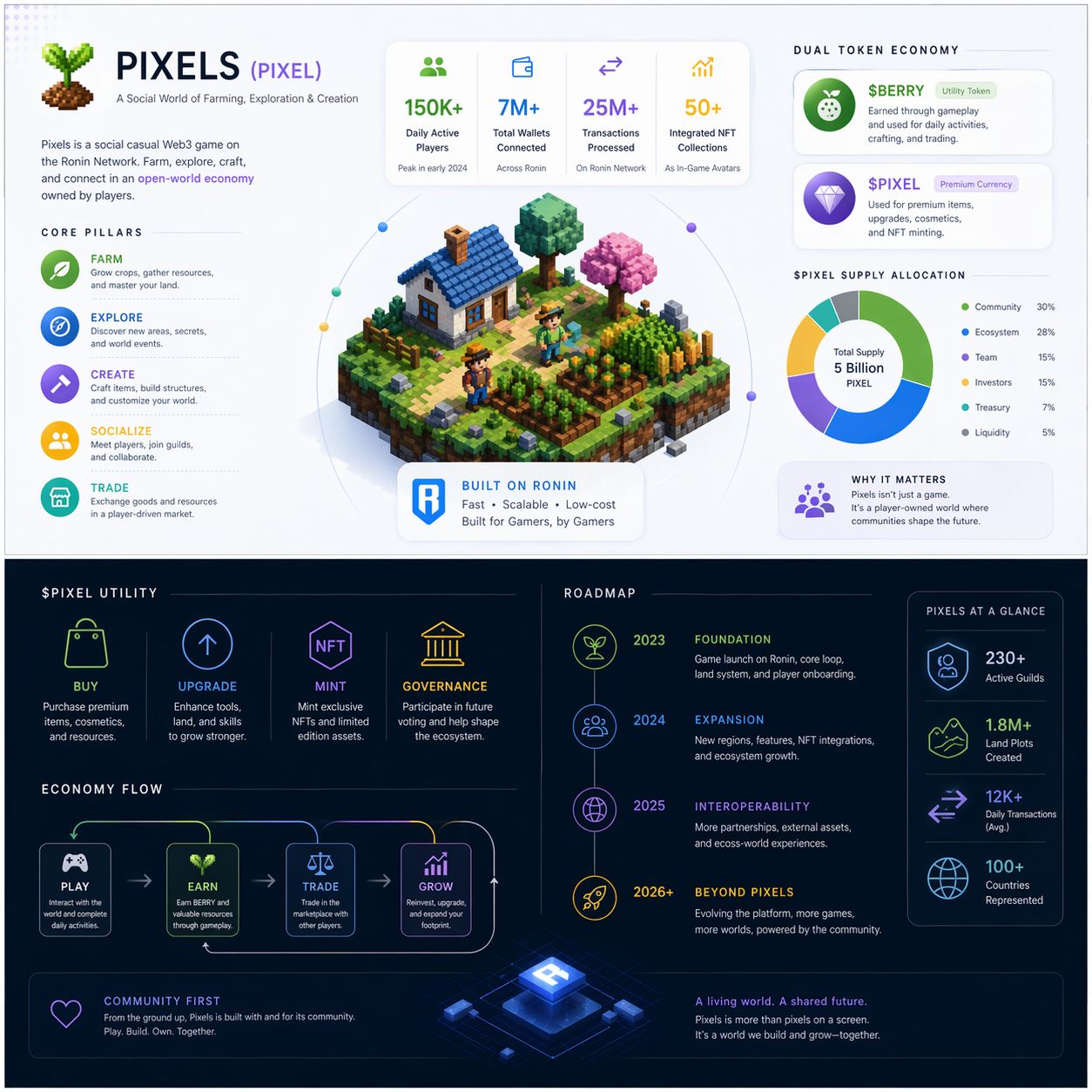 There is also a social texture to the game that gives it depth. Pixels is not built only on crops, land, and progression loops. It depends on presence. Other players matter here, not only because they are part of the economy, but because they make the world feel inhabited. There is a real difference between a world filled with users and a world filled with people. One feels transactional. The other feels alive. Pixels comes closer to the second when it is working well. You sense that others are not just passing through for a reward. They are building routines of their own. They are shaping the mood of the place simply by being there. That kind of shared familiarity is difficult to create, and once it appears, it is hard to fake.
Its connection to Ronin makes sense for this reason too. Ronin already carries the identity of a gaming-centered network, which gives Pixels a more natural home than a broader chain might have. The surrounding environment matters. A game world needs infrastructure, but it also needs context. It needs to exist somewhere that understands what players are doing there. On Ronin, Pixels fits into an ecosystem where game economies and digital ownership do not feel like side experiments. They feel expected. That alignment gives the project a stronger foundation and helps its design choices feel less isolated.
What makes Pixels interesting, though, is not that it has solved every problem. It has not. No game in this corner of the industry is free from the pressure of speculation. Markets change. Sentiment shifts. Token structures can distort even well-made systems if they become too loud. Pixels still has to live with that tension. It still has to prove that the world remains worth caring about when excitement cools down. That is the real test. Not whether people arrive when interest is high, but whether they keep returning when the noise fades.
And maybe that is the deepest reason the game leaves an impression. It is built around acts of return. You come back to see what has grown. You come back to gather what is ready. You come back because the world remembers where you left it. There is something emotionally powerful in that loop, even if it seems simple on paper. It gives the game a sense of continuity. It makes your time feel stored rather than spent. In a digital culture that often moves too fast and forgets too easily, that feeling can land harder than expected.
Pixels does not need to shout to be memorable. Its strength comes from the opposite impulse. It builds slowly. It trusts small actions. It understands that care can be a form of progression. That may not sound dramatic, but it reaches people in a deeper way than spectacle often does. There is a quiet pull in a world that lets you tend to something, shape something, and return to something that still feels like yours.
That is why Pixels stands apart. Not because it is louder, bigger, or more ambitious in the way projects usually claim to be. It stands apart because it feels more patient. More grounded. More willing to let attachment form at its own pace. And in a space that often mistakes urgency for meaning, that patience feels almost radical.
