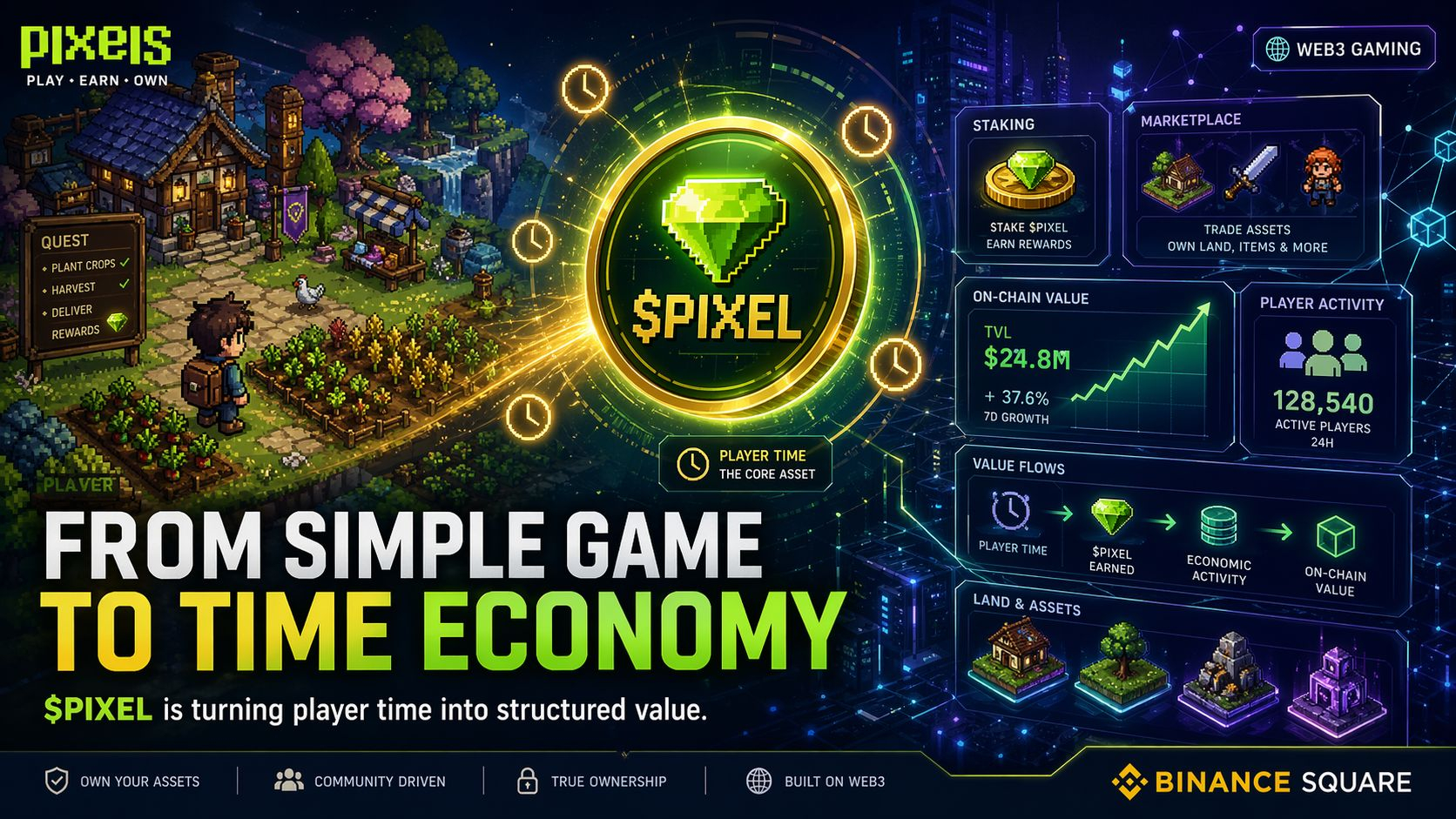
What makes Pixels interesting is not the fact that it looks simple. In truth, that is probably part of why so many people underestimate it. On the surface, it feels familiar: a light farming game, easy to enter, easy to understand, and easy to dismiss. But when you stay with it a little longer, a different picture starts to appear. What looks like a casual onchain game is gradually behaving more like a live digital economy where time itself is being organized, filtered, and valued through the logic of $PIXEL. That shift matters, because in Web3 gaming the biggest question has never been whether people can earn. The real question is whether a game can create a system where the time people spend inside it becomes meaningful without turning the whole experience into extraction.
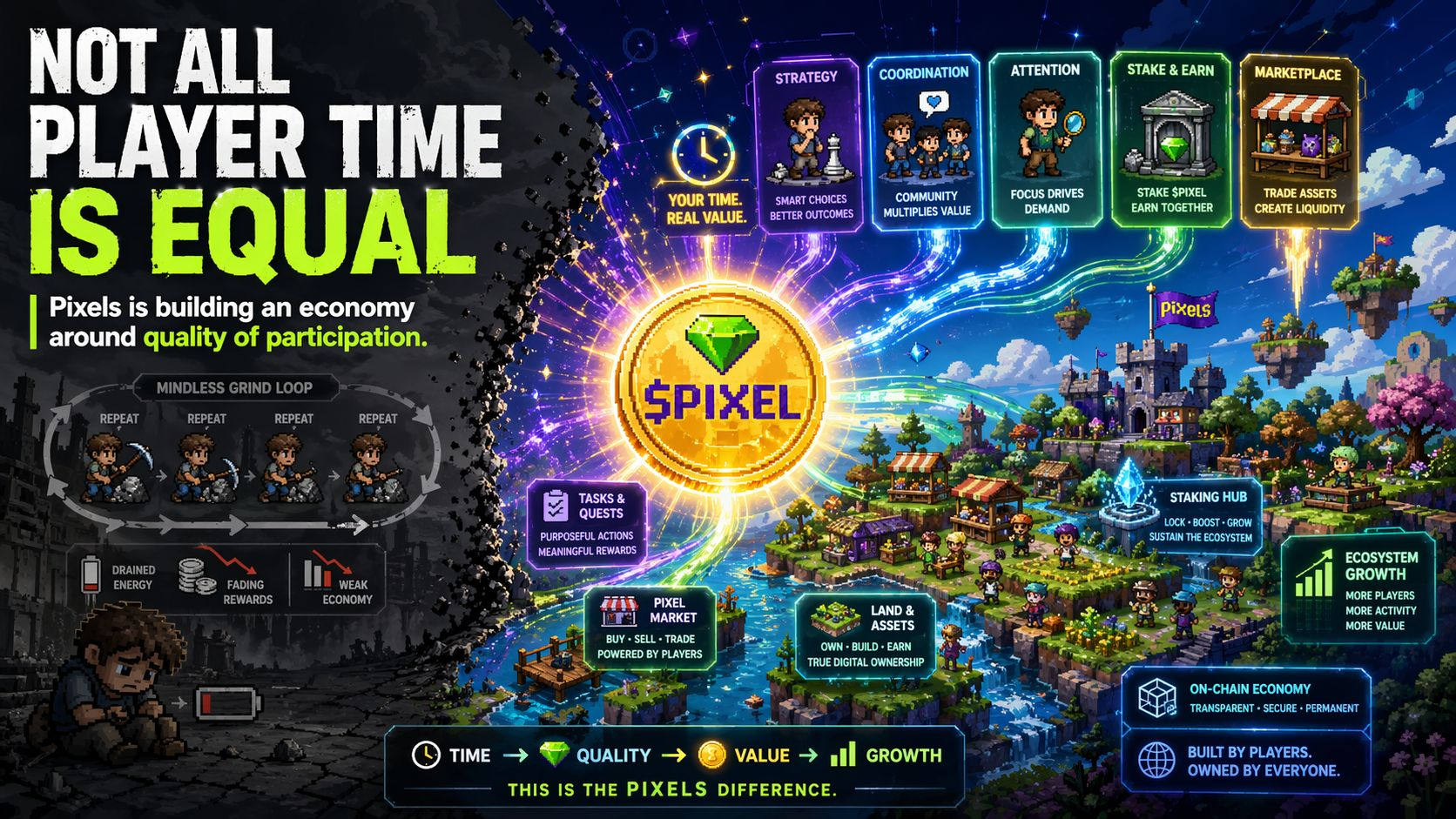 That is where Pixels stands out. A lot of blockchain games tried to reward activity, but many of them treated all activity as equally valuable. That approach usually created the same problem: people showed up for rewards, repeated the same actions, drained value from the system, and left when the economics weakened. Pixels feels like it is trying to move in a different direction. Instead of simply attaching a token to gameplay, it appears to be building an economy around the quality of participation. In other words, not all player time is the same. Some time strengthens the ecosystem, some time only consumes it, and some time creates value that can extend far beyond a single session. Once a game begins to make that distinction, it stops functioning like a simple reward machine and starts becoming something closer to a market for attention, behavior, coordination, and strategy.
That is why $PIXEL matters in a deeper way than many people realize. It is easy to see the token only through a trading lens, as if its value should be understood the same way people read any other chart. But that misses the more important story. In an ecosystem like Pixels, the token is connected to how participation is measured and directed. It sits closer to the center of the system than many people assume. If the economy grows, it will not only be because more users arrive. It will be because the game becomes better at translating time into actions that actually reinforce demand, retention, and player commitment. The stronger that loop becomes, the more $PIXEL starts to represent more than just an in-game asset. It becomes part of the structure that gives digital time economic shape.
For readers, the practical takeaway is to avoid looking at Pixels too narrowly. It is not enough to think of it only as a farming game, and it is not enough to think of $PIXEL only as a speculative token. The real thesis sits in the middle. Pixels is part game, part behavioral system, and part economic experiment. That makes it more interesting, but it also makes it more fragile. Time-based economies can be powerful, yet they are difficult to balance. If rewards become too loose, value leaks out. If the system becomes too optimized, the player experience can start to feel mechanical. If speculation moves faster than utility, the economy becomes unstable. And because it is all happening in an onchain environment, security, sustainability, and player trust matter just as much as growth.
What I find most compelling about Pixels is that it quietly points to a bigger idea. The next stage of Web3 gaming may not be about making play profitable in the loudest possible way. It may be about building systems that understand player time more intelligently. Pixels seems to be moving in that direction. And if that continues, then what feels like a simple game today may end up being remembered as something more important: an early example of how digital worlds began turning time into a structured economic force through $PIXEL.