
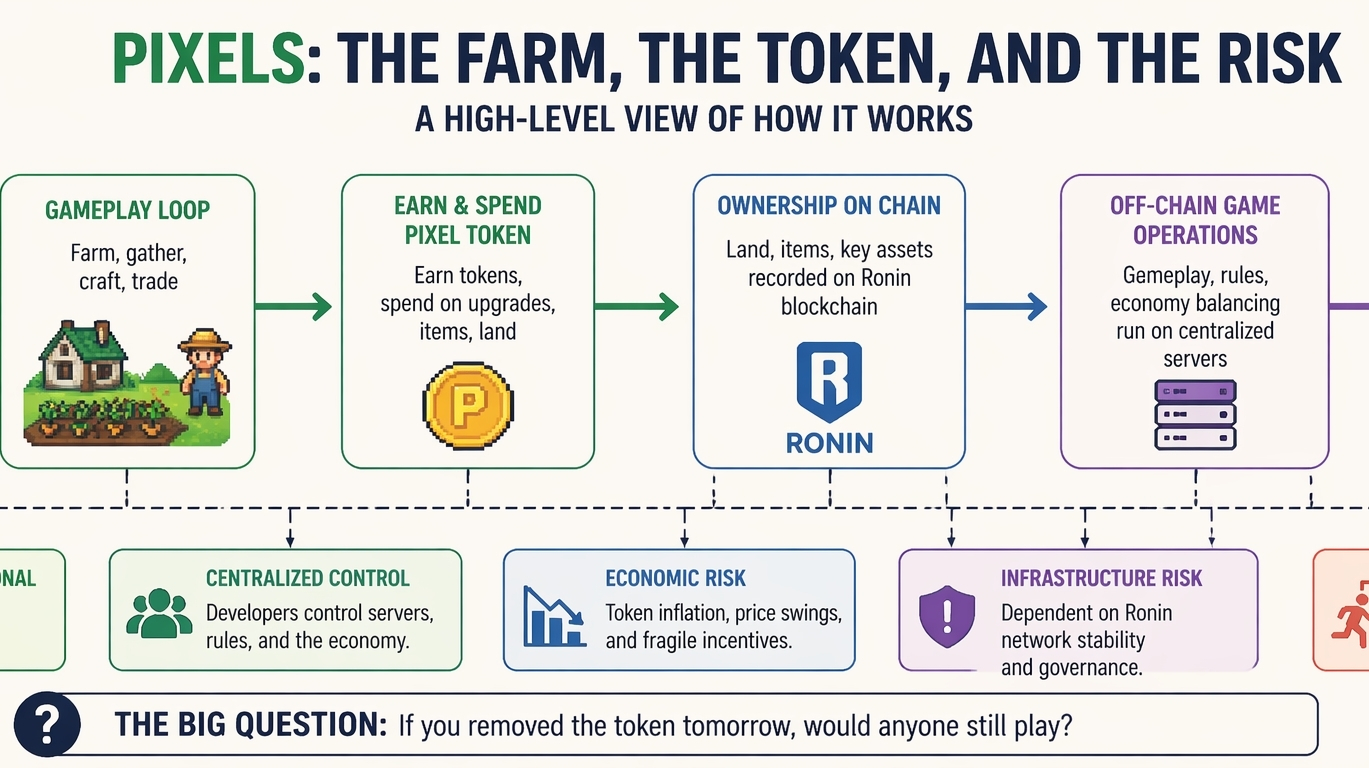
Look I’ve seen this movie before. A simple game shows up wraps itself in just enough crypto language to sound important and suddenly it’s not just a game anymore. It’s an economy. It’s ownership. It’s the future of digital interaction. That’s usually when I start asking uncomfortable questions.
Pixels at first glance feels harmless. A farming game. Pixel graphics. Low stakes almost nostalgic gameplay. Plant crops harvest trade repeat. It’s intentionally soft. Approachable. It doesn’t scream at you the way earlier blockchain games did.
And that’s exactly the point.
The core problem they claim to fix is one the industry has been repeating for years. Players don’t own anything in traditional games. You spend time maybe money and in the end it all sits inside a company controlled database. If the game shuts down everything disappears. Pixels like others before it says it fixes that. Assets live on chain. Land belongs to you. Items are yours to keep trade maybe even profit from.
It sounds tidy. On paper at least.
But let’s be honest. Ownership only matters if someone else cares about what you own. A plot of virtual land has no intrinsic value. It only works inside the game. If the game loses players your ownership becomes a souvenir from a system that no longer functions. The blockchain will still say you own it. That’s not the same as it being worth anything.
I’ve watched this play out too many times.
Now the solution Pixels offers isn’t really a solution. It’s a workaround layered on top of an already fragile idea. Instead of building a game and keeping it self contained they bolt on a token economy connect it to a blockchain and call it empowerment. What you actually get is more moving parts. More dependencies. More ways for things to go wrong.
Because here’s the part that gets glossed over. The game isn’t really on the blockchain. It can’t be. It would be too slow too expensive completely unusable. So the actual gameplay runs on regular servers. Centralized ones. Controlled by the developers.
So what’s decentralized
A few asset records. Some transactions. That’s about it.
Everything else the game logic the rules the balancing the servers staying online that’s still controlled by a small group of people. If they tweak the economy it changes. If they shut it down it’s over. Your ownership doesn’t protect you from that.
Let’s talk about incentives. Because that’s where things usually get messy.
There is a token. Of course there is. PIXEL. You earn it. You spend it. You can trade it. That’s the loop. And anytime you introduce a tradable token into a system like this you’re not just building a game anymore. You’re building a financial structure.
So ask yourself a simple question. Who benefits the most
Early players. Landowners. People who got in before the attention arrived. They accumulate assets when they’re cheap when competition is low. Then new users come in activity increases and suddenly those early positions start to look very profitable.
That’s not an accident. That’s how these systems are designed.
The marketing will tell you it’s a player driven economy. What it won’t emphasize is how much timing matters. Join late and you’re not building something. You’re supporting something that already exists often at a disadvantage.
And then there’s the dependency on Ronin. This isn’t some neutral infrastructure layer. It’s a specific network with its own history its own trade offs. Lower fees yes. Faster transactions sure. But also more control fewer validators less dispersion of power.
That matters. Especially when things go wrong.
Because they do go wrong.
Exploits happen. Economies break. Tokens crash. Players leave. When that happens all the nice language about ownership and decentralization tends to fade and what you’re left with is a system that behaves a lot like any other online service. It either survives because the operators keep it alive or it doesn’t.
And here’s the part nobody really wants to say out loud.
Most players don’t care about blockchain. They don’t want to manage wallets. They don’t want to think about token prices. They just want a game that works that feels rewarding that respects their time.
Pixels tries to hide the complexity. It smooths the edges. But the complexity is still there underneath. And when something breaks and something always breaks that complexity becomes very visible very quickly.
So you end up with this strange middle ground. Not quite a traditional game. Not quite a decentralized system. Something in between carrying the weaknesses of both.
And the big question just hangs there.
If you stripped out the token tomorrow would anyone still show up to farm virtual carrots