A lot of games can say that. What stands out is that it feels like a game first, and then, somewhere underneath that, there is this ongoing attempt to figure out how digital economies can exist without taking over everything else.
That distinction matters.
@Pixels has this easy, open-world feel to it. Farming, exploring, collecting, building. The kind of loop that does not demand too much from you at the start. You log in, do a few things, look around, maybe stay longer than you meant to. It has that social casual quality where the world feels active without feeling loud. And because of that, the economy inside it matters more than it might in a harsher or more competitive game. If rewards are handled badly, they do not just affect monetization. They change the texture of the whole world.
You can usually tell when that starts happening. A reward system begins by looking helpful. More incentives. More activity. More reasons to return. Then slowly the center of gravity shifts. Players stop asking what is fun and start asking what is extractable. Bots show up. Progress gets distorted. The economy starts serving the people who can exploit it fastest. At that point, the game may still look alive, but it feels thinner.
That seems to be the problem Stacked is really trying to answer.
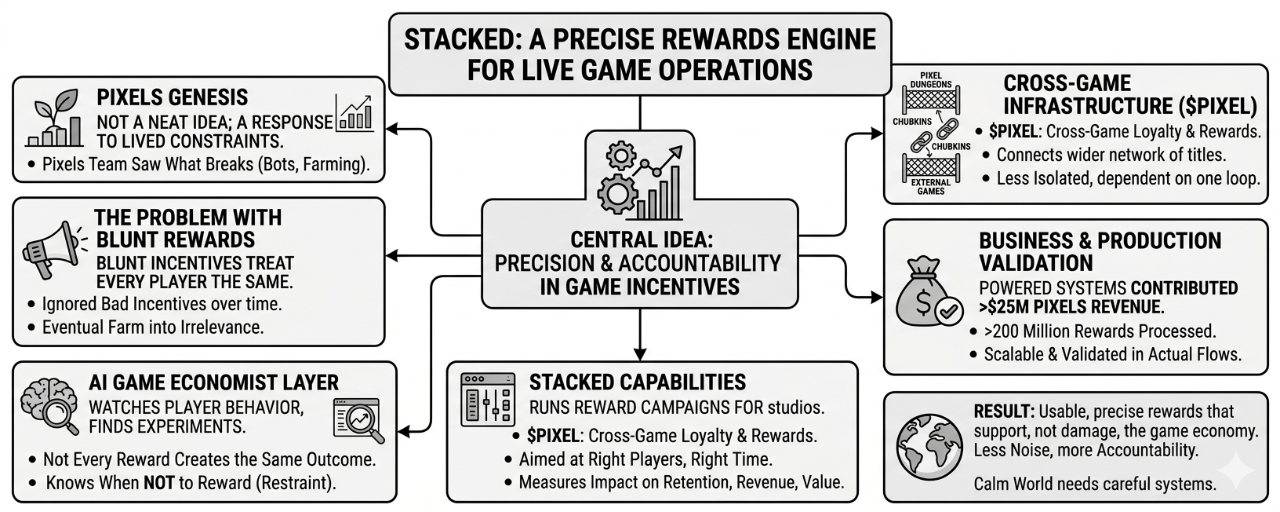
One way to describe it is simple enough: Stacked is a rewarded LiveOps engine built by the Pixels team. It helps studios run reward campaigns, either with real-money incentives or in-game rewards, aimed at the right players at the right time. Then it measures whether those rewards actually changed anything that matters, like retention, revenue, or long-term value.
But even that does not fully explain why it exists.
The more interesting angle is that Stacked feels like the result of a team getting tired of the usual failures. Not rejecting rewards completely. Just realizing that most reward systems in this space are too blunt. They treat every player the same. They assume more rewards automatically means more engagement. They ignore what bad incentives do over time. And eventually they get farmed into irrelevance.
That is where the Pixels background matters. The team did not arrive at this from theory alone. They had already gone through the cycle. They had already seen what breaks. So Stacked comes across less like a neat product idea and more like a response to lived constraints. Something shaped by friction, not just ambition.
That changes the way the whole thing reads.
Instead of asking, “How do we put rewards into games?” the question becomes, “How do we make rewards behave properly inside a game economy?” That is a quieter question, but it is probably the more useful one. Because almost any studio can add incentives. The hard part is making sure those incentives do not damage the thing they are supposed to support.
And that is where the AI game economist layer starts to make more sense. On the surface, that phrase can sound a little polished. But underneath it, the job is pretty grounded. Watch what players are doing. Notice where behavior changes. Find the moments where an experiment might actually help. Not every player needs the same push. Not every reward creates the same outcome. Some campaigns bring people back. Some just create noise. Some may boost short-term activity while making everything weaker later on.
It becomes obvious after a while that a lot of game economy work is really about restraint. Knowing when not to reward. Knowing when a bump in activity is artificial. Knowing when a good-looking metric is hiding a bad trend. If this system helps with that, then it is doing something more valuable than just distributing perks.
The production history behind it probably matters as much as the idea itself. Stacked is already live across Pixels, #pixel Dungeons, and Chubkins. That tells you this is not being introduced as an external layer dropped onto a game from nowhere. It already lives inside actual player flows. It has processed over 200 million rewards. That number is large, obviously, but the more useful part is what it implies. At that scale, systems stop being hypothetical. They have already run into weird behavior, abuse attempts, edge cases, and all the small failures that never show up in clean presentations.
The business side says something similar. Stacked-powered systems contributed to more than $25 million in Pixels revenue. That does not prove everything, and it does not answer every question, but it does move the conversation into more concrete territory. There is a difference between a reward engine that sounds smart and one that can be tied to actual economic outcomes inside a live ecosystem.
That probably matters a lot to outside studios. Especially now that the platform is opening beyond the Pixels ecosystem. Because if you are another game team looking at this, you are probably not wondering whether rewards can create activity. Of course they can. The real concern is whether they can create good activity. Activity that holds up. Activity that does not poison the economy underneath it. Activity that can be measured honestly instead of just celebrated in screenshots.
Then there is $PIXEL , which seems to sit inside this system in a broader way than people might expect. It is not just being framed as the token for one game. It is being used more like a cross-game rewards and loyalty currency inside a wider network of titles. That makes the token less isolated. Less dependent on one loop, one audience, one world. The idea seems to be that it becomes part of the infrastructure connecting games rather than a symbol locked to a single place.
Whether that expands cleanly is something time will answer. These things usually need distance before their shape is clear. But the direction is easy enough to see.
So maybe the clearest way to think about Stacked is not as a feature set, and not even really as a rewards platform in the usual sense. It feels more like an attempt to make incentives usable again. To turn rewards into something more precise, less naive, and a little more accountable to the game around them.
And with Pixels, that makes sense. A calm-looking world still needs careful systems underneath it. Maybe especially a calm-looking world. Otherwise the economy starts speaking louder than the game, and once that happens, it is hard to unhear it.

Článok
What stands out with Pixels is not really that it is a web3 game.
Zrieknutie sa zodpovednosti: Obsahuje názory tretích strán. Toto nepovažujte za finančné poradenstvo. Môže zahŕňať sponzorovaný obsah. Pozrite si zmluvné podmienky.