
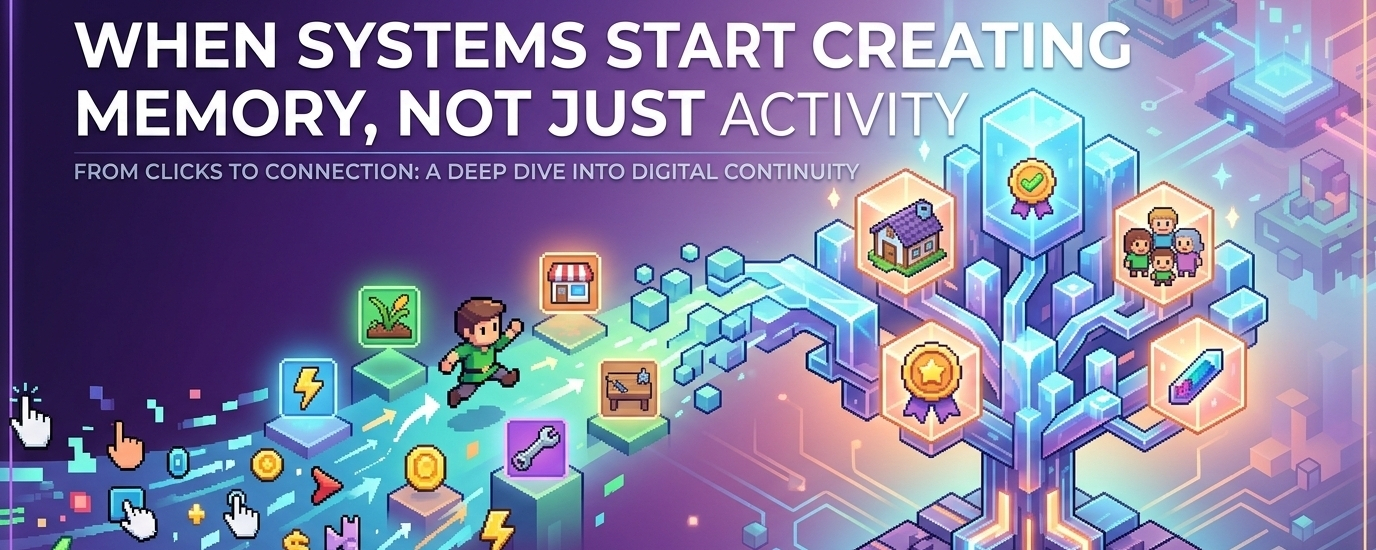
Most digital systems are built to generate activity.
Clicks, actions, sessions these are the things we usually measure. If numbers go up, the system looks healthy. If they slow down, something feels off.
But there’s another layer that doesn’t show up as easily.....
Memory.
Activity Is Immediate. Memory Is Cumulative.
Activity happens in the moment. You log in, do something, log out. It’s quick, measurable, and easy to track.
Memory works differently.
It builds slowly, across repeated sessions. It’s the feeling of recognizing a place, remembering past actions, noticing how something has changed since the last time you were there.
That shift — from doing something once to remembering doing it over time — is where systems start to feel more real.
Why Memory Changes the Experience
When a system starts creating memory, interactions stop feeling isolated.
A simple action is no longer just a task. It becomes part of a timeline. You don’t just perform it you remember it, compare it, and build on it.
That’s when engagement deepens.
Not because the system added complexity, but because time itself becomes part of the experience.
The Role of Continuity
For memory to exist, continuity has to hold.
If everything resets too often, or if past actions don’t carry forward, there’s nothing to remember. Every session feels like a fresh start.
But when the system preserves what came before even in small ways it allows users to build a sense of progression that isn’t tied only to rewards.
It’s tied to presence.
Where Pixels Becomes Interesting
In systems like Pixels, this layer starts to show up quietly.
You return to the same space. You recognize what you’ve built. You notice small changes over time. Even simple routines begin to carry weight because they connect to past sessions.
It’s not just about what you do today.
It’s about what today means compared to everything you’ve already done.
Why This Is Often Overlooked
Most discussions focus on mechanics, rewards, or growth.
But memory is harder to quantify, so it’s often ignored.
Even though it’s one of the main reasons people stay.
Because once a system holds memory, leaving it feels different. You’re not just stepping away from activity you’re stepping away from something you’ve built over time.
A system that only creates activity depends on constant input.
A system that creates memory starts to sustain itself.
Because people don’t just return for what they can do.
They return for what they remember.