

I didn’t really notice the problem at first.
The loop felt fine. You play, you earn, you claim. It looks like progress.
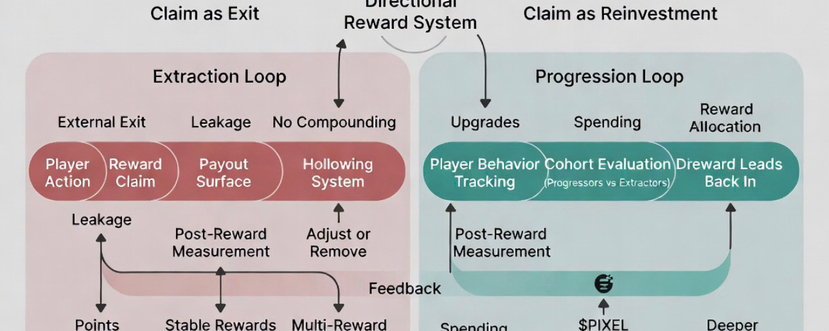
But after a while, something starts to feel off. The moment of claiming becomes the end of the experience. You get paid, and instead of going deeper into the system, you step outside of it.
That’s where most reward systems quietly break.
They don’t fail because they don’t pay enough. They fail because they don’t send you back.
That’s the shift I kept coming back to while reading the Stacked update from Pixels.
This isn’t about giving better rewards.
It’s about making sure rewards don’t become exits.
Because once rewards turn into extraction, the loop stops being a game economy and starts becoming a payout surface.
You see it everywhere. Activity looks strong, numbers go up, but nothing compounds. Players come in, take value out, and the system slowly hollows from the inside.
What stood out to me is that Pixels is trying to reverse that direction.
Not by removing rewards.
But by changing where they lead.
A healthy loop doesn’t end at claim.
It redirects.
Back into upgrades, into experimentation, into spending decisions that keep the player inside the system longer. That’s what the “real spend and real burn” idea is actually pointing at. It’s not just about token mechanics. It’s about whether value cycles internally or leaks externally.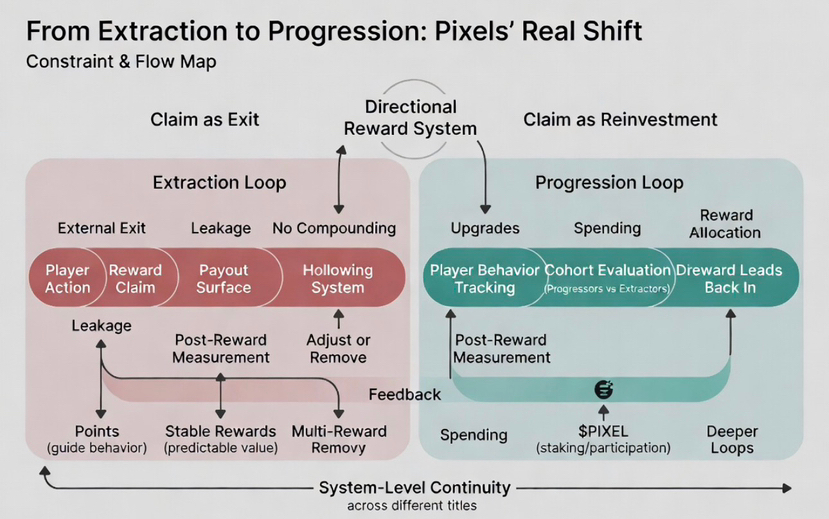
And that’s where Stacked starts to make sense.
At the surface, it still looks familiar. Missions, streaks, payouts. Nothing that immediately signals a deep change.
But underneath, it’s not just attaching rewards to actions anymore.
It’s deciding what kind of loop those rewards create.
That decision doesn’t start at the mission.
It starts before it.
Player behavior gets tracked over time. Not just what someone does once, but how they move through the system. Do they come back after rewards drop? Do they reinvest into the game? Do they explore different loops or stick to the easiest path?
Those patterns matter more than the action itself.
Because two players completing the same task are not the same input.
One is progressing.
The other is extracting.
If you reward both the same way, you’re funding two completely different outcomes with the same budget.
That’s where the system has to make a choice.
And this is where most reward designs avoid the problem.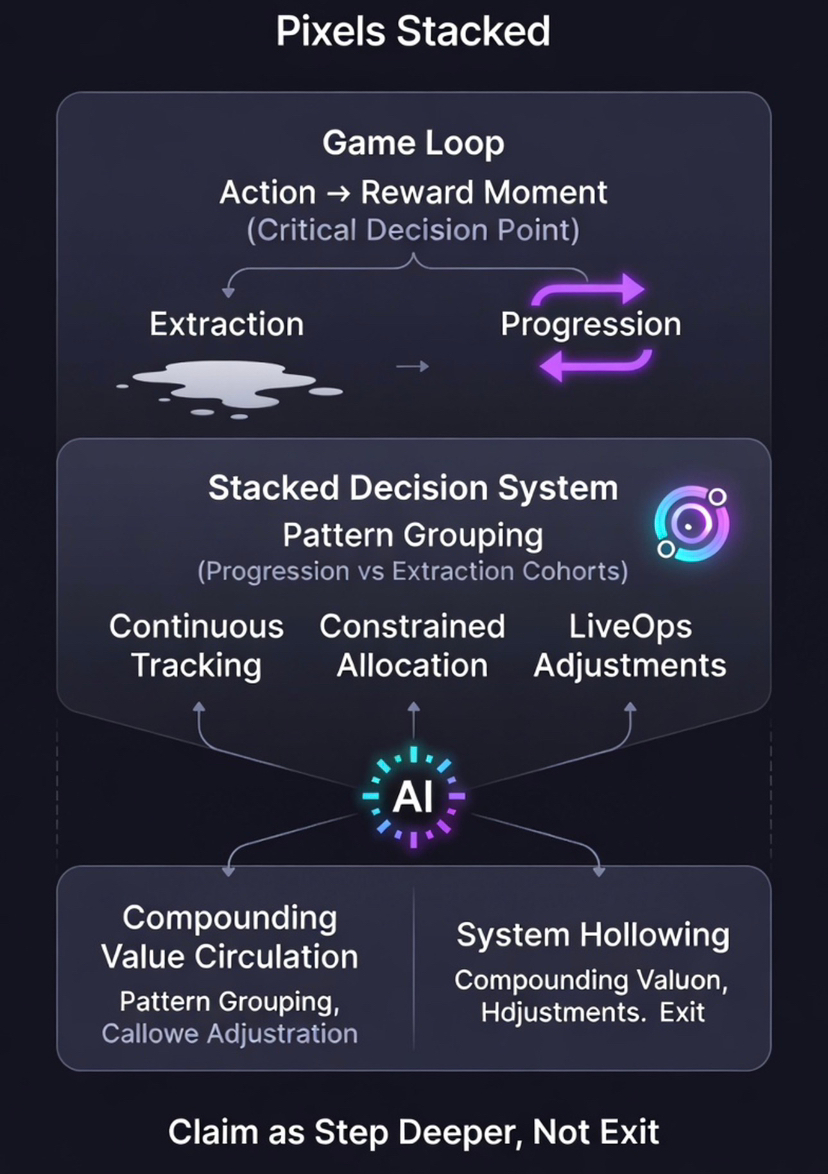
They treat rewards as something neutral. Complete X, get Y. No judgment, no filtering, no allocation. It feels fair, but it’s blind.
Stacked doesn’t operate that way.
It sits above the loop and starts from evaluation.
Player behavior → grouped into patterns → reward logic applied → outcomes measured → system adjusts
That flow is where progression gets enforced.
Because once you measure what happens after the reward, you can decide whether that reward should exist at all.
If a mission leads to deeper engagement, it stays. If it leads to quick extraction, it gets compressed or removed. If a certain cohort consistently exits after claiming, the system learns to stop funding that path.
That’s the mechanism.
Not “better rewards.”
But directional rewards.
And that only works under constraint.
There isn’t infinite budget.
So every reward is a trade-off.
Funding one behavior means not funding another.
That’s what turns rewards into capital instead of emission.
And once rewards become capital, you can’t distribute them evenly anymore.
You have to allocate them.
That’s where the LiveOps layer comes in.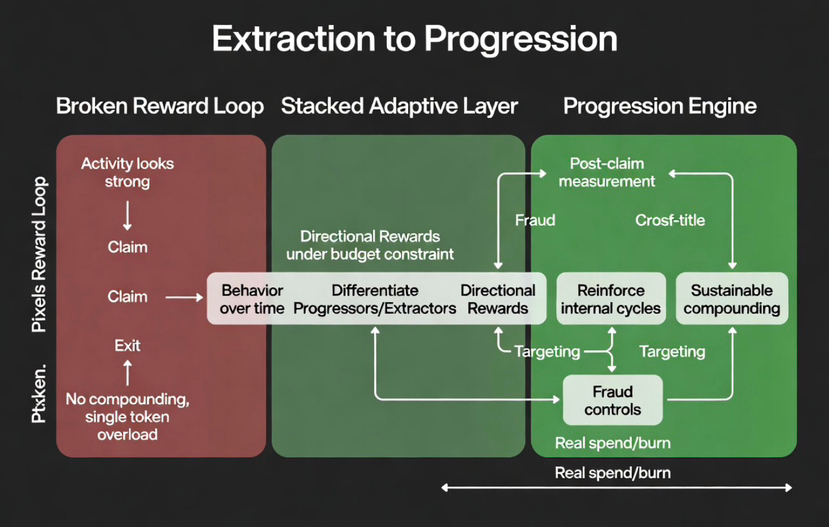
The way Pixels describes Stacked is important here, because it doesn’t frame it as a feature. It frames it as an operating system for incentives. Event tracking, targeting, reward logic, fraud controls, testing, attribution — these aren’t add-ons. They’re the components of a system that continuously asks whether reward spend is actually doing something useful.
If it’s not, it gets cut.
That’s the discipline most systems never reach.
They optimize for activity.
This is trying to optimize for progression.
And progression is harder to fake.
You can inflate activity with rewards.
You can’t fake whether players stay, spend, and build inside the system over time.
That’s why the controlled rollout matters.
From the outside, it might look slow. But inside a system like this, speed just amplifies mistakes. If the logic is wrong, scaling it faster just funds the wrong behavior at a larger scale.
Starting with internal titles changes that.
Pixel Dungeons, Sleepagotchi, Chubkins — different loops, different player profiles, different incentive responses.
But all inside an environment the team already understands.
That context matters.
Because it allows the system to learn under pressure without guessing.
If something overpays, they see it quickly. If a cohort behaves differently than expected, they can isolate it. If a reward actually pushes players deeper into the loop, they can scale it.
That’s calibration.
And it’s what makes the system reliable enough to extend beyond a single game.
Because once you connect multiple loops, something else starts to form.
Continuity.
A player isn’t just evaluated in one environment anymore. Their behavior carries across. How they respond to incentives in one loop informs how they’re treated in another.
That’s where progression becomes system-level, not game-level.
And that’s also where extraction becomes harder to sustain.
Because the system isn’t looking at isolated actions.
It’s looking at patterns over time.
That’s a different kind of control.
And it’s also why the token design is shifting.
One-token systems struggle here.
If every action pays out the same asset, you lose the ability to differentiate behavior. Progression and extraction both hit the same output, and over time, the system gets flattened.
Pixels is moving away from that.
Different rewards for different roles.
Points can guide behavior without immediate liquidity pressure. Stable rewards can provide predictable value when needed. And $PIXEL can move toward staking and deeper ecosystem participation instead of constant emission.
That separation only works if reward allocation is already disciplined.
Otherwise, it just fragments the system.
But here, it’s coordinated.
Because the decision layer sits above everything.
And that’s what allows rewards to push players back into progression instead of out of the system.
That’s the real shift.
Not more rewards.
Not smarter campaigns.
A system that understands that the moment of claim is the most dangerous point in the loop.
Because that’s where players decide whether to stay or leave.
Stacked is trying to influence that moment.
To make claiming feel like a step deeper into the system, not an exit from it.
And once you get that right, everything else changes.
The game stops being a place where rewards are distributed.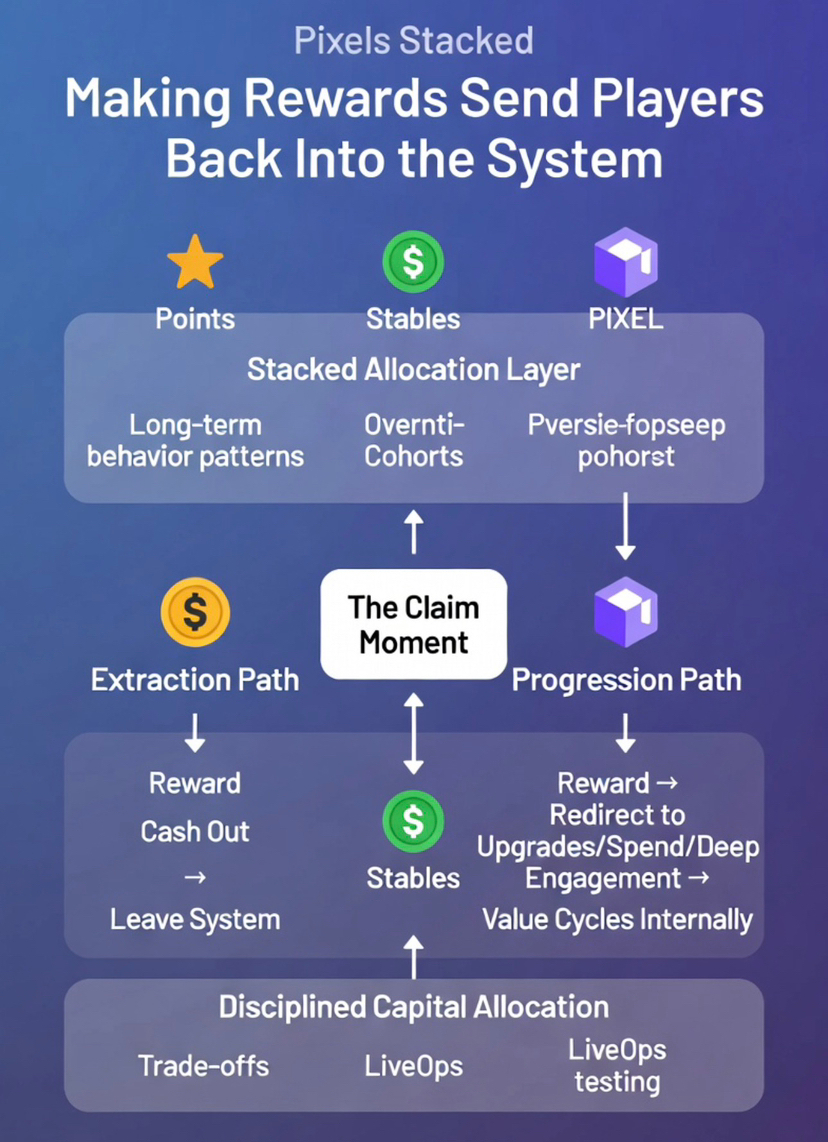
It becomes a place where value keeps circulating.
That’s much harder to build.
But it’s also what makes it sustainable.
Because progression compounds.
Extraction doesn’t.
And that’s why this doesn’t feel like a simple product launch.
It feels like Pixels taking everything it learned from watching rewards fail…
and turning it into a system that makes them work in the only way that matters.
By keeping players moving forward instead of letting them cash out and disappear.