
To be honest, when I first started playing Pixels, I did not think of myself as someone creating anything. I was just moving through tasks, planting crops, collecting resources, and trying to understand the basics. It felt structured, almost predefined, like I was following a path that had already been designed for me. I think I saw myself more as a participant than a contributor.
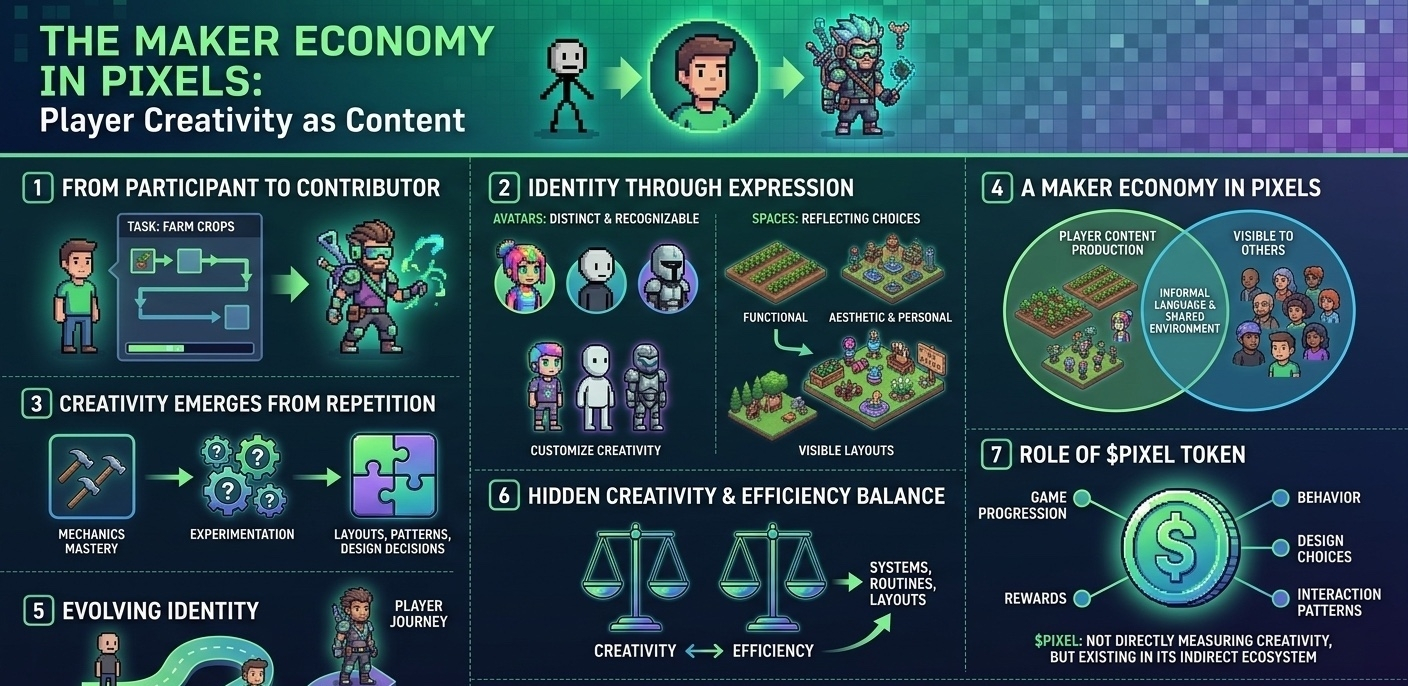
At the beginning, customization felt like a small detail. Changing how my avatar looked or arranging my space did not seem important compared to progression. It felt optional, something decorative rather than meaningful. I assumed most players would focus on efficiency first and leave expression for later, if at all.
Over time, I started noticing that some players were doing something very different. Their spaces looked intentional, their avatars distinct, and their presence felt recognizable. It was not about having more resources or progressing faster. It was about how they were shaping their environment and identity inside the game. That difference stood out more than I expected.
Slowly, I began to understand that Pixels was not only about completing loops, but also about how those loops could be expressed. The same tools I was using for efficiency could also be used creatively. A farm did not have to be just functional. It could reflect choices, preferences, even personality. I think that realization changed how I approached the game.
In a way, creativity in Pixels does not announce itself. It emerges quietly from repetition. The more familiar I became with the mechanics, the more freedom I felt to experiment. Layouts, movement patterns, small design decisions all started to feel less fixed and more flexible. I was no longer just following a system. I was shaping how I existed within it.
What makes this interesting is how that creativity becomes visible to others. Even without direct interaction, players can observe each other’s spaces and avatars. Over time, certain styles start to stand out. Some players prioritize symmetry, others prefer efficiency, and some lean entirely into aesthetics. These differences create a kind of informal language that does not rely on words.
I think this is where the idea of a maker economy begins to take form. Players are not just consuming content provided by the game. They are indirectly producing it through how they play. Every designed space, every customized avatar, every unique setup adds to the overall environment. The game becomes a collection of individual expressions layered on top of each other.
At some point, I realized that identity inside Pixels is not fixed. It evolves with how I choose to interact with the system. Early on, my avatar was just a default presence. Later, it started to feel like a representation of how I approached the game. Small changes in appearance or layout began to carry meaning, even if that meaning was only clear to me.
This process reminded me of how identity forms on digital platforms outside of games. People do not just exist on those platforms. They shape how they are seen through repeated choices. Over time, those choices form a pattern that others begin to recognize. I think Pixels reflects something similar, but in a more subtle and slower way.
Another thing I began to notice was that creativity does not always compete with efficiency. Sometimes the two overlap. A well-designed space can also be an efficient one. A carefully chosen setup can improve both functionality and appearance. This balance makes creativity feel less like a distraction and more like an extension of gameplay.
At the same time, not all creativity is visible in obvious ways. Some players develop systems, routines, or layouts that are only noticeable if you look closely. These hidden forms of creativity shape how they interact with the game, even if others do not immediately recognize them. It adds another layer to what it means to create within this environment.
Because of this, the role of $PIXEL starts to feel slightly different again. It is not only connected to progression or rewards. It also exists within a system where creative expression influences how players position themselves. While the token does not directly measure creativity, it exists in an ecosystem where behavior, design choices, and interaction patterns all connect in indirect ways.
I think the most interesting part is how this shifts the meaning of participation. Playing the game is not just about completing tasks anymore. It becomes about how those tasks are performed and how they are presented. The same action can feel different depending on how it fits into a larger pattern of expression.
In the end, I am not sure where the line exists between playing and creating in Pixels. The more I engage with it, the more those two ideas seem to overlap. Every choice, even a small one, contributes to something that others can see or interpret in their own way.
And thinking about it now, I find myself wondering whether the real value in this system comes from what the game provides, or from what players gradually build within it without fully realizing it.
