
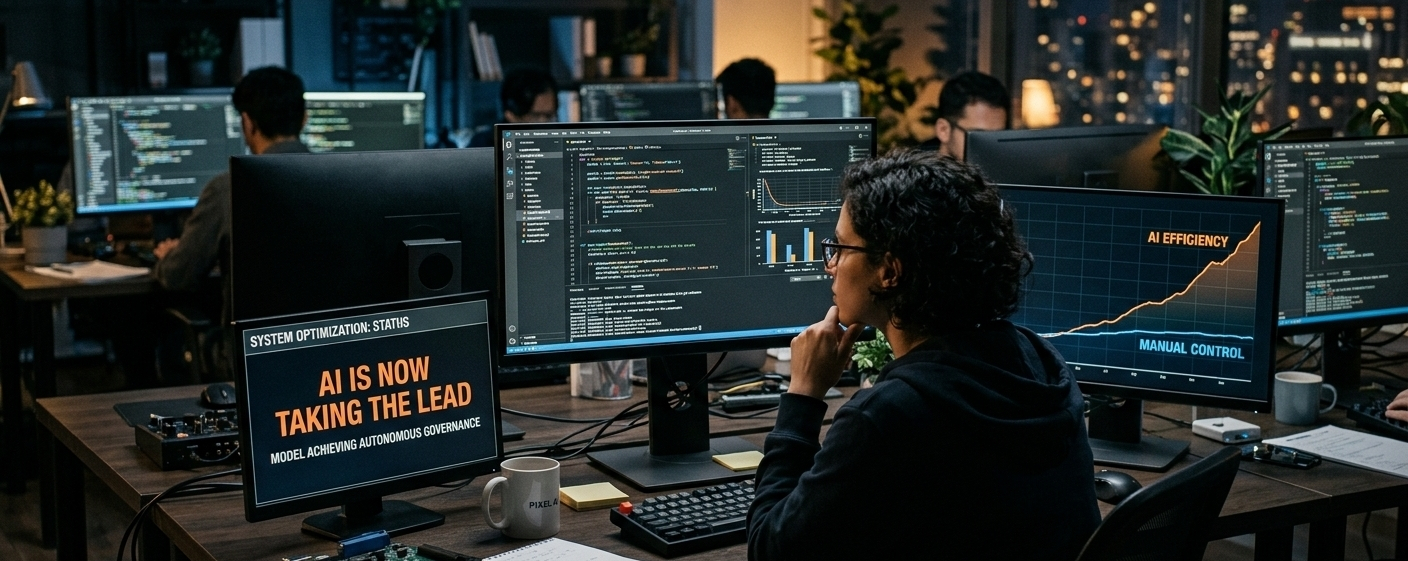
I wasn’t even looking into AI that day. Just doing my usual routine — checking charts, flipping through Binance, half-paying attention while the market moved sideways. One click led to another, and somehow I ended up reading about these AI agents like Auto-GPT.
At first, it didn’t feel like anything new. Just another layer of automation, another tool promising to save time. But then I watched how it actually worked, and something about it felt slightly off in a way I couldn’t immediately explain.
It wasn’t just answering questions.
It was deciding what to do next.
That sounds small, but it changes the entire feeling of using it. Normally, AI waits for you. You ask, it responds. You guide it step by step. Even when it’s advanced, it still feels like you’re in control.
This didn’t wait.
You give it a goal, and it starts moving on its own. It breaks the task into steps, follows them, checks if they worked, then adjusts and continues. It doesn’t pause to ask if you agree. It just keeps going.
I remember watching it try to research something simple. Instead of giving an answer, it made a plan, questioned that plan, revised it, and only then started collecting information. It felt less like using a tool and more like watching someone think out loud.
That’s when something clicked for me.
You’re not really controlling it anymore. You’re just pointing it in a direction and hoping it takes a sensible path.
There’s something exciting about that. You can see how it could handle messy, multi-step problems that usually take time and attention. Things you’d normally avoid automating suddenly feel possible.
But at the same time, it’s a bit uncomfortable.
Because the system is quietly making decisions for you. Not big obvious ones, but small continuous choices — what matters, what doesn’t, what counts as progress, when something is “done.” And those decisions aren’t always visible when you look at the final result.
That’s the part that stayed with me.
If it gives a wrong answer, you’ll probably catch it. But if it follows the wrong process and still gives you something that looks reasonable, would you notice?
I’m not sure I would every time.
And it’s not really a flaw. It’s just how these systems work. They’re designed to keep moving forward, to complete tasks, to simulate progress. But progress depends on how the goal is interpreted, and that interpretation isn’t always perfect.
It made me think about how quickly we might start relying on this without fully understanding what’s happening underneath.
Because everything about it feels smooth. Logical. Step-by-step. Almost reassuring.
But under that surface, it’s still guessing what you meant.
There’s also something subtle about control. With normal tools, you’re involved in every step. Here, you step back. You let it run. And that distance is useful, but it also means you’re less aware of how decisions are being made along the way.
Most people probably won’t question that. If the result looks good, that’s enough.
And maybe that’s fine.
Or maybe it’s one of those quiet shifts that only becomes obvious later — when we realize we’ve gotten used to systems that don’t just respond, but act on our behalf in ways we don’t fully track.
I don’t think it’s something to worry about. If anything, it’s genuinely interesting. It opens the door to handling complexity in a way that feels more natural, more fluid.
But it also changes the relationship.
It doesn’t feel like using a tool anymore.
It feels like working with something that has its own way of moving forward.
And I’m still not sure if that’s something we’ll learn to trust… or just something we’ll slowly stop noticing.
