

It doesn’t really feel like something new at first glance.
Just another Web3 game. Another open world where you farm, explore, build things, repeat the loop. I’ve seen that shape so many times now that it stops triggering any real reaction. It just sits there in the same mental category as others that sounded promising early on and slowly faded into background noise.
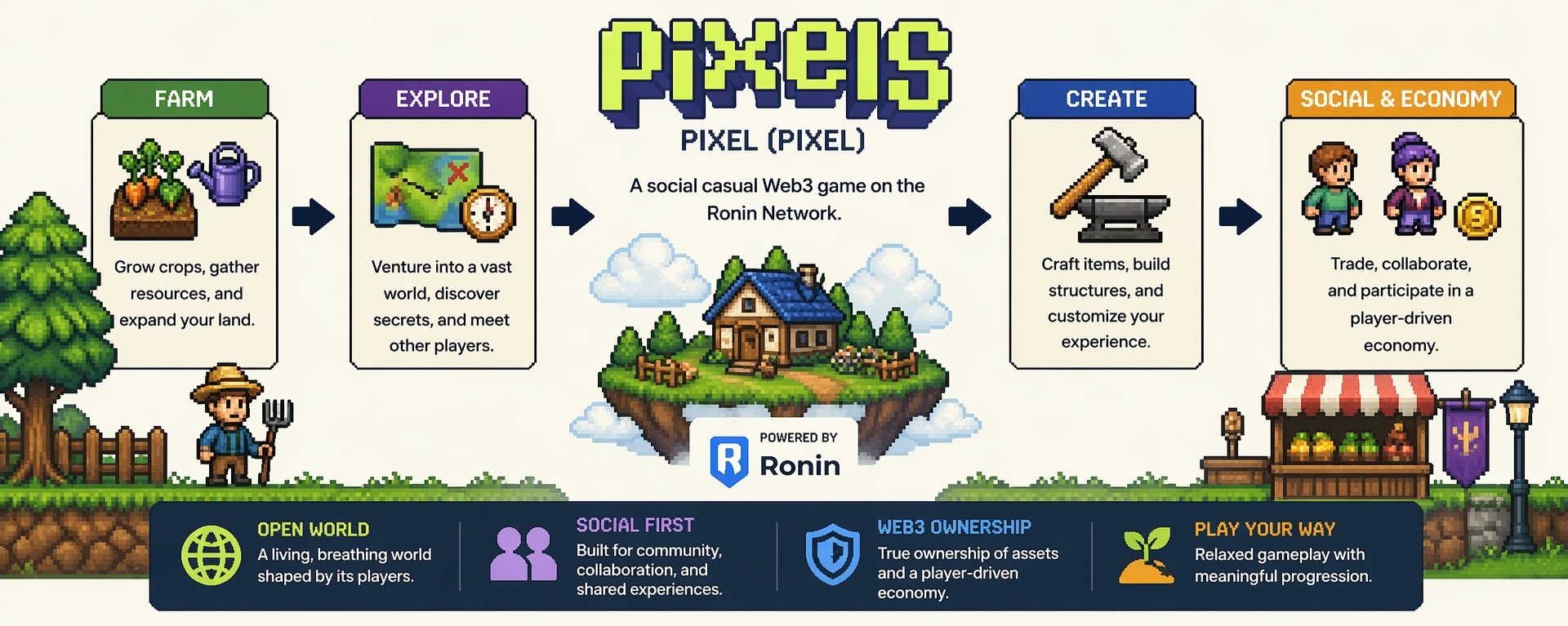
Pixels fits into that space in a very familiar way. It runs on the Ronin Network, and it presents itself as a social, casual world built around farming and creation. On paper, it’s easy to understand. You move around, gather resources, upgrade your land, interact with others. Nothing about that feels unfamiliar anymore in this ecosystem.
But after a while, the surface description becomes the least interesting part.
What matters more is what the system is actually trying to do underneath all of that. And usually, it’s not just “make a fun game.” It’s something more fragile than that. It’s about keeping people inside a loop long enough for the system to feel alive.
That’s where things start to get complicated.
Because players don’t stay passive for long. They adapt. They figure out the fastest way to progress. They start optimizing without even thinking about it. What begins as casual farming slowly turns into efficiency. And once that shift happens, the experience changes shape. It becomes less about being in a world and more about extracting value from it.
I’ve watched that transition enough times to recognize it early now. It doesn’t happen loudly. It happens in small behavioral shifts. Shorter attention spans inside the game. More repetitive actions. Less curiosity, more routine.
Pixels is trying to hold that balance between play and structure. It needs the game to feel light and social, but it also depends on systems that reward consistency and participation. Those two things don’t always stay aligned for long.
And then there’s the layer it sits on. The Ronin ecosystem isn’t just background detail. It carries its own history and expectations from earlier cycles in Web3 gaming. That context always leaks into how people perceive anything built on top of it, even if they don’t consciously think about it.
So what you end up with isn’t just a game. It’s a system trying to normalize blockchain-based play. To make it feel like something people just do, without questioning it too much. Something that blends into routine instead of standing out as experimentation.
That sounds simple, but it isn’t. Routine is difficult to build when the underlying structure depends on incentives that can change quickly. Stability has to exist in an environment that naturally leans toward volatility. That tension never really disappears.
And in systems like this, I’ve seen a pattern repeat often enough that it’s hard not to notice. Early curiosity. Then engagement as people explore what’s possible. Then optimization as they learn the edges of the system. And eventually, either fatigue or a quieter, more mechanical kind of participation where the excitement is gone but the habit remains.
Sometimes everything still looks fine from the outside during all of this. Activity numbers stay up. The world still runs. But internally, the feeling changes. The sense of discovery weakens. The actions become familiar in a way that starts to feel automatic.
That’s usually the point where you realize a system isn’t judged by whether it works, but by whether people still want to be inside it without being pushed.
With Pixels, it’s too early to say where it settles. It’s still active, still forming, still being shaped by the people moving through it every day. It hasn’t locked into anything permanent yet.
So it just sits there in that unfinished state. Not failing, not succeeding in any final way. Just running, being used, being tested.
And I think that’s the only honest way to look at it right now.
Not as something defined, but as something still trying to figure out what kind of behavior it can actually sustain when no one is explaining it anymore, and people are just left to decide for themselves whether they come back tomorrow or not.