
Pixels sits in an interesting corner of crypto because it wraps hard coordination problems inside something that looks soft: farming loops, social play, routine progression, light attention. That surface matters less to me than the machinery underneath it. I look at PIXEL not as a game token, but as coordination infrastructure trying to organize labor, time, status, and liquidity inside one closed environment. The real question is never whether people enjoy the system when prices rise. It is what breaks first when participation becomes economically irrational. In my experience, systems built on voluntary repetition rarely fail through dramatic collapse. They fail through subtle disengagement, where the motions continue but conviction disappears.
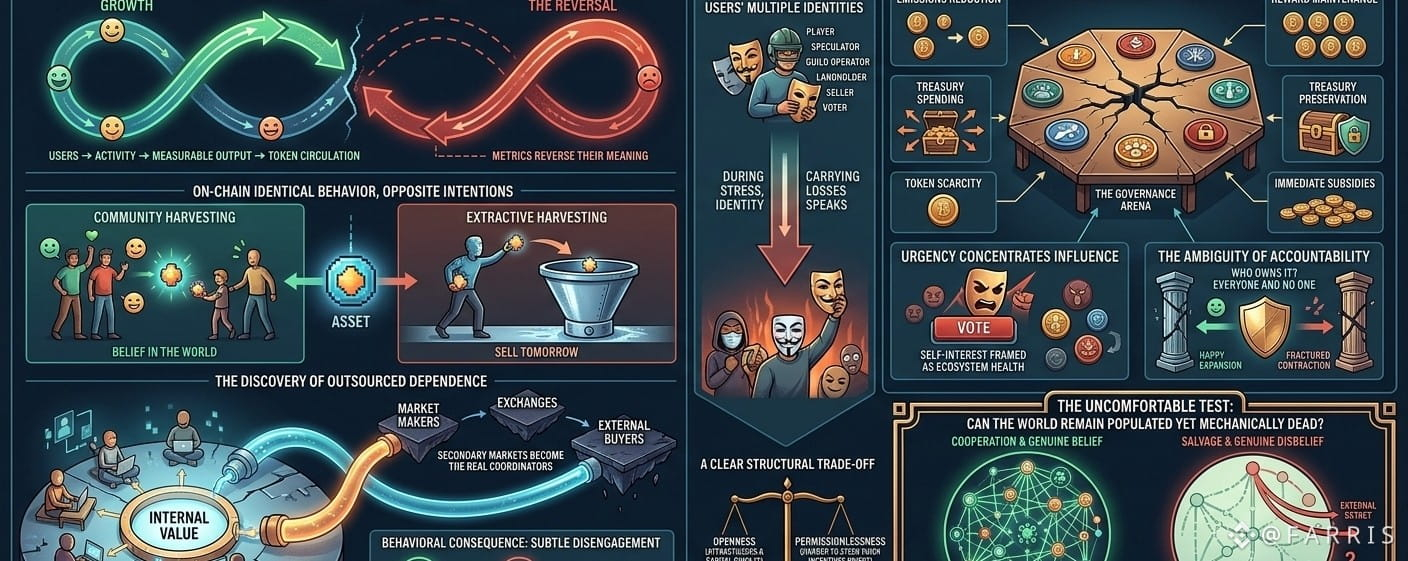
The first pressure point is reward reflexivity. When a protocol turns user activity into measurable output, it creates a loop where people optimize for whatever can be counted. In calm conditions, that looks like growth. More users, more tasks completed, more retention, more token circulation. But under stress, metrics reverse their meaning. The same users once interpreted as community become a supply pipeline. The same activity once seen as engagement becomes extraction. I have watched capital rotate through narratives long enough to know that participants can behave identically while holding opposite intentions. A player harvesting because they believe in the world and a player harvesting because they want to sell tomorrow look the same on-chain until exits begin.
That distinction matters because liquidity does not absorb intent equally. If enough users view participation as inventory creation, then every reward cycle manufactures future sell pressure. The protocol may claim to remove intermediaries, yet market makers, exchanges, and external buyers quietly become the real coordinators of stability. Without them, internal effort cannot translate into durable value. The system says users coordinate with each other, but in stress they coordinate around the exit door. That is where many tokenized environments discover an uncomfortable truth: they did not eliminate middlemen, they outsourced dependence to secondary markets.
The behavioral consequence is slower than a bank run and more dangerous. High-value participants reduce time commitment first. Mid-tier users increase extraction intensity before leaving. New entrants sense the mood and stop replacing churn. None of this requires panic. It only requires arithmetic. Once expected reward falls below perceived effort, social language stops mattering. Communities often mistake silence for resilience. I read it as spread widening between stated loyalty and actual behavior.
The second pressure point is governance without enforceable authority. Many decentralized systems assume aligned incentives can substitute for hierarchy. Sometimes they can. But when resources tighten, preferences stop being abstract. Some users want emissions reduced. Others want rewards maintained. Some want treasury spending to stimulate activity. Others want preservation. Some want token scarcity. Others need immediate subsidies. These are not philosophical disagreements; they are balance sheet positions expressed as ideology.
In a game-linked economy, this becomes sharper because users do not enter with one identity. A participant can be player, speculator, guild operator, landholder, seller, and voter at the same time. Which identity speaks during stress? Usually the one carrying losses. Governance then becomes a venue where private pain seeks public relief. Voting power may look decentralized, but urgency concentrates influence. Those with larger exposure show up more aggressively, campaign harder, and frame self-interest as ecosystem health.
I have seen markets celebrate governance participation as legitimacy. I often see something else: delayed recognition that authority still exists, only diffused enough to avoid accountability. If a harmful decision passes, who owns it? Everyone and no one. That ambiguity can sustain optimism in expansion, but under contraction it erodes trust quickly. Users tolerate unequal outcomes more than opaque ones.
There is also a clear structural trade-off here. The more open a coordination system becomes, the easier it is to attract users and capital quickly. The more permissionless it becomes, the harder it is to steer behavior when incentives invert. Frictionless entry usually means frictionless exit. Designers can optimize growth or controllability, but not maximize both at once.
PIXEL, as coordination infrastructure, therefore faces the same test many token systems face: can it keep useful activity alive when speculative demand is absent? Not temporary volatility, but genuine disbelief. Can users still justify effort when token upside is removed from the story? If not, then what was coordinated all along: a community, or a distribution channel?
That is the uncomfortable question I keep returning to when I study systems like this. Because sometimes nothing visibly breaks. Servers stay online. Votes continue. Tokens trade. Tasks are completed. The world remains populated enough to look alive. Yet the core mechanism has already changed from cooperation to salvage, and from there the numbers can still move for a long time.