Honestly… I didn't expect to feel this specific kind of attention reading through how Pixels structures the upgrade path for owned land plots.
Not skepticism. not alarm. something closer to the feeling you get when a system that reads like a simple progression mechanic turns out to be one of the most consequential compounding dynamics in the entire game economy.
because there's a pattern in how Web3 games describe land ownership that this space accepts without examining what time actually does to the gap between early and late participants. the standard framing compares entry prices. early adopters paid less for their land NFTs. late entrants pay more. the advantage is described as a cost basis difference, a financial head start that reflects timing rather than effort.
but in Pixels, the more interesting gap is not what early land owners paid. it is what they built while everyone else was not yet playing.
because the system they are describing is real. land owners in Pixels add value to their NFT by working it, industrializing it, upgrading it, automating it, and decorating it. industries can be activated, expanded, mothballed, and restarted. a land owner who has been running active industries since 2022 has not just held an appreciating asset. they have built a productive infrastructure layer on top of that asset whose output capacity reflects years of accumulated investment decisions, upgrade choices, and operational experience inside the game economy.
so yeah… the land upgrade system is genuinely interesting.
but upgrade systems have never been the hard part of creating durable advantage in a game economy.
the hard part is understanding what happens when that advantage compounds across multiple chapter cycles while the player base is growing faster than the land supply can accommodate.
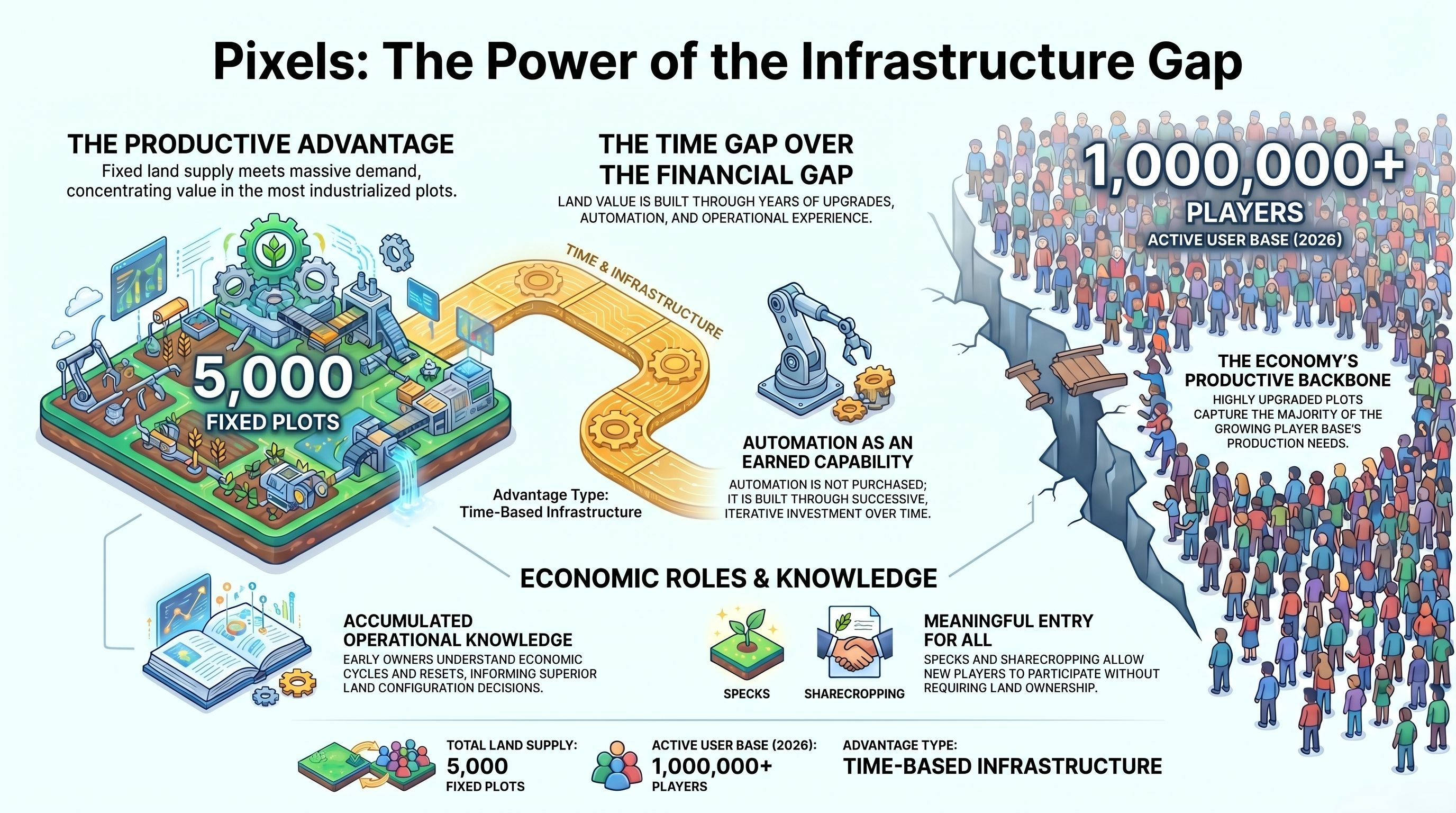
because here's what I keep coming back to. Pixels has 5,000 land plots. that number is fixed and will never increase. the game reached over one million active users in early 2026. the ratio of active players to available land plots is not a static relationship. every new player who enters the Pixels economy and does not own land is a potential sharecropper, a potential customer for land-based production output, a potential participant in the crafting economy whose inputs flow primarily from land-based resource nodes.
as the active player base grows, the demand pressure on land-based production does not distribute itself evenly across all 5,000 plots. it concentrates on the plots that are most industrialized, most upgraded, most configured for high-throughput output. a land owner who spent four years activating industries and upgrading production capacity is not just ahead of a new entrant on a linear scale. they are operating at a point on the upgrade curve that a new land purchaser in 2026 would need years of continued investment to reach, regardless of how much PIXEL they are willing to spend at the current moment.
then comes the automation question. because of course.
and here's where the compounding becomes genuinely fascinating to examine. the whitepaper describes land owners as being able to automate their plots, generating output without requiring the owner to be actively present. automation is not a feature you purchase at land acquisition. it is a capability you build toward through successive upgrades over time. a land owner operating an automated plot in 2026 is running infrastructure that represents years of iterative investment. a new land owner acquiring a plot today is acquiring the right to build toward automation, not automation itself.
the gap between those two states is not a financial gap. it is a time gap expressed as productive capacity, and productive capacity inside a fixed-supply land system with a growing player base is the thing that actually determines who captures the economy's output over time.
there's also a dimension nobody talks about enough.
early land owners who have been operating through multiple chapter transitions have something that no amount of capital can directly purchase: operational knowledge of how the Pixels economy behaves across economic resets. they watched how the $BERRY phase-out affected resource flows. they saw how Chapter 3's competitive mechanics changed demand patterns for specific crafting inputs. they experienced how seasonal events move prices before the price moved. that accumulated observational knowledge informs upgrade decisions, industry configurations, and sharecropper arrangements in ways that shape the productive output of their land independently of the upgrade level itself.
still… I'll say this.
the accessibility of Pixels to new players without land ownership is genuine and meaningful. the Speck system, the public farming areas, the sharecropping pathway, these are real entry points that allow participation in a productive economy without requiring capital at the level of land acquisition. the game is designed to be playable and economically meaningful at every level of ownership.
the question is not whether new participants can find value in Pixels. they clearly can. the question is whether the players entering the ecosystem in 2026 understand that the economy they are joining has been shaped by four years of infrastructure decisions made by participants who are not visible in the leaderboard but whose upgraded plots, automated industries, and accumulated skill levels form the productive backbone of everything the growing player base is now interacting with.
and in this world, understanding that layer is the difference between participating in an economy and understanding the one you are actually inside.
@Pixels #pixel $PIXEL $CHIP $BAS