
Pixels (PIXEL) is a social casual Web3 game built on the Ronin Network. This update expands on its features, focusing on a mesmerizing open-world experience centered around farming, exploration, and creation.
Today I want to explain that the overall changes in the game system like the restructuring of animals, the deeper crafting, and supply controls are reshaping how we engage with the game....
I’ve been sitting with this update for a while now, not really trying to “understand” it in the usual way, but just letting it settle. At first glance, it feels like any other patch more features, more systems, more things to do. But the longer I look at it, the more it starts to feel like something quieter… something that doesn’t announce itself loudly.
It reminds me of how the market has been behaving lately.
Not dramatic. Not crashing. Not soaring.
Just… shifting.
There’s this strange hesitation everywhere. Prices move, but not with conviction. People react, but a little slower than before. Even decisions feel delayed, like everyone is waiting for something—but no one knows exactly what. And maybe that’s why this update feels familiar. It carries the same kind of energy.
Not a sudden leap forward.
More like a tightening.
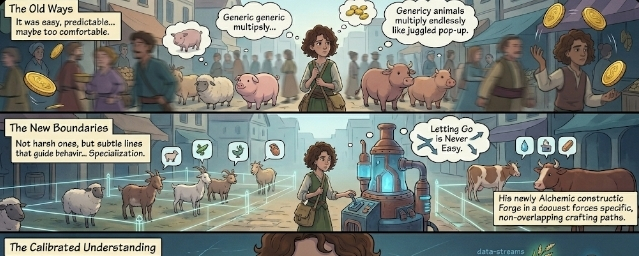
When I read through the changes—animal systems becoming more structured, crafting getting deeper, supply being controlled—it doesn’t feel like expansion in the usual sense. It feels more like boundaries being drawn. Not harsh ones, but subtle lines that guide behavior without forcing it.
I keep thinking about the change to animals. Before, they were simple. Almost passive. You placed them, and they gave something back. It was easy, predictable. Maybe even a little too comfortable. Now, there’s intention involved. Feeding, managing, optimizing. And more importantly, limits—public animals no longer producing offspring.
That one detail stayed with me longer than I expected.
It quietly removes something infinite.
And in doing that, it introduces something else… responsibility, maybe. Or awareness. You can’t just rely on the system to keep giving. You have to think about how and why you’re using it.
It’s strange, because I’ve noticed a similar shift in how people are approaching the market these days. A few months ago, it felt like everything was about speed—jumping in early, chasing momentum, reacting fast. Now, there’s more hesitation. People double-check. They wait. Sometimes they don’t act at all.
Not because they don’t see opportunities.
But because they’re not sure the system will behave the way it used to.
And that uncertainty changes everything.
The introduction of something like the Alchemic Forge adds another layer to this feeling. On paper, it’s just a new industry, another production chain. But when I think about it more slowly, it feels like an invitation to specialize. To choose a path, instead of doing a little bit of everything.
That idea keeps coming back to me specialization.
It sounds efficient, but it also means letting go of other options. And letting go is never as easy as it looks. There’s always that small voice wondering if you’re narrowing too much, if you’re missing something elsewhere.
I’ve felt that in my own decisions lately. Not just in-game, but outside too. Choosing where to focus feels heavier now, like each choice carries more weight than before. Maybe because the environment itself feels less forgiving. Or maybe because the illusion of endless growth has started to fade, just a little.
Even the economy changes in this update seem to echo that.
Boosting production from land, reducing crafting surplus it subtly shifts what’s valuable. It’s no longer just about stacking outputs or repeating the same loop endlessly. There’s a kind of friction being introduced. Not enough to stop you, but enough to make you notice.
And that friction… it slows things down.
Not in a frustrating way, but in a way that forces awareness.
I think that’s what I keep circling back to. Awareness.
The update doesn’t shout its intentions. It doesn’t force a new style of play overnight. But it gently nudges you toward thinking differently. Toward paying attention to how systems connect, how resources flow, how small decisions compound over time.
It’s not about doing more.
It’s about understanding more.
And that’s where it starts to feel less like a game update and more like a reflection of something broader. Because right now, outside of this system, things feel similar. The market isn’t rewarding randomness the way it used to. Patterns still exist, but they’re harder to see. Signals are weaker. Noise feels louder.
So people adapt.
They become more careful. More selective. Sometimes more quiet.
I’ve noticed myself doing that too. Spending more time observing than acting. Letting things play out a little longer before stepping in. It’s not always comfortable. There’s a tension in waiting, especially when you’re used to moving quickly.
But there’s also something else in that space.
Clarity, maybe.
Or at least the possibility of it.
When I think about Tier 5, it doesn’t feel like a milestone in the traditional sense. It’s not just “more.” It feels like a new ceiling, yes—but also a new kind of pressure. Reaching it isn’t just about progress. It’s about whether your system your way of playing, your way of thinking can actually sustain that level.
Because once you’re there, the margins matter more.
The small boosts from tools, the efficiency from decisions, the way you connect one system to another… all of it becomes more visible. There’s less room for randomness to carry you.
And that’s where the update quietly changes its tone.
It stops being about what you can access, and starts being about how you use it.
I don’t think that shift is fully obvious at first. It’s easy to focus on the surface—the new recipes, the new quests, the added layers. But underneath, something is being recalibrated. Growth is being slowed, not stopped. Systems are being connected more tightly, not expanded loosely.
It’s like the game is asking a different question now.
Not “how much can you do?”
But “how well do you understand what you’re doing?”
And maybe that’s why it feels so aligned with the current moment. Because outside of this, in the real world, it feels like the same question is being asked in quieter ways. Through volatility that doesn’t resolve quickly. Through trends that start but don’t fully form. Through decisions that feel heavier, even when the stakes haven’t obviously changed.
There’s a subtle shift happening.
Not dramatic enough to point at.
But enough to feel.
And I keep wondering if that’s the real update not just in the game, but in how we move through systems like this. A shift from speed to awareness. From expansion to intention. From doing more to understanding better.
It’s not something you can measure easily.
You just notice it… slowly.
So I’m sitting with that for now. Not rushing to optimize, not trying to solve everything immediately. Just observing how these changes settle, how they reshape the way I think about progress, about systems, about control.
Because maybe the most interesting part isn’t what’s been added.
It’s what’s been quietly taken away… and what that absence reveals.
And I can’t help but wonder
are we actually adjusting to these systems, or are they slowly reshaping the way we think without us fully realizing it??
