Honestly... I didn't expect to feel this specific kind of attention reading through how Pixels structures the long-term advantages of sustained participation.
Not alarm. not skepticism. something closer to the feeling you get when you realize a game that markets itself as free-to-play has quietly built one of the most sophisticated compounding advantage structures in the Web3 gaming space, and it rewards the same behavior consistently across every layer.
because there's a pattern in how blockchain games describe early participation that this space accepts without examining what it actually accumulates over time. the standard framing positions early mover advantage as a purchase timing question. you were early, you paid less, you gained more when price moved. the advantage is linear, fixed at the moment of entry, and does not grow after the initial price event.
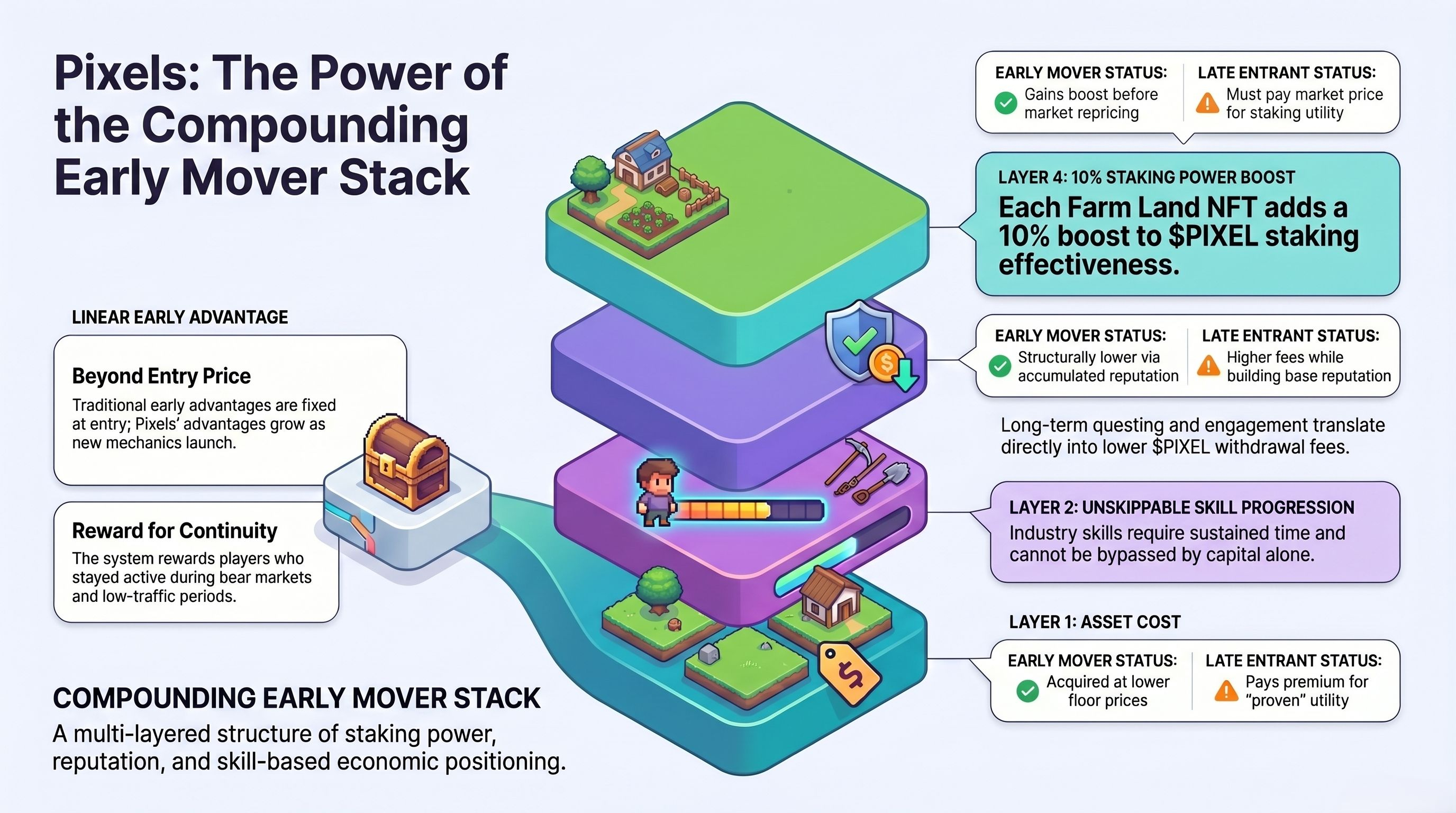
but Pixels built a different kind of early mover advantage. one that is not primarily about entry price and is not capped by a single token event. it compounds across staking power, reputation score, skill progression, and ecosystem positioning simultaneously, and it keeps adding layers as the platform develops.
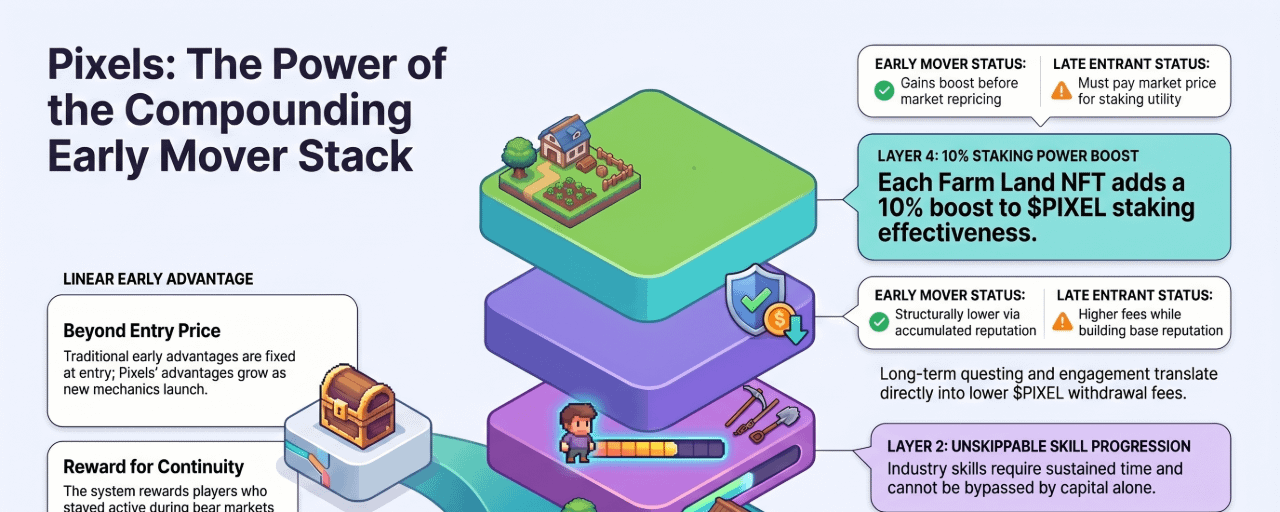
because the product they are describing is real. Farm Land NFTs acquired in 2023 and early 2024 at lower floor prices now carry a 10% staking power boost per NFT in the current staking system. reputation scores built through sustained months of quests, events, and economic activity translate directly into lower Farmer Fees when withdrawing PIXEL today. skills leveled through continuity of production on specific industries require sustained time that cannot be shortcut by capital alone. each layer was added at a different point in the ecosystem's development. each one compounds quietly on top of the ones that came before.
so yeah... the early mover advantage is real.
but early mover advantage has never been just about price.
the hard part is the compounding structure. and this is where Pixels is doing something that deserves to be examined much more carefully than the typical early-versus-late conversation allows.
because here's what I keep coming back to. in most token economies, early mover advantage is linear. you bought at X, price went to 10X, your gain is fixed. time does not add new layers after the initial price movement. but in Pixels, the advantage structure keeps accumulating as the ecosystem develops new mechanics. the player who held land NFTs through the bear market not only preserved the staking power boost those NFTs now provide. they also accumulated the reputation score that comes from sustained in-game activity during the period when most players had left. they leveled skills through industry continuity that later entrants have to rebuild from zero. they established production relationships with other landowners and sharecroppers before new players arrived to compete for the same industries.
the early mover did not just get a cheaper entry price. they got every subsequent layer of advantage before the market understood what each layer was worth and priced it into the assets required to access it.
then comes the staking power question. because of course.
and here's where it gets genuinely compelling. the staking system launched in May 2025 created a new compounding layer for existing land holders specifically. each Farm Land NFT adds 10% staking power to the holder's in-game PIXEL stake, capped at 100,000 PIXEL per NFT. a player who entered early and holds five land NFTs stakes with 50% more effective power than a player holding the same PIXEL balance without land. a player entering today can access that same amplification, but only by purchasing land NFTs at secondary market prices that have already repriced to reflect the staking utility those NFTs now carry. the early mover got the staking boost before the market understood what it was worth. the later entrant pays the price that the early mover's advantage has already demonstrated.
there's also a dimension nobody talks about enough.
reputation scores determine Farmer Fee rates directly. higher reputation means lower fees on PIXEL withdrawal, with all collected fees redistributed back to stakers. the player with two years of consistent questing, event participation, and economic engagement is paying structurally less to withdraw their earnings than a player who joined last month and is still building their score. both players see the same game. both complete the same daily tasks. but when withdrawal time comes, the sustained participant's cost structure is lower in a way that compounds quietly across every single earnings cycle. the fee difference is not dramatic on a single withdrawal. across hundreds of withdrawals over months, it is a meaningful structural advantage that accumulates without requiring any additional action.
still... I'll say this.
the decision to build compounding advantage into sustained participation rather than only into purchase price reflects a genuine commitment to rewarding the players who stayed through the difficult periods of the ecosystem's development. the players who held land when PIXEL was at its lowest, who continued farming when daily active wallets declined, who built reputation through consistent engagement when the game was not trending, are now operating with a structural foundation that newer participants are purchasing at the price that foundation has already proven it is worth. that is not an accident. it is a deliberate design philosophy about what kind of participation deserves to be rewarded most.
the question is not whether early movers have advantage. they clearly do. the question is whether players entering the Pixels ecosystem today have mapped all the layers of that compounding structure before deciding how to position themselves to build the equivalent foundation over the next two years.
and in this space, the players who understand what they are actually compounding toward are building something fundamentally different from the ones who are still treating participation as a daily task loop with no long-term architecture behind it.
@Pixels #pixel $PIXEL $CHIP $BTC