
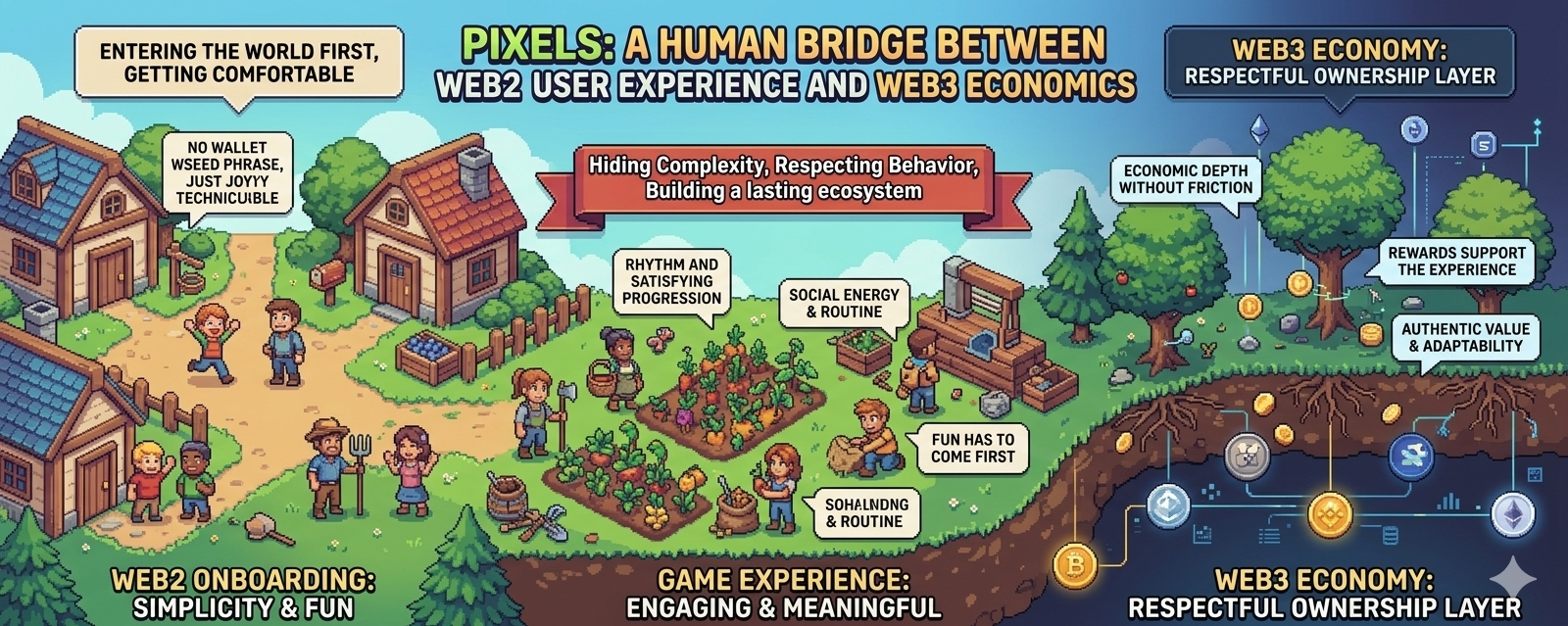
What makes Pixels stand out to me is that it does not feel like a project trying to shove Web3 in my face from the first second. That is honestly where a lot of blockchain games lose people. They make the wallet the main character. Before a new user even understands the world, they are being asked to think about seed phrases, tokens, gas, networks, and transactions. Most normal players do not want to deal with any of that. They just want to open a game, understand it quickly, enjoy the experience, and decide for themselves whether it is worth coming back to. Pixels seems to understand that better than most projects in this space, and that is why I think it has become such an important example of how Web3 and Web2 can actually meet in the middle.
When I look at Pixels, I do not just see a farming game with crypto elements attached to it. I see a project trying to solve a much bigger problem. Web3 has always had interesting ideas around ownership, open economies, and digital assets, but the user experience has usually been too clunky for mainstream adoption. Web2, on the other hand, is very good at making products feel simple, familiar, and easy to use, but it does not usually give users the same level of ownership or economic participation. Pixels feels like an attempt to combine the strengths of both worlds. It wants to keep the economic depth of Web3 while presenting it through a more natural, low-friction experience that feels closer to what ordinary gamers already know.
That balance matters a lot to me. I think one of the biggest mistakes in early blockchain gaming was assuming players would tolerate bad onboarding just because the economy looked exciting. That may work for a small crypto-native audience, but it does not work for the wider market. Most people are not rejecting Web3 because they hate the idea of ownership. They are rejecting it because the first interaction often feels exhausting. Pixels seems to take the opposite approach. It feels like it wants people to enter the world first, get comfortable first, enjoy the game first, and only then start discovering the economic layer underneath. That is a much more human way to design a product.
What I personally like about that is how respectful it feels toward the player. It does not demand that every new user become a mini crypto expert before they are allowed to have fun. Instead, it lowers the barrier to entry in a way that feels familiar. That is where the Web2 side of the bridge really shows up. The project seems to understand that good onboarding is not a small detail. It is everything. If the beginning feels smooth, people stay curious. If the beginning feels like paperwork, they leave. Pixels appears to know that simplicity is not the enemy of innovation. In fact, simplicity is often what allows innovation to reach more people.
I also think Pixels deserves credit for not treating token rewards as the entire reason to play. That is another area where many Web3 projects went wrong. For a while, the whole industry leaned too hard on the idea that people would stay if they were constantly earning. But that kind of participation is usually fragile. When users are only there for extraction, they are never really attached to the world itself. The moment the economics become less attractive, the relationship disappears. Pixels feels more aware of that reality. It seems to understand that fun has to come first, because no economic model can carry a game that people do not genuinely enjoy.
That lesson is simple, but it is deeper than it sounds. A game needs rhythm. It needs social energy. It needs progression that feels satisfying. It needs players to feel that their time inside the world means something beyond just short-term rewards. When that foundation exists, then the Web3 layer becomes stronger. Ownership starts to feel meaningful. Assets feel personal. Economic activity feels connected to real engagement instead of forced behavior. To me, that is one of the most important reasons Pixels remains relevant. It is not treating Web3 as a shortcut around game design. It is trying to make the economic layer support the experience rather than dominate it.
Another thing I find interesting is that Pixels does not feel static. It feels like a project that has been learning in public. That matters to me because the teams I trust most in this space are not the ones pretending they got everything perfect from day one. They are the ones willing to admit what needs to change. Web3 gaming has gone through enough failed models that adaptability is a strength, not a weakness. Pixels seems to have understood that it cannot rely on unsustainable systems forever. It has had to rethink parts of its economy, refine its reward structure, and make the overall experience more practical for real users. I actually respect that. It makes the project feel more serious and less performative.
From my point of view, the economic side of Pixels is one of the most ambitious parts of the whole project. It is not just building a token economy for the sake of saying it has one. It seems to be thinking carefully about whether incentives are actually productive. That is a much smarter approach than simply flooding a game with rewards and hoping hype does the rest. In Web2, companies constantly measure whether spending actually leads to growth and retention. Pixels seems to be bringing a similar mindset into Web3. That tells me the team is not only thinking like game developers. They are also thinking like operators trying to build a system that can last.
I think that is a huge part of the bridge between Web3 and Web2. On one side, Pixels keeps the idea that players should have some real relationship to the economy of the world they spend time in. On the other side, it applies a more disciplined, user-focused logic that feels closer to mainstream product design. It is not enough to have incentives. Those incentives need to make sense. They need to create healthier behavior, better retention, and stronger long-term value. That kind of thinking is much more mature than the old play-to-earn mindset that depended too heavily on endless expansion.
What also stands out to me is that Pixels no longer feels limited to being just one game. The more I think about it, the more it feels like a broader ecosystem play. It seems to be building not only a game world, but also a kind of economic and engagement framework that could eventually extend beyond its original format. That is where the project becomes especially interesting. It starts to look less like a single title and more like a larger experiment in how tokenized game ecosystems can work in a practical way.
That ambition matters because it changes how I see the project’s long-term value. If Pixels can prove that it knows how to attract users, keep them engaged, and tie incentives to real behavior, then that logic can become much bigger than one farming game. It can become infrastructure. It can become a model for how other projects think about onboarding, retention, and in-game economies. That possibility is part of what keeps the project relevant to me. Even people who are not personally invested in the game itself can still learn something from the way Pixels is approaching the problem.
I also think the social layer matters more than people give it credit for. In my experience, the strongest digital economies are not built on rewards alone. They are built on habits, identity, and community. People return to places where they feel present, where their effort has meaning, and where they can build some kind of routine. Pixels seems to understand that. It is not just about earning. It is about creating a world where people want to spend time, interact, progress, and feel connected. Once that emotional layer exists, the economic layer becomes much more believable.
That is why I keep coming back to the idea that Pixels feels more human than many Web3 projects. Not because it avoids complexity entirely, but because it seems to understand how people actually behave. Most users do not want to feel like traders every time they log into a game. They do not want to constantly think about token pressure, market timing, or technical steps. They want an experience that feels natural. They want value without friction. They want ownership without confusion. They want innovation without being forced to study the infrastructure first. Pixels feels like one of the few projects seriously trying to offer that combination.
In the end, that is why I believe Pixels matters. It is not just building a blockchain game. It is trying to make Web3 feel usable in a mainstream-friendly way. It is showing that the future of this space probably does not belong to projects that are the most aggressively crypto-native on the surface. It belongs to projects that know how to hide complexity, respect user behavior, and create experiences people actually enjoy. To me, Pixels is important because it understands that the real bridge between Web3 economics and Web2 user experience is not hype, jargon, or technical flexing. It is good design, good timing, and a real understanding of what makes ordinary users stay.