
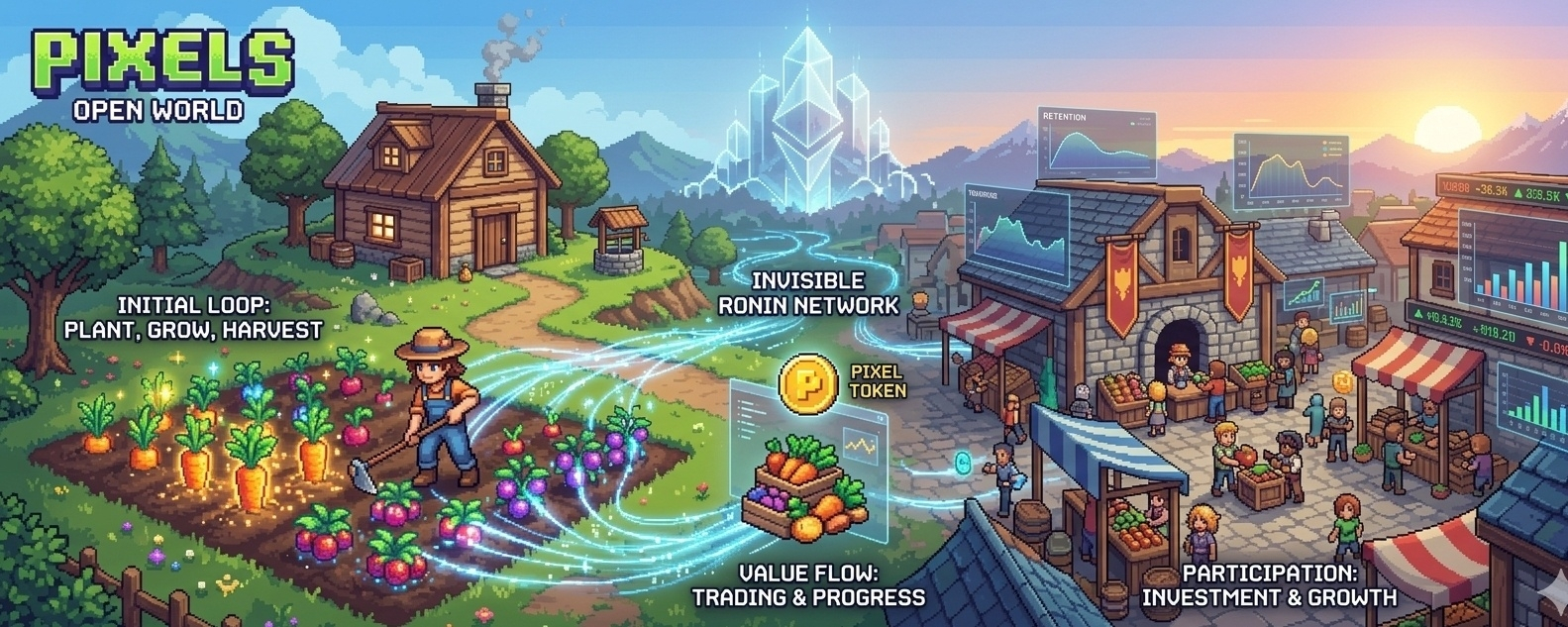
Whenever a project like Pixels (PIXEL) appears calm, almost understated, wrapped in farming, exploration, and social loops it usually gets misread in two ways. Some people dismiss it as “just another casual Web3 game.” Others rush to over-interpret it as the next big structural shift. Both reactions miss what I think is actually happening underneath.
I’ve learned not to trust either excitement or dismissal too early. They’re both emotional shortcuts.
What I try to look at instead is the behavior it quietly encourages when no one is watching the narrative.
At surface level, Pixels looks like an open-world farming experience running on the Ronin Network ecosystem. You plant, you gather, you explore, you interact. Nothing about that sounds revolutionary anymore. We’ve seen versions of this loop before. Sometimes successful, often temporary.
But I’ve stopped judging these systems by their surface mechanics alone. Mechanics are the easiest part to copy. What’s harder to replicate is the rhythm of attention they create over time.
And rhythm is where the truth usually hides.
I’ve noticed something subtle: Pixels doesn’t aggressively demand attention. It doesn’t scream for urgency the way most Web3 projects do in their early phases. There’s no constant pressure to act, no forced escalation loop that pushes me toward immediate optimization.
Instead, it feels like it assumes I’ll come back even when nothing significant is happening.
That assumption is dangerous but also revealing.
Because most digital systems are built on the opposite belief: if you’re not stimulated, you leave. Pixels quietly experiments with a different premise: if the environment becomes part of your routine, you don’t need stimulation to stay.
That’s not a gameplay decision. That’s a behavioral bet.
And I’ve seen enough cycles to know behavioral bets are where projects either quietly become culture—or slowly fade without anyone noticing the exact moment they stopped mattering.
The uncomfortable part is that I can’t immediately tell which direction this is leaning.
On one hand, I see something that resembles stability. A kind of low-volatility engagement loop where players aren’t constantly pushed into emotional extremes. That can be healthy. It can also be misleading, because stability can sometimes be mistaken for depth when it’s really just reduced friction.
On the other hand, I also recognize something familiar: the early formation of routine-driven participation. People logging in not because they are excited, but because it has become a small part of their day. Almost like checking a garden that doesn’t urgently need attention, but feels wrong to ignore.
That’s where things start to get interesting from a structural perspective.
In Web3 environments, most attention economies fail because they rely too heavily on spikes—hype cycles, reward bursts, speculative waves. But systems that survive longer often do something less visible: they normalize participation.
And normalization is powerful because it stops feeling like participation at all. It becomes behavior.
I’ve seen this before in earlier cycles. Not necessarily in Pixels specifically, but in similar attempts where creators tried to shift away from pure financial urgency toward slower social ecosystems. The pattern usually follows a familiar arc:
First, curiosity drives early adoption.
Then, mechanics stabilize into routine.
Then, the narrative layer tries to catch up and explain what is already happening.
And finally, external markets attempt to reframe everything in terms of value extraction again.
That last step is where most systems lose their original shape.
Because once something becomes valuable externally, it stops being experienced internally in the same way.
What I find myself questioning with Pixels is whether it can resist that translation layer for long enough to form something culturally meaningful instead of purely economically reactive.
I don’t have a clean answer.
What I do have is observation fatigue from having watched too many systems get reinterpreted out of their original intent.
The Ronin environment adds another layer to this. Not because it determines outcome directly, but because it carries memory. Ecosystems remember. Users remember even more. And that memory shapes expectations more than most teams realize.
When I see a game building in that space, I don’t just see mechanics. I see inherited assumptions about rewards, sustainability, exit points, and speculation cycles.
And those assumptions are hard to erase.
So even when Pixels tries to present itself as a calm, social farming experience, it is still operating under the shadow of previous expectations that want to turn everything into a tradeable narrative.
That tension is always present, even when it’s not visible on the surface.
What I find most intellectually interesting, though, is not whether Pixels “succeeds” in a traditional sense. That feels like the wrong question.
The more important question is: what kind of human behavior does it stabilize over time?
Because in systems like this, success is not just about user numbers or token performance. It’s about whether people develop a new baseline for how they interact with digital space.
Do they start valuing slow accumulation over fast reaction?
Do they treat digital environments as places to exist rather than extract from?
Or do they eventually revert to the same cycle of urgency once external incentives become strong enough?
I’ve seen all three outcomes before.
And I don’t trust any early signal that claims to know which one will dominate.
There’s also a more uncomfortable layer I keep circling back to: boredom.
Most people underestimate boredom in digital systems. They treat it as failure. But boredom is often where the real structure of a system reveals itself.
If a game can hold attention without constant stimulation, that might indicate depth. Or it might indicate inertia. The difference is hard to measure in real time.
I’ve personally felt both inside systems like this. The quiet pull of returning without urgency. And the quiet realization that I’m returning without reason.
Those two experiences feel similar on the surface, but they lead to very different long-term interpretations.
So when I look at Pixels, I don’t see a finished narrative. I see a system still negotiating its identity between three forces: gameplay, habit, and market interpretation.
And those forces rarely align cleanly in Web3.
If I step back far enough, what I really see is this: Pixels is not just trying to be a game. It is trying intentionally or not to test whether persistence can exist without hype as its primary fuel.
That’s a fragile experiment.
Because hype is not just noise in this space. It’s often the only thing holding attention together long enough for structure to form.
Removing it too early can cause collapse. Leaning on it too heavily prevents maturity.
So I remain in a middle position, neither convinced nor dismissive.