
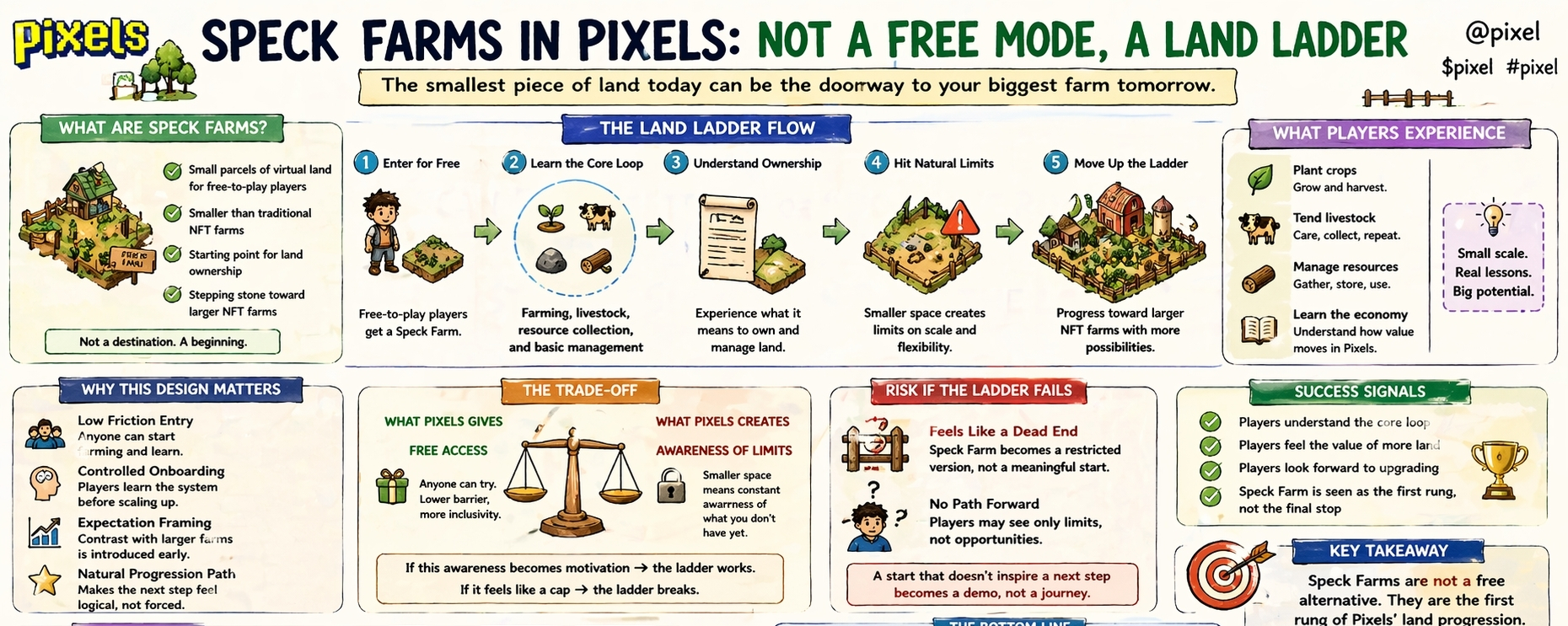
While reading through how Speck Farms are described in Pixels, one line kept pulling my attention back. They are small parcels for free-to-play players, but also framed as a starting point for land ownership and a path toward larger NFT farms. That combination doesn’t read like a side mode. It reads like a direction.
The way I see it, Speck Farms are not just there to let new players try farming. They quietly set the expectation that this is where you begin, not where you stay.
On the surface, it is simple. A new player gets access to a small piece of land. They can farm, manage resources, and understand the basic loop. Nothing unusual there. Most games give you a starter version of the core system.
But Pixels does something slightly different with how it positions that starter space.
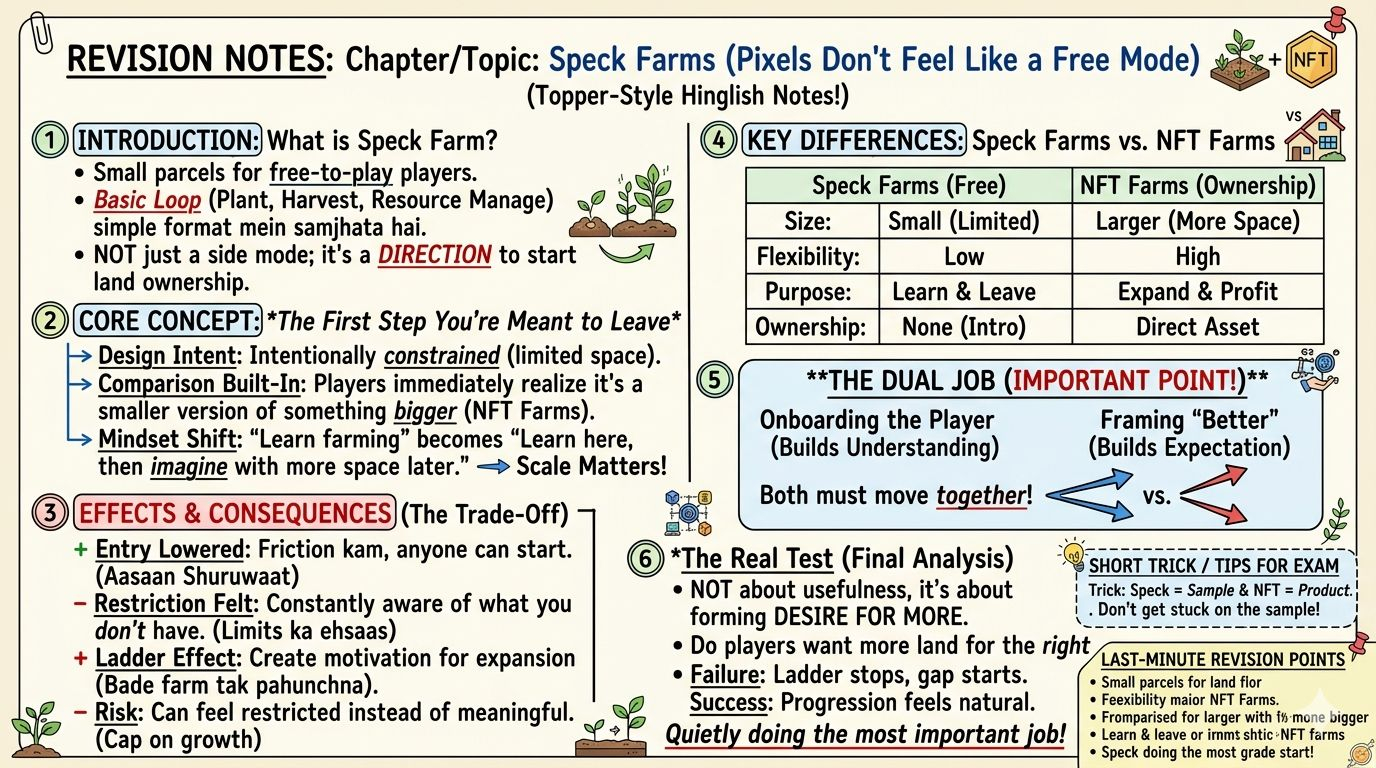
It is smaller than traditional NFT farms by design, and it is described as a stepping stone. That matters. It tells the player, early on, that what they are using is a limited version of something bigger. The comparison is built into the system from the start.
So the experience is not just “learn farming.” It becomes “learn farming here, then imagine doing it with more space later.”
That shift changes how the free-to-play layer functions.
If Speck Farms were meant to be a full alternative, they would need to feel complete on their own. Instead, they feel intentionally constrained. They teach the mechanics, but they also show the boundaries of those mechanics at a small scale.
That creates a very specific kind of pressure.
A player who spends time on a Speck Farm is not just learning how to plant, harvest, and manage resources. They are also getting used to the idea of land as a productive unit. And once that idea settles in, the difference between a small parcel and a larger NFT farm stops being abstract.
It becomes practical.
More space likely means more flexibility in how you farm. More room to organize. More room to expand whatever loop you are already running. Even without adding new mechanics, scale alone starts to matter.
That is where the ladder effect becomes real, but it is not just about moving up. It is about how early that comparison is introduced.
Pixels is not waiting until a player is advanced to show them what bigger land looks like. The contrast is embedded in the starting point itself. The Speck Farm is useful, but it is also a reference point for something larger.
That creates a trade-off that is easy to miss.
Making the entry free lowers friction. Anyone can start farming. But shaping that entry as a smaller, clearly transitional space also means the player is constantly aware of what they do not have yet.
If the system works as intended, that awareness turns into motivation. The player understands the loop, sees its limits at a small scale, and starts to value expansion.
If it does not work, the same design can backfire. The Speck Farm can feel like a restricted version of the game instead of a meaningful starting point. In that case, the player may not see a path forward. They just see a cap.
That is the risk built into this design.
The free layer is not neutral. It is doing two jobs at once. It is onboarding the player into farming, and at the same time, it is framing what “better” looks like through larger land.
One part builds understanding. The other part builds expectation.
And those two do not always move together.
A player can understand the system perfectly and still decide that the jump to a larger farm is not worth it. When that happens, the ladder stops being a path and starts feeling like a gap.
That is why I do not see Speck Farms as a simple free mode.
They are closer to a controlled first exposure to land ownership logic in Pixels. They let players experience the core loop, but within a space that highlights its own limits.
The result is a very specific kind of onboarding.
It is not trying to keep players in the free layer forever. It is trying to make that layer meaningful enough that leaving it feels like a natural next step.
And that puts pressure on the design in a different place.
The real test is not whether Speck Farms are useful. They clearly are. The real test is whether they make players want more land for the right reasons.
Because if that desire does not form, then the starting point does not lead anywhere.
And if it does, then the smallest piece of land in Pixels is quietly doing the most important job in the entire progression system.
