
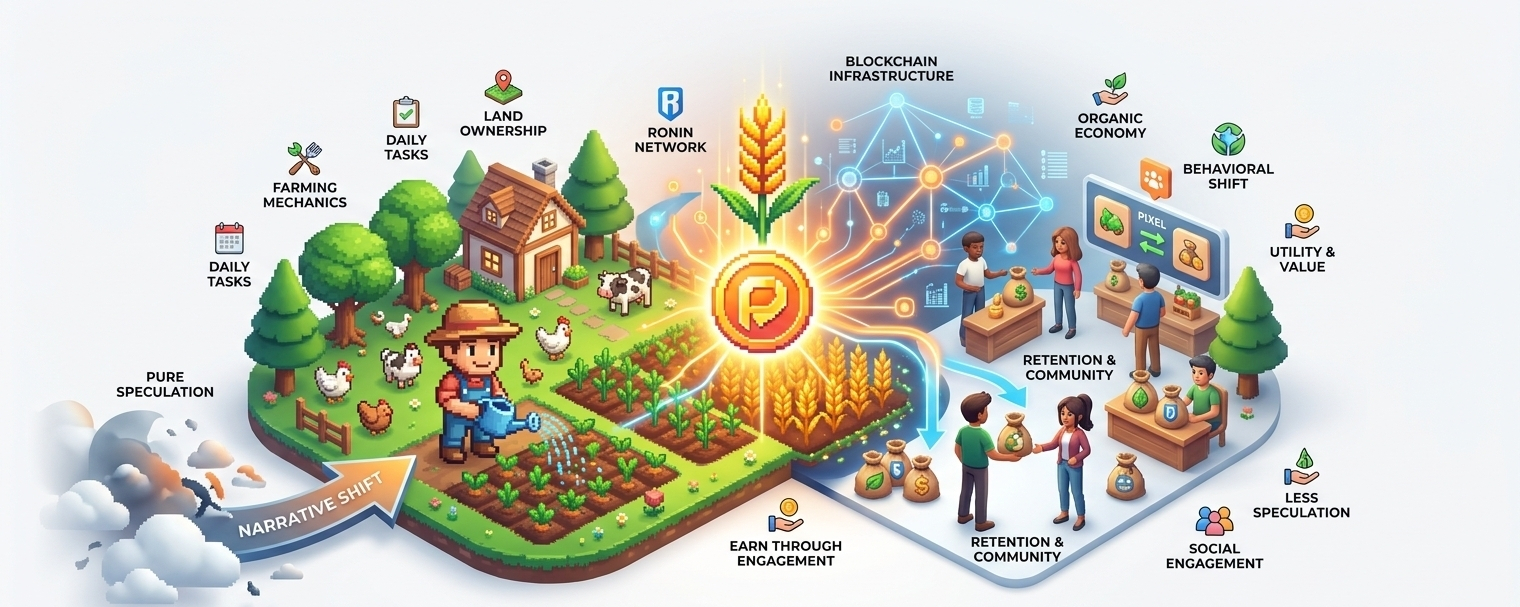

I didn’t expect to get pulled into a farming game while the market is doing what it’s doing right now. Lately, everything feels like it’s rotating faster than usual. Liquidity comes in, chases one narrative, gets bored, and moves on. One week it’s AI, the next it’s modular chains, then suddenly gaming starts whispering again. Not loudly, not like the last cycle’s hype… just enough to make you look twice.
That’s exactly what happened to me with Pixels.
At first, I brushed it off. A casual Web3 game? Farming? It sounded like something I’d normally scroll past. But then I kept seeing it pop up in conversations that didn’t feel forced. Not influencer threads, not aggressive shilling… just people casually mentioning that they were actually spending time in it. That’s rare. In crypto, people talk about tokens all day, but very few talk about actually using something.
So I decided to take a closer look.
What caught my attention wasn’t just the game itself, but the timing. We’re in a phase where people are getting tired of pure speculation. You can feel it. Even traders who live off volatility are starting to look for something stickier, something that holds attention beyond charts. That’s where gaming quietly becomes relevant again, not as a hype cycle, but as a behavioral shift.
And Pixels sits right in the middle of that.
From what I’m seeing, the core idea is deceptively simple. It’s an open-world farming game where you plant crops, gather resources, explore land, and build your little digital life. But underneath that simplicity is something more interesting. It’s built on Ronin, which already tells me they’re leaning into a network that understands gaming users rather than just crypto users.
That distinction matters more than most people realize.
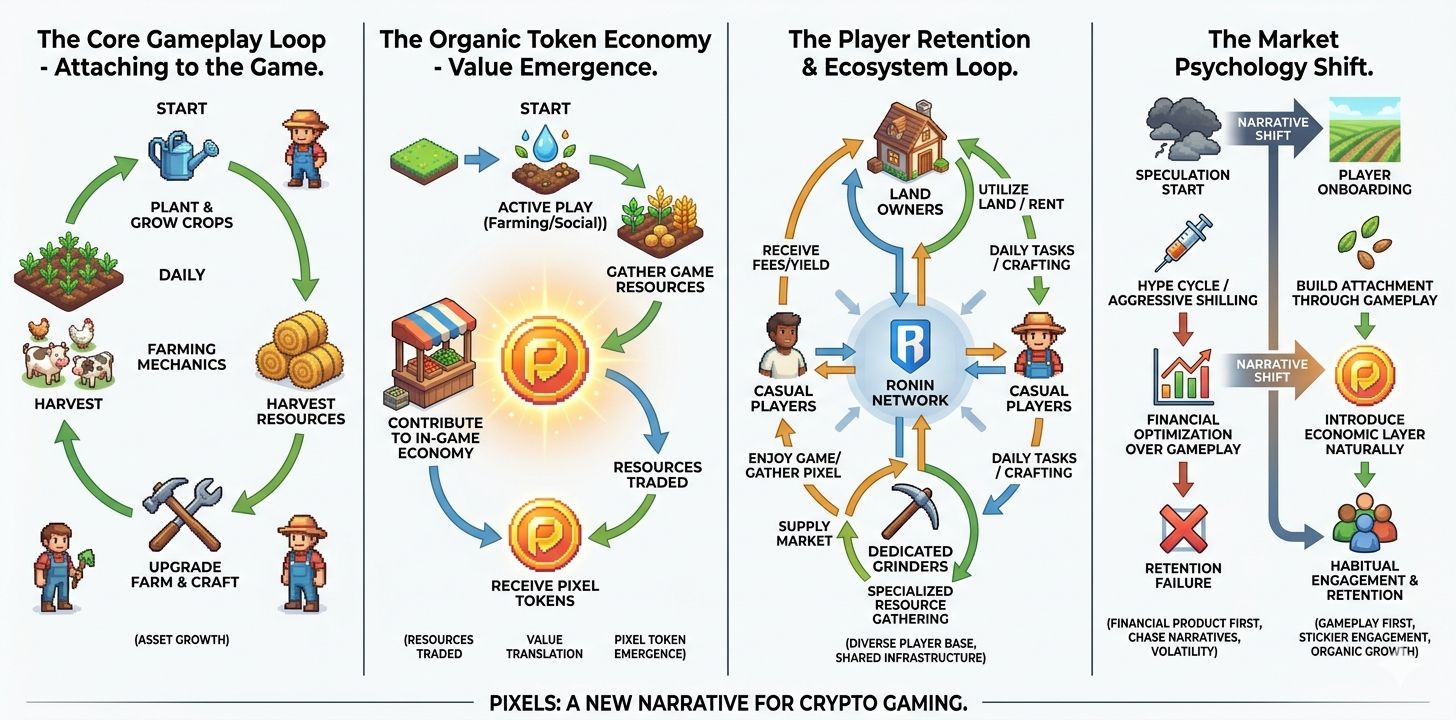
A lot of Web3 games fail because they’re designed like financial products first and games second. You feel it instantly when you play them. Everything revolves around earning, optimizing, extracting. It becomes work disguised as gameplay. Pixels, at least from my experience so far, feels like it’s trying to flip that. The gameplay comes first, and the earning layer sits quietly in the background.
I didn’t expect that.
When I started exploring, I noticed how the mechanics ease you in. You’re not overwhelmed with tokenomics or staking dashboards right away. You’re just playing. Farming, crafting, interacting. Over time, you start realizing that your actions have economic weight. Resources you gather can be traded. Time spent in the game translates into something tangible.
That’s where PIXEL, the token, comes into play.
Instead of being aggressively pushed upfront, the token feels like it emerges naturally from the ecosystem. You earn it through participation, through contributing to the in-game economy. It’s used for upgrades, for progression, for interacting with different systems inside the game. It’s not just sitting there as a speculative asset waiting for price action.
And honestly, I think that’s one of the more underrated design choices here.
Most projects overemphasize the token at the start. Pixels seems to delay that moment, letting users build attachment before introducing financial incentives. Psychologically, that changes everything. You’re not just holding a token… you’re holding something connected to your time, your progress, your in-game identity.
Now, does that automatically make it sustainable? Not necessarily. That’s where things get more nuanced.
The real problem Pixels is trying to solve is something the Web3 gaming space has struggled with for years. Retention. Not onboarding, not hype, not token launches… but actual retention. Getting people to come back the next day, and the day after that, without needing constant financial incentives.
From what I’ve observed, Pixels is leaning heavily into social and routine-based engagement. Daily tasks, land ownership, community interaction… these aren’t new ideas, but the way they’re combined here feels more cohesive. It reminds me a bit of how traditional games build habits first, then layer in progression systems that keep you hooked.
The difference is, here those systems are tied to a blockchain economy.
Ronin plays a big role in making that possible. Transactions are cheap, fast, and almost invisible to the user. That’s important because friction kills engagement. If every small action felt like a transaction, people would drop off quickly. Instead, the blockchain layer feels more like infrastructure than a feature.
And that’s how it should be.
What’s interesting is how the ecosystem is starting to form around it. Land owners, casual players, more dedicated grinders… each group interacts with the game differently, but they’re all part of the same loop. Resources flow between players. Time gets converted into value in different ways depending on how you engage.
I’ve noticed that this creates a kind of organic hierarchy, not in a bad way, but in a way that mirrors real economies. Some players specialize. Some just explore. Some invest in assets and let others utilize them. It’s messy, a bit unpredictable… but that’s also what makes it feel alive.
Still, I can’t ignore the risks.
Token-based economies are fragile by nature. If the inflow of new users slows down, or if reward structures aren’t balanced properly, things can break quickly. We’ve seen it before. Play-to-earn models collapse when earning becomes the only reason people are there.
Pixels seems aware of this, at least from a design perspective. The focus on gameplay first suggests they’re trying to avoid that trap. But execution is everything. Balancing fun and financial incentive is one of the hardest problems in this space.
Then there’s the broader market context.
Right now, attention is fragmented. Even if Pixels does everything right, it still has to compete with every other narrative pulling liquidity and user interest. Gaming isn’t the dominant story at the moment. It’s more of a background theme, slowly rebuilding.
That could actually work in its favor.
Projects that grow quietly tend to build stronger foundations. Less pressure, more time to iterate, fewer expectations to meet instantly. I’ve noticed that some of the most resilient ecosystems started this way, almost unnoticed at first.
Compared to other Web3 games I’ve looked at, Pixels feels less like a financial experiment and more like an actual game that happens to have an economy. That’s a subtle but important difference. It doesn’t scream for attention. It just keeps building.
And maybe that’s why it stuck with me.
There’s also something about the aesthetic and simplicity that lowers the barrier to entry. Not everyone wants high-end graphics or complex mechanics. Sometimes, a simple loop done well is more powerful than an ambitious system that’s hard to understand.
I’ve seen people underestimate that before.
One thing I keep thinking about is how this fits into the bigger picture of crypto adoption. Not everyone is going to onboard through DeFi or trading. In fact, most people probably won’t. But games? That’s a different story. Games don’t need to explain blockchain. They just need to be fun.
If Pixels can maintain that balance, it could become more than just another Web3 game. It could be an entry point.
But that’s still a big “if.”
There’s execution risk, competition, and the ever-present volatility of crypto markets. Token unlocks, shifts in sentiment, changes in player behavior… any of these can impact the ecosystem. Nothing here is guaranteed.
What I find most interesting, though, is how it made me pause.
In a market where everything moves fast and attention is short, Pixels made me slow down and actually engage with something. Not analyze it from a distance, not just look at charts… but experience it.
That doesn’t happen often.
So now I’m left thinking about a bigger question. Is this the beginning of a quieter shift back toward utility and engagement in crypto? Or is it just another experiment that feels promising in the moment but fades when the next narrative takes over?
I don’t have a clean answer yet.
But I do know this… if more projects start focusing on behavior instead of just speculation, we might start seeing a different kind of cycle unfold. And Pixels, in its own simple way, might be one of the early signs of that shift.
