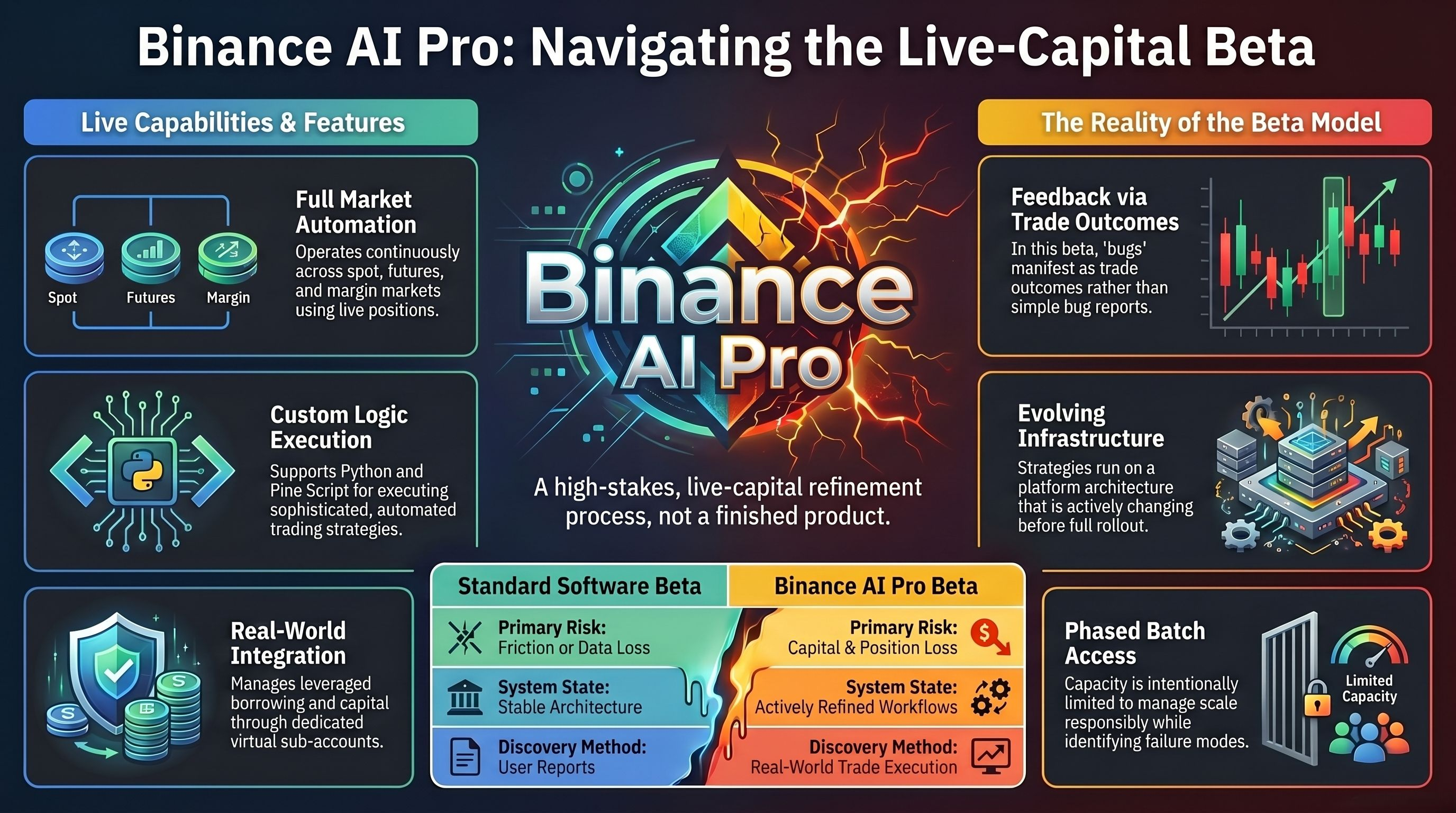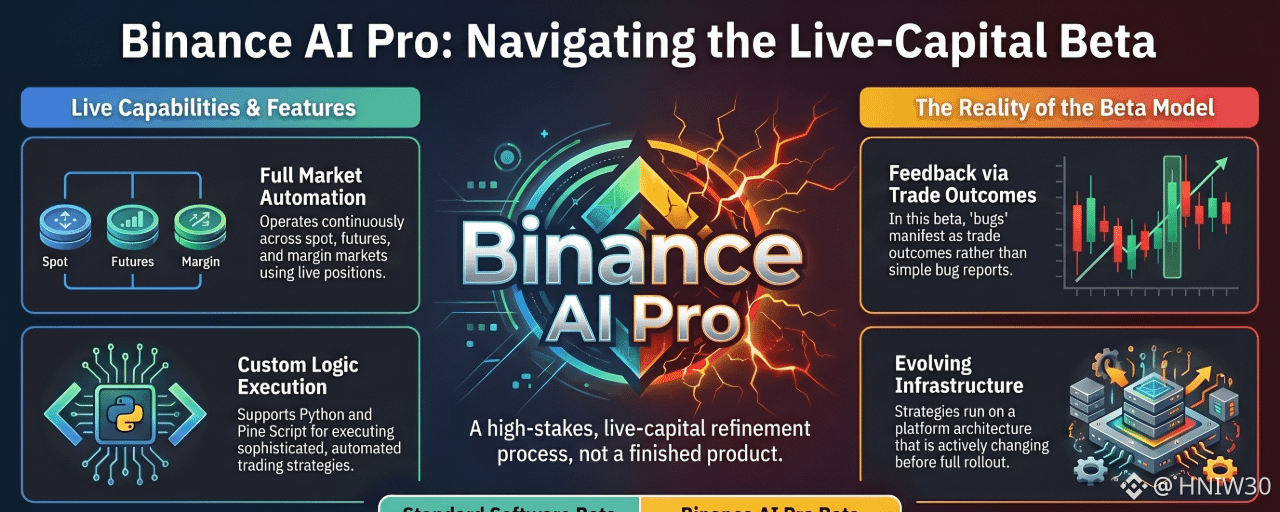
Honestly… I didn't expect to feel this specific kind of attention reading through how Binance Ai Pro frames its beta phase.
Not alarm. not skepticism. something closer to the feeling you get when a product development model that sounds standard in software suddenly carries a different weight when the users providing feedback are also the users holding real capital inside the system being refined.
because there's a pattern in how technology platforms describe beta releases that this space accepts without examining what beta means when the product is an autonomous trading agent. the pitch frames the beta as a collaborative improvement process. user feedback is actively invited to expand supported workflows before broader availability. the feedback-driven development model is real and the intent behind it is genuine.
but beta in a productivity application and beta in an AI system that executes live trades are not the same category of product development.
when a beta note-taking app has a bug, the user loses a document. when a beta autonomous trading agent has a miscalibrated behavior, the user loses a position. the cost of discovering an edge case in a live trading system is not a bug report. it is a trade outcome.
because the product they are describing is real. Binance Ai Pro is in beta, capacity-limited, with access slots being released in batches. the platform can write and execute Python and Pine Script code against live positions, manage leveraged borrowing through the virtual sub-account, and operate continuously across spot, futures, and margin markets. the capabilities are live. the accounts are real. the funds are real.
so yeah… the beta label is honest.
but honest is not the same as consequence-free.
and this is where the structural question nobody asks directly becomes impossible to ignore.
because here's what I keep coming back to. beta software is designed to find failure modes that controlled testing did not surface. the mechanism that surfaces those failure modes is real-world usage. in most software categories, real-world usage means real users encountering real bugs in real workflows. the cost is friction, data loss, or a frustrating experience that gets reported and fixed.
in an autonomous trading system, real-world usage means real users running real strategies with real capital during the period when the system is still actively being refined. the failure modes that beta is designed to discover are being discovered inside live accounts. the edge cases that controlled testing missed are being surfaced through actual trade execution.
this is not a criticism of the beta model. it is a description of what the beta model means in this specific context.
then comes the code execution question. because of course.
and here's where it gets harder to look away. Binance Ai Pro allows users to write and execute Python and Pine Script code for custom strategy execution. in a mature, fully released system, code execution against live accounts carries inherent risk that experienced users understand and accept. in a beta system that is still identifying unsupported workflows and expanding capabilities based on user feedback, code execution against live accounts adds a layer of complexity that the feedback loop was not necessarily designed to stress-test.
a custom Python script that executes correctly in the current beta environment may behave differently after a workflow update. a strategy that runs as expected today is running inside an architecture that the development team has explicitly said will continue to change before full rollout. the user who deploys a custom script during beta is not just running their own logic. they are running their own logic on top of a platform that is still in active development.
there's also a deeper tension nobody names directly.
the beta is capacity-limited intentionally. slots are released in batches. the rollout is staged. this means the user population providing feedback during the beta is a selected group, not the full distribution of users who will eventually access the platform. the failure modes that a sophisticated beta user surfaces may be different from the failure modes a broader user population would encounter. and the strategies that work correctly for beta users may perform differently when the platform scales to a wider, more varied set of configurations.
still… I'll say this.
choosing to run a beta openly rather than in closed internal testing reflects a genuine commitment to building a product that responds to real-world usage rather than controlled scenarios. the invitation for user feedback is not a formality. the phased rollout is a responsible approach to managing scale before architecture is finalized. the transparency about beta status is more honest than releasing under a stable label before the system is actually stable.
the question is whether a user who activates Binance Ai Pro during beta, transfers funds into the virtual sub-account, and deploys a custom strategy understands that they are participating in a product refinement process, not just accessing a finished tool.
and in this space, the difference between those two things matters most when the edge case your usage surfaces is the one that affects your open position.
Trading always carries risks. Suggestions generated by AI are not financial advice. Past performance does not reflect future results. Please check the availability of the product in your region.
@Binance Vietnam $XAU #BinanceAIPro $CHIP $BTC