
At first, Pixels feels almost too simple to question. You log in, plant crops, harvest, repeat. It’s familiar enough that your brain goes on autopilot. Nothing feels new, and that’s kind of the point.
But stay a little longer and something begins to feel uneven. Two players can put in similar time and walk away with very different results. Not because one is more skilled. Not because of luck either. It’s subtler than that. The system seems to respond differently depending on how that time is structured.
That’s where Piixels quietly shifts from being just a game into something more deliberate.
Early on, it ran into predictable problems. Inflation built up as tokens entered the system faster than they were spent. At the same time, players reached a point where progression lost meaning. The economy kept expanding, but the experience underneath started to feel hollow.
So the recent updates don’t feel random. They feel corrective. Speck upgrades allow expansion, but with rising costs, so growth isn’t free. Crafting durability turns permanent items into temporary ones, reintroducing demand. Inventory caps discourage hoarding and keep resources circulating. Each change nudges the system away from stagnation and back into motion.
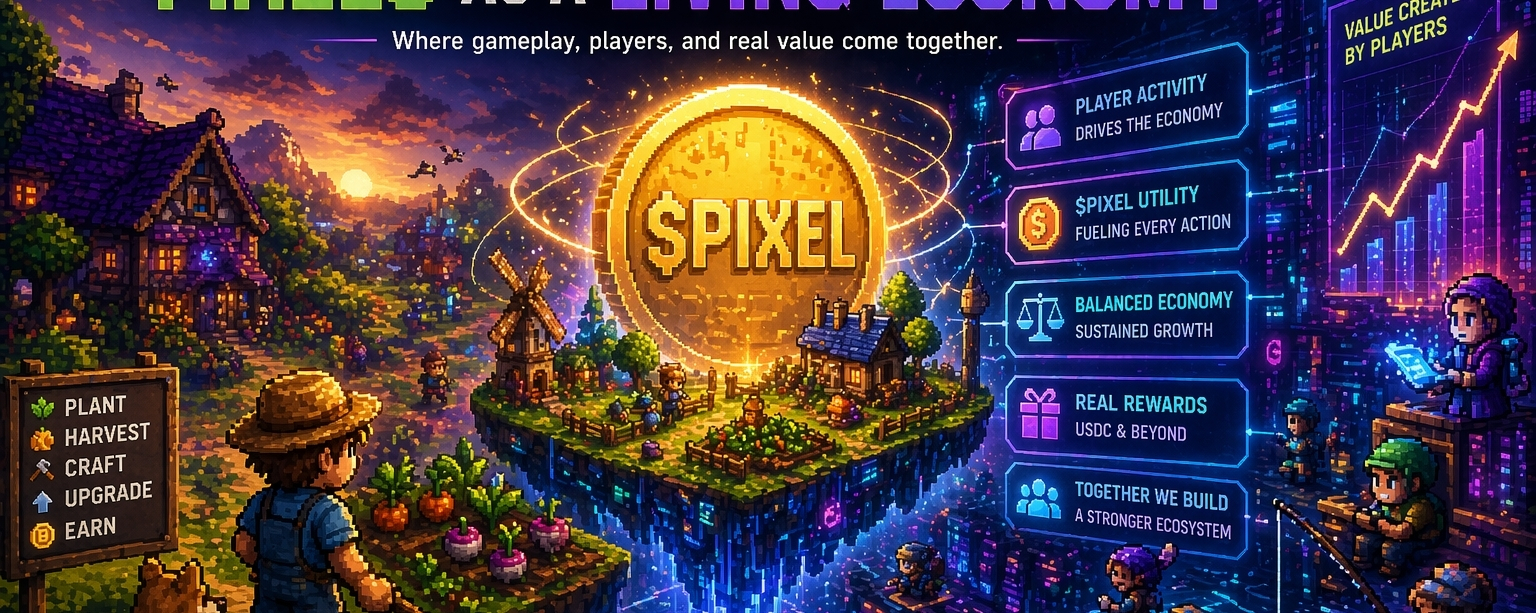
Craft, earn, upgrade, repeat. But now it actually sustains itself.
Then Chapter 3 pushes things further. With Bountyfall, factions, and guild coordination, progression becomes collective. It’s no longer just about what you produce, but how you organize with others. Supply chains, shared rewards, and competition between groups start to shape the experience.
Add Exploration Realms and LiveOps events, and the world feels less static. The introduction of social features makes it less isolating too. It’s no longer just you and your farm. It’s you inside a network.
Even onboarding reflects that shift. A wallet-free entry phase lowers friction. Microtransactions through vPIXEL ease players into the economy gradually. It’s structured, but not overwhelming.
Still, the most interesting change isn’t obvious at first. It’s how time behaves. In most games, time is neutral. You put in an hour, you expect a fairly consistent return. In Pixels, that assumption starts to break. Some routines feel smoother. More consistent. Less random.
You begin to notice patterns. That’s where $PIXEL changes meaning. It stops being just a reward token and starts acting like a signal. The system isn’t only tracking what you do, it’s quietly responding to how you do it. Consistency, repetition, efficiency. Small behaviors that start to compound.
What looks like a farming loop starts to feel more like a sorting system. Players who settle into stable patterns seem to progress differently. Not faster in a dramatic sense, just smoother. Less friction, fewer disruptions. It doesn’t announce itself, but you feel it.
And that creates a subtle tension. Because once players sense what works, they begin to adjust. Exploration fades. Optimization takes over. Behavior starts to converge. The system becomes easier to stabilize, but also less flexible.
Pixels becomes a system between game and economy shaping behavior through structured rewards patterning and subtle adaptation over time it