Something clicked today. I was watching my nePhew set up his first aquarium. He spent an hour arranging the grAvel, placing the plants, choosing where the fish would swim. It was not a game anymore. It was a space he was building to feel real. That is exactly what crossed my mind when I saw Pixels announce pets and hint at industries coming next.
I have been in this space long enough to know what a roadmap announcement usually looks like. It is a list of features dressed up as a vision. Most projects announce things to move price, not to move product. So when Pixels started rolling out pets, I did not immediately reach for optimism... I reached for patience, because the more interesting question was not what they announced. It was what they were trying to build underneath it...
Here is what I keep thinking about... The moment a game adds pets, it stops being purely about mechanics and starts being about attachment.... My nePhew was not arranging that aquarium to win something. He was arranging it because it felt like his. That psychological shift is not a small thing in the context of a blockchain game. Most play-to-earn models collapsed because players were renters, not residents. They came for yield and left when the yield dried up... Pixels seems to understand that the only users worth building for are the ones who feel like they belong somewhere inside the product.
Pets do that work quietly. A player who has named a creature, raised it, and watched it interact with their farm is not the same player who logs in to complete a task list. The emotional surface area of the product expands, and that changes the retention math entirely.
But I want to be careful here, because emotional design without economic coherence is still a trap. We have seen charming games with beautiful worlds and broken token economies. The question I keep asking is whether the industries update will create genuine demand loops or whether it will add complexity on top of a foundation that is still fragile. Complexity without purpose tends to accelerate the problems it was supposed to solve.
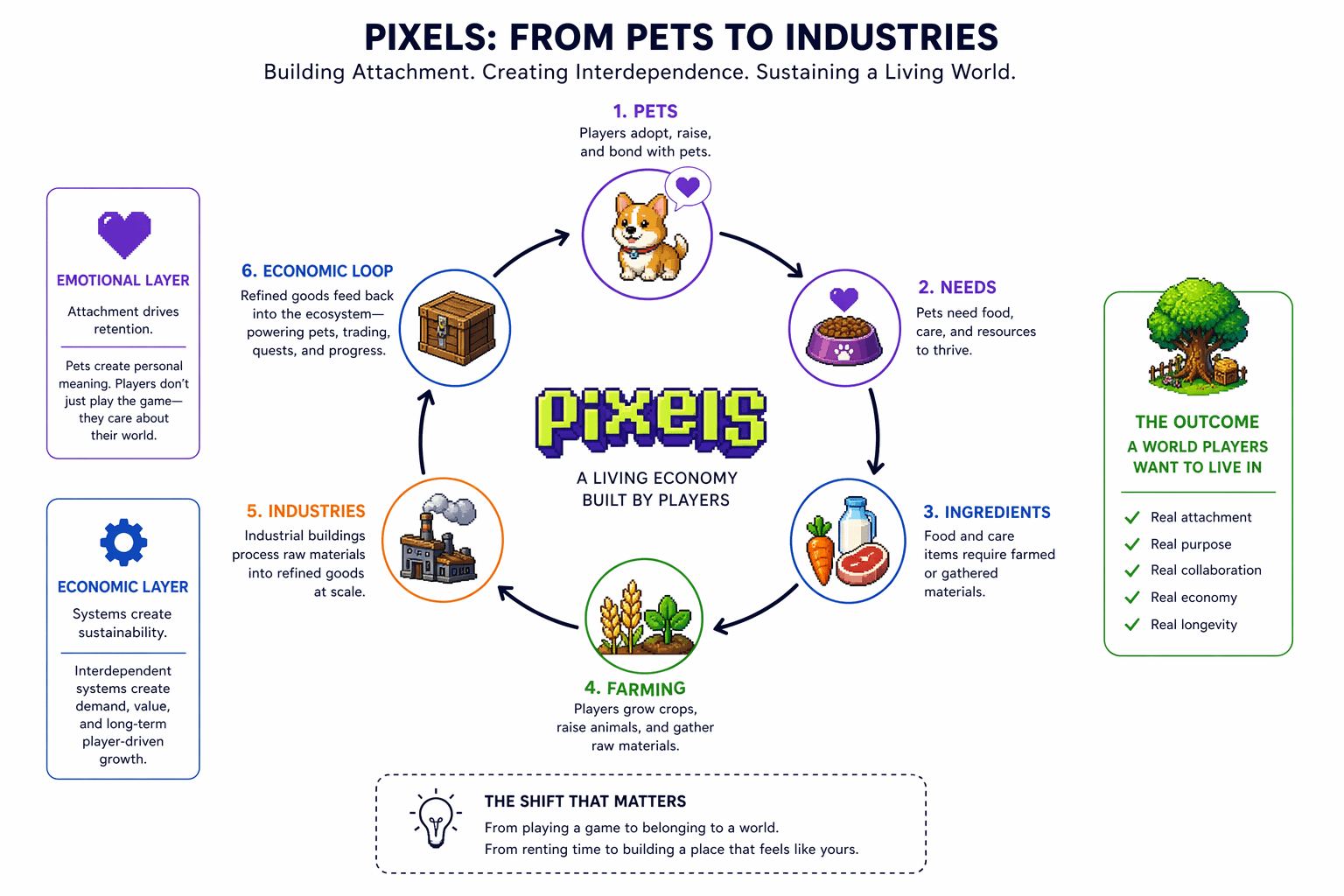
What gives me some real pAuse is the structural logic of layering industries on top of a pet system. If peTs require feeding, and feeding requires ingredients, and ingredients require farming, and farming becomes scalable through industrial infrastructure, then you are starting to describe an actual economy with actual interdependencies. That is a very different thing from a game with a token attached to it. The distinction matters enormously, not just for players but for anyone paying attention to where PIXEL fits inside that loop.
One small example. If a tannery becomes a functional industry inside Pixels, players who breed the right animals will have a supply chain reason to engage with it. That is not game design. That is economic design wearing game clothes. Done well, it means the player who raises animals is not competing with the player who processes materials. They are collaborating without knowing it. That kind of emergent interdependence is genuinely hard to build, and very few blockchain games have managed it.$PIXEL
I am still skeptical about the execution timeline. Announcing a roaDmap is the easy part. Delivering systems that feel coherent under real player behavior is where most projects fall apart. Pixels has already survived longer than most in this category, which earns them some credibility, but credibility is not the same as confidence.
What I find myself returning to is this. The games that outlast their own hype cycles are not the ones with the most features. They are the ones where players start making decisions that feel personally meaningful, even within a constructed world. The aquarium my nephew built will probably stay in his room for years because he made it his... If Pixels can manufacture that same fEeling at scAle, they are building something that has almost nothing to do with gaming and almost everything to do with how people form habits inside digital spaces.
That is the question worth staying curious about. Not whether the price recovers, but whether the world being built is one people actually want to live inside.@Pixels #pixel