
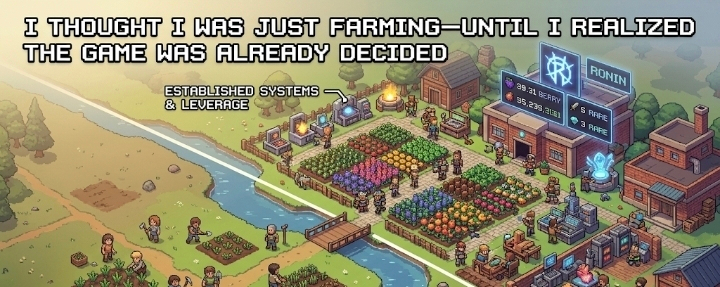

@Pixels I remember the first few hours feeling almost peaceful.
There was no pressure, no urgency—just a loop that made sense. Plant something, wait, harvest, maybe craft a tool, wander a bit. It felt like one of those worlds where everyone starts on equal ground, where progress is simply a matter of time and attention. Nothing about it suggested hierarchy. Nothing hinted at control.
But that feeling didn’t last.
Not because the game changed—but because my understanding did.
At some point, without any clear signal, the world stopped being about what I was doing and started being about where I stood inside it. The same actions—farming, crafting, exploring—began producing different outcomes depending on how early you had arrived, what you had already accumulated, and which loops you had quietly locked in before others even noticed they existed.
That’s when it clicked. This wasn’t just a game with mechanics. It was a system with memory.
The players who came early weren’t just ahead—they were embedded. They had already moved through the phase where everything was simple and unclaimed. They had touched resources when they were abundant, built tools when costs were low, and positioned themselves in places that didn’t look special at the time but slowly became central as everything else connected around them.
And the strange part is, none of it felt aggressive. There was no moment where someone “took over.” It just… settled. Like water finding its level.
You begin to notice small things first. Someone crafting faster than you. Someone always having what others are looking for. Certain areas feeling more active, more valuable, without the game ever explicitly saying so. Then you realize those aren’t coincidences—they’re outcomes. The result of earlier decisions compounding over time.
In Pixels, resources aren’t just things you collect. They’re quiet forms of leverage. Having more doesn’t just mean you can do more—it means you can decide when to act, when to wait, when to convert effort into something bigger. Tools aren’t just upgrades. They’re accelerators that change how quickly your entire loop evolves. And once someone’s loop evolves far enough, they’re no longer reacting to the system—they’re shaping how it feels for everyone else.
By the time I started seeing this clearly, it was already too late to experience the world the way early players did.
That version of the game was gone.
Not locked away, not restricted—just… passed.
You can still progress, of course. You can still build, still learn, still find your own rhythm. But everything is subtly repriced. What once required curiosity now requires strategy. What once needed time now demands precision. Catching up isn’t impossible, but it’s never neutral. Every step forward feels like it’s measured against a system that has already stretched ahead.
And yet, the surface never loses its charm.
Pixels still feels open. It still invites you in without friction. The farming is simple, the exploration is smooth, and the act of creating something from nothing still carries that quiet satisfaction. It’s built in a way that doesn’t overwhelm you with complexity upfront. You don’t need to understand any of this to enjoy it.
Maybe that’s the most important part.
Because while it feels like a game first—and it is, genuinely—there’s another layer unfolding underneath, one that only becomes visible after you’ve spent enough time inside it. A layer where progression isn’t just about effort, but about position. Where systems don’t just function independently, but start reinforcing each other, creating pathways that are easier for some and steeper for others.
And over time, certain players stop feeling like participants.
They feel like part of the environment itself.
Their presence influences availability. Their decisions ripple outward. The way they’ve built their position quietly shapes how others move, what others can access, and how the entire flow of the game evolves. New players don’t enter an empty world—they enter a landscape that has already been touched, structured, and subtly defined.
The Ronin-powered foundation makes all of this feel seamless. Everything moves quickly, interactions feel light, and the world keeps expanding without friction. New features come in, new systems layer on top, and instead of resetting anything, they deepen what’s already there. Ownership—whether through assets, resources, or tokens—adds weight to every action, making progress feel persistent rather than temporary.
And that’s where the realization settles in fully.
Pixels isn’t just about what you do today. It’s about when you started, what you understood early, and how those early decisions continue to echo forward. It’s about how a system evolves quietly while most people are still learning how to see it.
I went in thinking I had time to figure things out.
But the truth is, by the time you start asking the right questions, the answers are already being lived by someone else.
And the system—without ever announcing it—has already moved on.
