
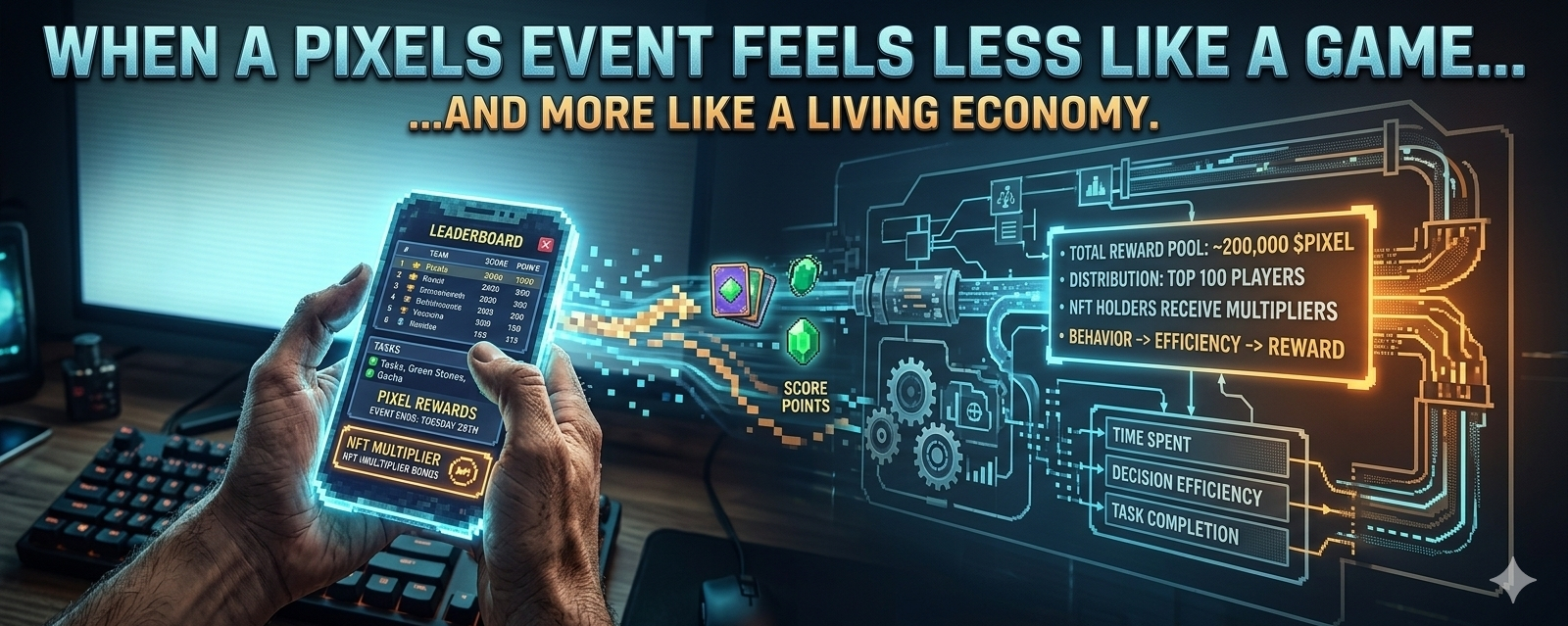
@Pixels I had been waiting for this Pixels event since yesterday, so when the update finally dropped and the event officially started today, I felt genuinely excited. On the surface, it looks simple enough. You do tasks, collect items, push your way up the leaderboard, and if you perform well enough, you earn $PIXEL rewards. That is the obvious layer, and honestly, that alone is enough to pull people in. But the more I sit with events like this, the harder it becomes to see them as just another in-game activity. Every time Pixels launches something like this, I end up thinking about it in a slightly different way. It stops feeling like a normal game loop and starts looking more like a small economic system in motion. What seems casual at first begins to reveal structure underneath it, and once you notice that structure, it becomes difficult to ignore.
What makes this event interesting to me is that the value is not only in the rewards themselves, but in the way the whole system translates player behavior into measurable progress. Green Stones, gacha cards, leaderboard points, task completion, all of these things may look like ordinary game mechanics, but they are doing something deeper. They are turning time, effort, and decision-making into visible outcomes. In a way, these items are not just items at all. They are proof of activity. They represent how much a player is showing up, how efficiently they are moving, and how seriously they are treating the event. That is why the leaderboard matters more than it first appears. It is not simply ranking luck or participation. It is ranking converted effort. The more you play, the better you optimize, the more your activity gets compressed into score. And once score becomes the language of the event, the whole experience starts to feel less like playing casually and more like competing inside a system that constantly measures you.
The timing of the event adds another layer to that feeling. It starts today and runs until Tuesday the 28th, and that limited window changes everything. A short event period creates its own kind of pressure. You know that if you delay too much, other players will move ahead. You know that starting late means chasing momentum instead of building it. And if you begin from day one, it instantly feels like you have entered a race that does not really pause. That is where the event becomes psychologically interesting. It moves players away from relaxed participation and toward competitive optimization. You are no longer just logging in to enjoy the game. You are thinking about timing, efficiency, routes, and how to stay ahead before the gap becomes too wide. That pressure is subtle, but it is powerful. It changes the way the game is experienced. What could have been a simple event turns into something much more intense because the system quietly teaches players that every hour matters.
Then there is the reward structure, which may not look massive in pure dollar terms, but conceptually it is much more important than the number itself. Around 200,000 PIXEL tokens are being distributed, and that reward pool is controlled, limited, and selective. Not everyone benefits equally. In fact, most players will not benefit in a meaningful way at all. Only the top 100 receive rewards, and even within that group, there is a major difference between simply making the list and reaching the top. The top 10 stand in a completely different zone. That creates a clear hierarchy of outcomes where better performance directly means a bigger share of the reward pool. This is where the event stops feeling random and starts feeling intentionally economic. A limited pool, a ranked competition, unequal distribution, and a time-bound opportunity all combine into a structure that resembles an economy much more than a casual seasonal activity. It may still wear the skin of a game, but underneath it, the logic is much harder and more competitive.
The NFT multiplier adds another dimension that makes the whole design even more revealing. Players who hold Pixels NFTs receive bonus multipliers, which means that two people can complete the same action but receive different results because one of them owns an asset inside the ecosystem. At first, that can feel unfair if you look at it only from the angle of equal competition. But from the ecosystem’s point of view, it is not random favoritism. It is a loyalty layer. It is the system rewarding deeper commitment, not just active participation. Ownership becomes part of performance. Suddenly, time alone is not the only thing being measured. Existing alignment with the ecosystem also matters. That creates a more complex environment where progression is influenced not just by what you do during the event, but by what position you already hold within the broader Pixels world. Whether someone likes that or not, it is a very deliberate design choice, and it shows that the event is not just about giving away tokens. It is about reinforcing the internal structure of the ecosystem itself.
But to me, the most fascinating part is not the reward pool or the NFT bonus. It is the way the event slowly shapes player behavior. From the outside, it looks like a leaderboard race. Inside, it feels much more like a behavior loop. The system is watching how much time players commit, how efficiently they move through tasks, which strategies they choose, and how consistently they can maintain momentum across the event period. That is what changes the whole meaning of the experience for me. When a game begins to notice not just what you are doing, but how efficiently you are doing it, something important shifts. It is no longer only responding to play style. It is responding to efficiency patterns. And once that happens, the game starts acting more like a system that tracks, ranks, and rewards behavior with surprising precision. That is the point where it begins to feel less like entertainment in the traditional sense and more like an organized environment where time, effort, and optimization are continuously turned into economic signals.
Even with all of that, I cannot deny that these events are genuinely engaging. That is probably why they work so well. You are not just passively collecting rewards. You are participating in something structured, competing with others, testing your own decisions, and trying to predict where your effort might place you by the end. There is tension in that. There is uncertainty in that. And strangely, that is what makes it feel alive. Some players will make it into the top 10. Some will do reasonably well and stay somewhere in the middle. Some will grind hard and still walk away with nothing. That is the reality of systems like this. But the interesting part is that everyone is moving through the same framework with different strategies, different levels of preparation, and different ideas about what is worth optimizing. That creates a kind of controlled chaos that keeps the event from feeling flat. The gameplay itself may not be dramatically changing, but the cycle of play is clearly becoming stronger, tighter, and more behavior-driven.
That is why today does not feel like just another event launch to me. It feels like a small economy resetting itself and beginning a fresh run. The token rewards matter, the leaderboard matters, the NFT bonuses matter, but the deeper story is about how all of these pieces work together to reshape the way players behave inside the game. What looks simple from the outside is actually a layered competition built around time, strategy, commitment, and measurable efficiency. That is what makes it exciting to watch. Not because I know who will win or lose, but because it is becoming easier to see how Pixels is redefining itself through these systems. On the surface, yes, it is still a play-and-earn event. But under that surface, it feels like a compact economic battle where players are constantly trading time and effort for position, probability, and reward. It is a little messy, a little noisy, and definitely not perfect, but that is also why it feels real. And honestly, that is exactly why I was waiting for this event since yesterday.