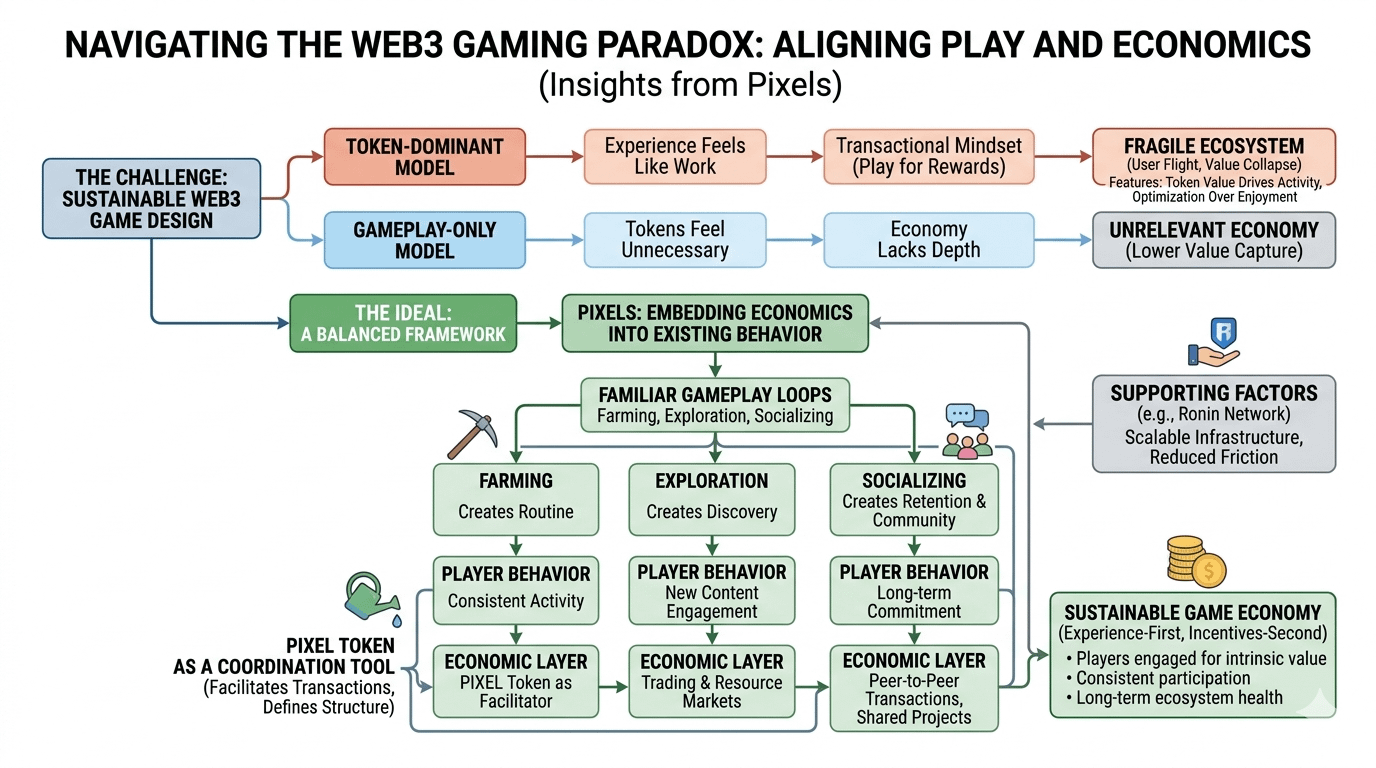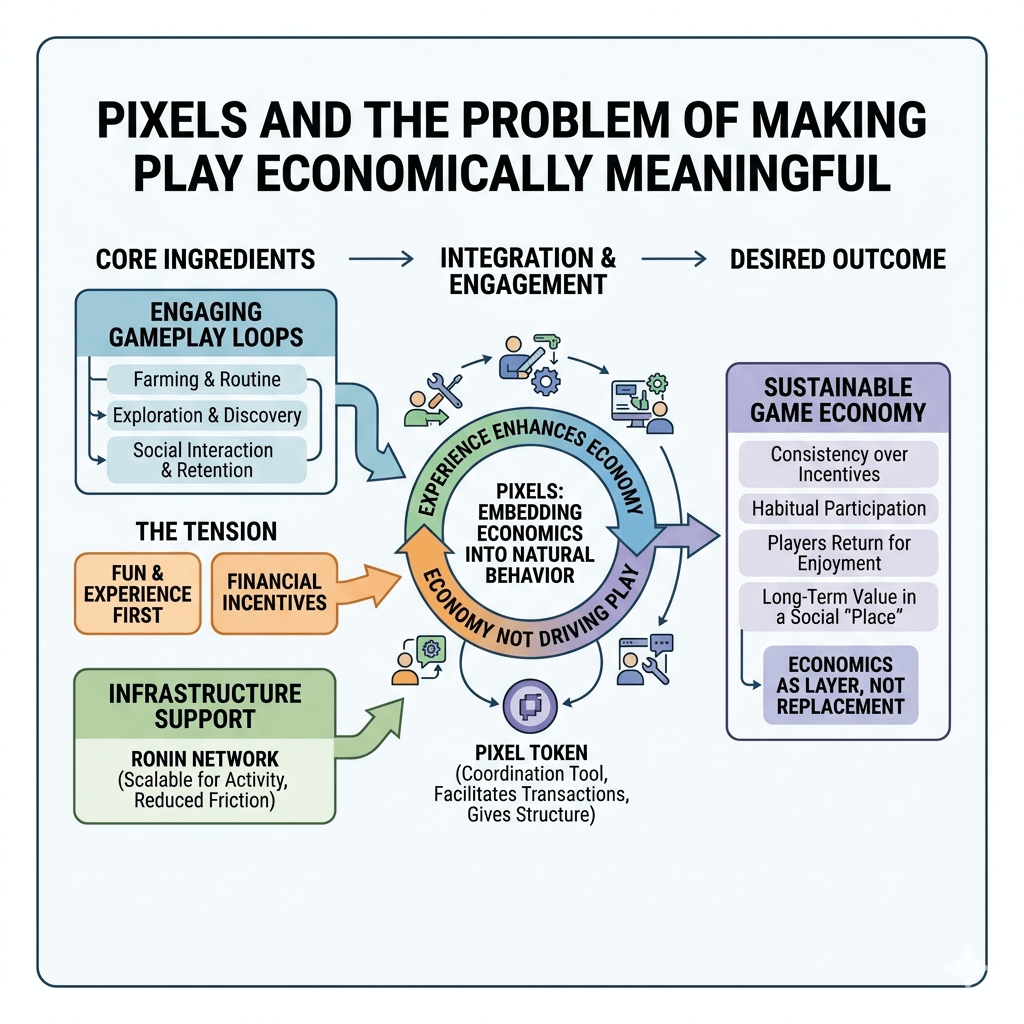

There’s a version of the PIXEL story that looks impressive on the surface — explosive growth, millions in revenue, charts going up. And then there’s the version underneath it, where the system almost breaks under its own incentives.
2024 was both.
Pixels scaled fast. Too fast, maybe. It became one of the most active web3 games in terms of daily users and pulled in roughly $20 million in revenue. But the thing is, growth exposed something most projects don’t want to confront early: the economy wasn’t built to survive its own success.
The Cracks Showed Quickly
Token inflation wasn’t subtle. Emissions were high, rewards were loose, and value started leaking out faster than it was being recycled.
Players weren’t really “playing” in the long-term sense. A large portion were extracting.
That created a familiar loop: earn → dump → leave → repeat.
And because rewards weren’t targeted well, even low-value activity was getting paid. Engagement existed, but it wasn’t the kind that compounds.
So the system did what these systems always do under pressure — it started weakening from the inside.
The Pivot: Less Noise, More Signal
Pixels didn’t just tweak numbers. It shifted direction.
Now the focus is narrower, sharper, and honestly more selective.
Data-backed incentives are at the center of this shift. Instead of rewarding raw activity, the system now tries to identify who actually contributes to long-term value — the players who spend, reinvest, or stick around. Those are the ones getting prioritized.
Not perfect. But at least it acknowledges that not all users are equal.
Then comes friction — intentionally added.
Liquidity fees on $PIXEL withdrawals make it harder to extract value without consequence. That friction isn’t there to punish users. It’s there to slow down the bleed and redirect value back into the system, especially toward stakers.
Because without friction, everything just exits.
Turning Players Into Allocators
The more interesting shift is structural.
Pixels is moving toward a stake-to-vote-and-earn model. Instead of a single game dictating value flows, players allocate capital into game pools. Where they stake influences which games receive emissions and incentives.
So now players aren’t just participants. They’re allocators.
Games compete for attention, capital, and retention. And if they don’t perform, they don’t get funded.
It’s closer to a market than a reward system.
The Bigger Play: Beyond One Game
This is where the ambition stretches.
Pixels isn’t positioning itself as just a game anymore. It’s trying to become something closer to a decentralized version of mobile growth platforms like AppsFlyer or AppLovin — but built on-chain.
The core idea revolves around a metric they call RORS (Return on Reward Spend).
Which is basically asking: If we distribute tokens, do we actually get value back?
That question sounds obvious. It usually isn’t.
Most ecosystems inflate themselves chasing users. Pixels is trying — at least in theory — to measure whether those users are worth the cost.
What Changes on the Ground
This shift isn’t abstract. It changes how the ecosystem behaves.
There’s now a stronger emphasis on quality over quantity when it comes to DAU. Fewer users is acceptable — as long as they’re actually engaged.
A new token, $vPIXEL, acts as a spend-only layer across games. No friction on usage, but no direct extraction either. It keeps activity flowing without immediately translating into sell pressure.
Growth incentives like referrals and content creation are still there, but they’re being tuned to attract the “right” users — not just more users.
Inside the core game, things tighten up even more:
Key features and earnings are increasingly gated behind VIP-style systems
Social and casual mechanics — the stuff that originally drove retention — are being reintroduced
In-game balances for active users can be automatically staked, especially when paired with Farm Land NFTs
It’s all pointing in the same direction: deeper engagement, not wider reach.
The Trade-Off Nobody Likes to Admit
This kind of shift comes with a cost.
Metrics might drop. DAU could shrink. Growth might look slower from the outside.
But that’s kind of the point.
Pixels is choosing to compress its user base into something more durable rather than keeping it artificially inflated. Whether that works depends on execution — and whether players actually accept the new rules.
Because adding friction and selectivity always feels worse before it feels better.
Where This Leaves PIXEL
Right now, PIXEL is in a transition phase.
It’s moving from being a reward-heavy, extraction-friendly token toward something more controlled, more utility-driven, and more tied to measurable outcomes.
That’s harder to design. And harder to sell.
But if it works, it doesn’t just fix a game economy — it builds a framework other games might plug into.
And if it doesn’t…
Well, then it becomes another example of how difficult it is to align incentives in web3, especially when growth comes before sustainability.
Either way, this isn’t a minor adjustment.
It’s a reset.