
I keep noticing something in Pixels that's easy to miss at first.
Nothing dramatic no signal, just a slow shift.
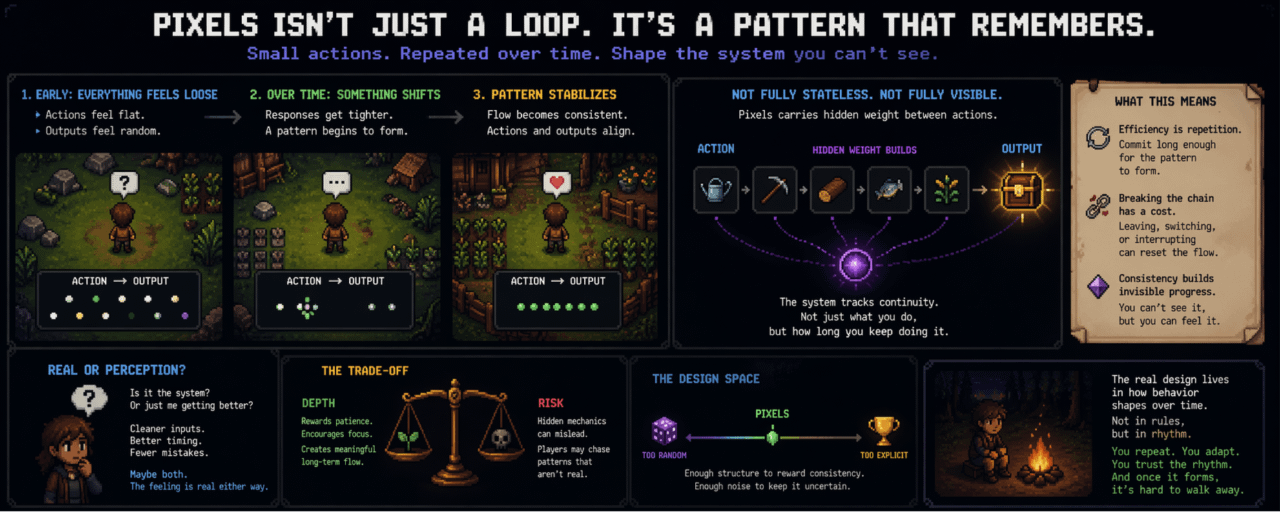
It feels like the game starts to shape itself around actions I do over and over.
At the start everything feels loose.
I move around try zones and test actions.
The system responds,. It feels flat like each action stands alone.
Then after some time in one place doing things something changes.
The response gets tighter.
It's not faster in a way and not higher rewards in a way I can measure.
The flow becomes more consistent.
Actions. Outputs feel less random.
It's like the system is building a pattern from what I keep doing in Pixels.
This is where it gets interesting.
Most game systems are event-driven.
You do an action get a result and the system resets and waits again.
Pixels does not fully behave like that.
It feels stateful like it carries memory between actions.
Not an explicit memory that I can track. More like hidden weight.
Each small action adds a bit of direction to how the system responds
If thats true then it changes how I should approach the game.
Efficiency is not about doing the best action once.
It becomes about repeating a type of action enough times for the system to stabilize around it.
That creates a kind of optimization.
Less about switching more about committing long enough for the pattern to form in Pixels.
Here's the part I'm not fully convinced about.
I can't see the system. I have to question whether this is real system behavior or just perception.
Humans are good at finding patterns when none exist.
If I stay in one zone longer I naturally get better at timing.
My inputs become cleaner. My mistakes reduce.
That alone can create the feeling of output.
So part of this might be skill adaptation, not system design.
Still the consistency feels too stable to ignore.
There are moments where I repeat a loop and the outcome feels locked in.
Like the system is no longer rolling fresh each time; its continuing something that already started in Pixels.
If Pixels is designed this way then it sits somewhere between a stateless loop and a persistent system.
That's not common.
In similar systems persistence is tied to visible metrics like levels, streaks or bonuses.
You know when you're building something.
Here it's hidden or at least not clearly exposed.
That creates both depth and risk.
Depth because it rewards attention.
I start noticing shifts adapt my behavior and treat the system with more patience.
Risk because lack of clarity can lead to strategies.
Players might believe in patterns that don't actually exist leading to wasted time.
There is also a design question
If small actions build patterns then breaking the sequence should have a cost.
It does feel like that sometimes.
Leaving a zone switching activity or interrupting a loop often feels like something resets.
Not everything,. Enough to lose that smooth state.
That suggests the system might be tracking continuity.
Not what I do, but how long I keep doing it without interruption.
If thats intentional then it pushes players toward stability.
Stay in one place do one thing well. Let the system settle.
That's very different from systems that reward exploration.
It also slows down the game in a way.
I'm not rushing to find the best spot; I'm trying to deepen the current one.
There's a trade-off.
If patterns build slowly new players may never feel it.
They might leave before the system reveals its depth.
If patterns break easily then it discourages experimentation.
Now it feels like Pixels is balancing in the middle.
Not clear not fully random.
Enough structure to reward consistency.
Enough noise to keep it uncertain.
What stands out is that the system does not shout its mechanics.
It lets me sit in it.
I repeat actions start to feel a rhythm and then begin to trust that rhythm even if I can't prove it.
That's where the real design lives.
Not in rules but in how behavior shapes over time in Pixels.
I'm still not sure how deep this goes.
It could be lightweight under the hood or an emergent feeling from simple loops.
The effect is there.
Small actions don't feel isolated.
They feel like they're stacking into something.
Once that something forms it's hard to walk away, from it without feeling like I lost a piece of progress I never fully saw in Pixels.