In crypto, “whales” are wallets or entities that hold massive amounts of a token — enough to shift price with a single move. For PIXEL, the native token of the Ronin Network gaming ecosystem Pixels, these whales are some of the most watched players in GameFi. Their on-chain footprints tell a story of conviction, speculation, and sometimes manipulation.
*1. Who Are the PIXEL Whales?*
Pixel whales aren’t just VCs or treasury wallets. They include early Pixels guild leaders, NFT land owners who farmed heavily at launch, major exchanges, and smart-money wallets that rotate between GameFi tokens. You can spot them on-chain through Ronin block explorers: wallets holding 1M+ $PIXEL show up as top holders, and their transfers often exceed 100K tokens at once.
Because pixel has utility — staking for VIP, in-game spending, guild wars, and marketplace fees — whales aren’t purely speculative. Many are ecosystem participants with real reasons to accumulate. That’s different from meme coins where whales just hold and wait.
*2. Why Whale Watching Matters for PIXEL*
The 48h liquidation heatmap you shared earlier shows exactly why whales matter. Big clusters of liquidity form where whales have placed leveraged positions. When a whale market-sells 500K PIXEL, it can slice through thin order books and trigger cascades of liquidations. Conversely, when whales buy OTC and move tokens off exchanges, supply dries up and shorts get squeezed.
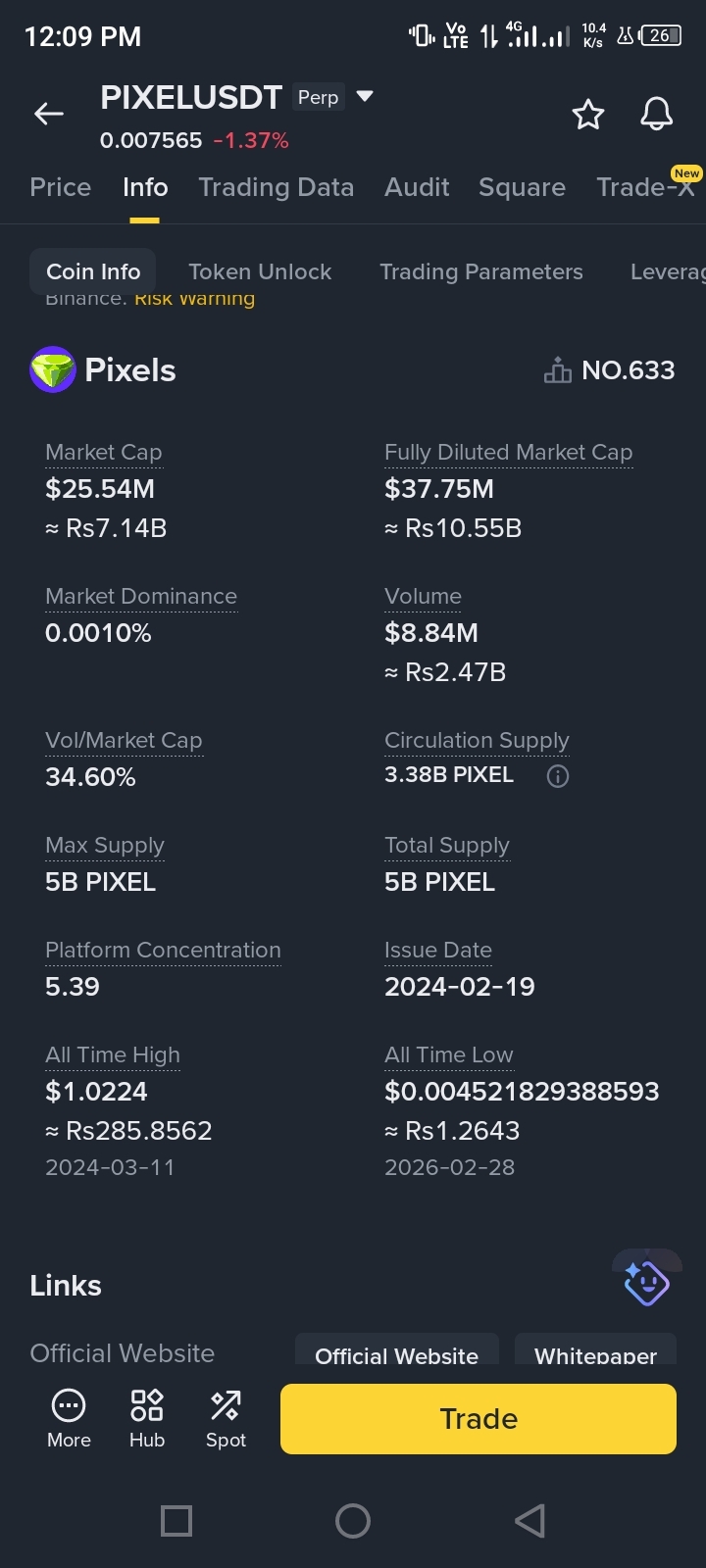
Recent on-chain movements in August 2026 showed several wallets withdrawing 2M+ pixel from Binance after the price dipped to 0.0072. Within 24 hours, price wicked to 0.0084 as short liquidations hit. That’s whale impact in real time: accumulation → liquidity vacuum → short squeeze.
*3. Common Whale Patterns in @Pixels
- *Accumulation Zones*: Whales often ladder buy during low-volume periods. Watch for multiple 50K–200K inflows to fresh wallets over days.
- *Distribution at Hype*: Major game updates or CEX listings bring retail FOMO. Whales use that liquidity to exit. Look for large exchange deposits right after announcements.
- *Staking Signals*: Since pixel VIP requires staking, a spike in staked supply often means whales are locking up for long-term yield instead of selling.
- *Guild Treasury Moves*: Top guilds coordinate pixel for in-game events. When a guild wallet moves 1M+ pixel to a hot wallet, expect big in-game spending that can drive token sinks.
*4. How to Track Them Without Noise*
Raw holder lists lie — exchanges hold user funds in omnibus wallets. Better signals:
1. *Net exchange flows*: Track inflows/outflows to Binance, OKX, Ronin Bridge. Whales withdrawing = bullish.
2. *Top 100 non-contract holder changes*: Use Chainbase or RoninScan to see which private wallets are adding.
3. *Liquidation clusters*: Heatmaps reveal where whale leverage is stacked. Price hunts liquidity.
4. *Smart money tags*: Nansen/Arkham labels help separate market maker wallets from real holders.
*The Wake of Silent Giants*
Whales don’t tweet their moves. They leave on-chain wakes — big transfers, staking spikes, liquidity grabs. For $PIXEL, where game mechanics tie directly to token flow, those wakes often precede the next wave of price action.
Watching whales won’t give you a crystal ball, but it shows where the weight is shifting. And in a GameFi token like $PIXEL, weight moves markets. #pixel #PIXEL! #PIXEL/USDT $PIXEL @Pixels