
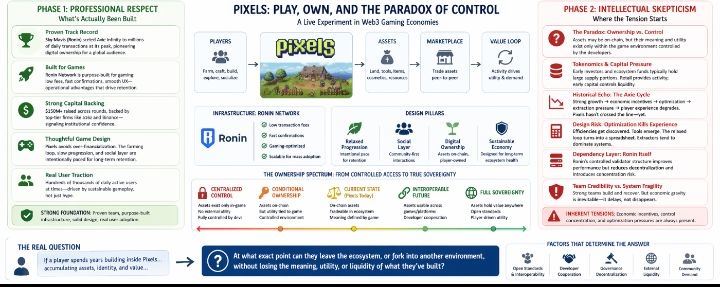

Sky Mavis, the team behind the Ronin Network, has already proven they can scale a gaming ecosystem before. Their earlier success with Axie Infinity wasn’t just a niche win. At its peak, it processed millions of daily transactions and introduced a new model of digital ownership to a global audience.
Pixels sits on that same infrastructure.
That matters.
Because Ronin isn’t just another chain. It was purpose-built for games. Low transaction fees. Fast confirmations. A smoother user experience compared to most blockchain platforms. These are not theoretical advantages. They are operational decisions that directly affect retention and usability.
From a capital perspective, Sky Mavis has raised over $150 million across multiple rounds, backed by firms like Andreessen Horowitz (a16z) and Binance. That level of backing doesn’t guarantee success, but it does signal institutional confidence in the infrastructure layer supporting Pixels.
Then there’s the design itself.
Pixels avoids the usual Web3 trap of over-financialization at the surface level. You don’t log in and immediately feel like you’re inside a trading terminal. The farming loop, the slow progression, the social layer, it all feels intentionally paced. That’s not accidental. It’s a design choice aimed at retention rather than speculation.
And so far, it’s working.
Daily active users have crossed hundreds of thousands at times, making it one of the more consistently active Web3 games in recent cycles. Not because of hype spikes, but because the experience doesn’t break easily.
Phase 2: Intellectual Skepticism — Where the Tension Starts
Now the harder part.
Because what Pixels promises and what it operates within are not perfectly aligned.
The Paradox: Ownership vs. Control
The core narrative is simple: players own their assets.
But ownership in a Web3 game is rarely absolute.
Yes, assets may exist on-chain. Yes, they can be traded. But their utility is still tied to the game environment controlled by the developers. If Pixels disappears, the assets don’t vanish… but their meaning does.
That’s not full sovereignty. That’s conditional ownership.
So the question becomes: are players owning assets, or are they owning access to a system that still has a central point of failure?
Tokenomics and Capital Pressure
While PIXEL as a token is designed to support in-game activity, the broader economic structure introduces familiar risks.
Early investors, private allocations, and ecosystem funds typically hold a significant portion of supply in most Web3 projects. Even without exact public breakdowns at all times, this creates an inherent imbalance:
Retail players provide activity
Early capital often controls liquidity
That imbalance doesn’t always show immediately. It builds over time.
And when it does, the game starts shifting from a “place to play” into a “system to optimize.”
You’ve seen this before.
Historical Echo: The Axie Cycle
There’s a reason Axie Infinity is relevant here.
It followed a similar path:
Strong early adoption
Real economic incentives
Rapid growth
Then pressure from extraction
Once players realized the most efficient way to play was to maximize earnings, the game loop changed. It stopped being about playing and started being about optimizing.
Pixels hasn’t fully crossed that line yet.
But the conditions that create that shift already exist.
The Design Risk: When Optimization Kills Experience
Here’s the subtle danger.
Pixels works right now because it feels slow. Calm. Almost intentionally inefficient.
But economies don’t like inefficiency.
Over time, players discover optimal paths. Tools emerge. Strategies get shared. And slowly, the relaxed farming loop turns into a spreadsheet.
At that point, two types of users emerge:
Players who want to enjoy the game
Players who want to extract value
And historically, the second group tends to dominate the system.
Dependency Layer: Ronin Itself
There’s also a deeper structural dependency.
Pixels relies heavily on the Ronin Network.
That creates efficiency, yes. But it also introduces concentration risk.
Ronin is not a fully decentralized, permissionless network in the same way as older blockchains. It operates with a more controlled validator structure. That improves performance, but reduces independence.
So again, the same paradox appears:
Faster, smoother gameplay
But tighter control at the infrastructure level
Team Credibility vs. System Fragility
To be clear, this is not a criticism of capability.
The team behind Pixels and Ronin has demonstrated they can build, scale, and recover from setbacks. Their engineering track record is not in question.
But strong teams don’t eliminate economic gravity.
They just delay its impact.
The Real Question Moving Forward
Pixels is not just a game.
It’s a live experiment in blending:
Player experience
Digital ownership
And economic systems
Right now, it’s balanced. Carefully.
But balance in these systems is temporary unless constantly managed.
The Question That Actually Matters
If a player spends years building inside Pixels… accumulating assets, identity, and value…
At what exact point can they leave the ecosystem, or fork into another environment, without losing the meaning, utility, or liquidity of what they’ve built?
