
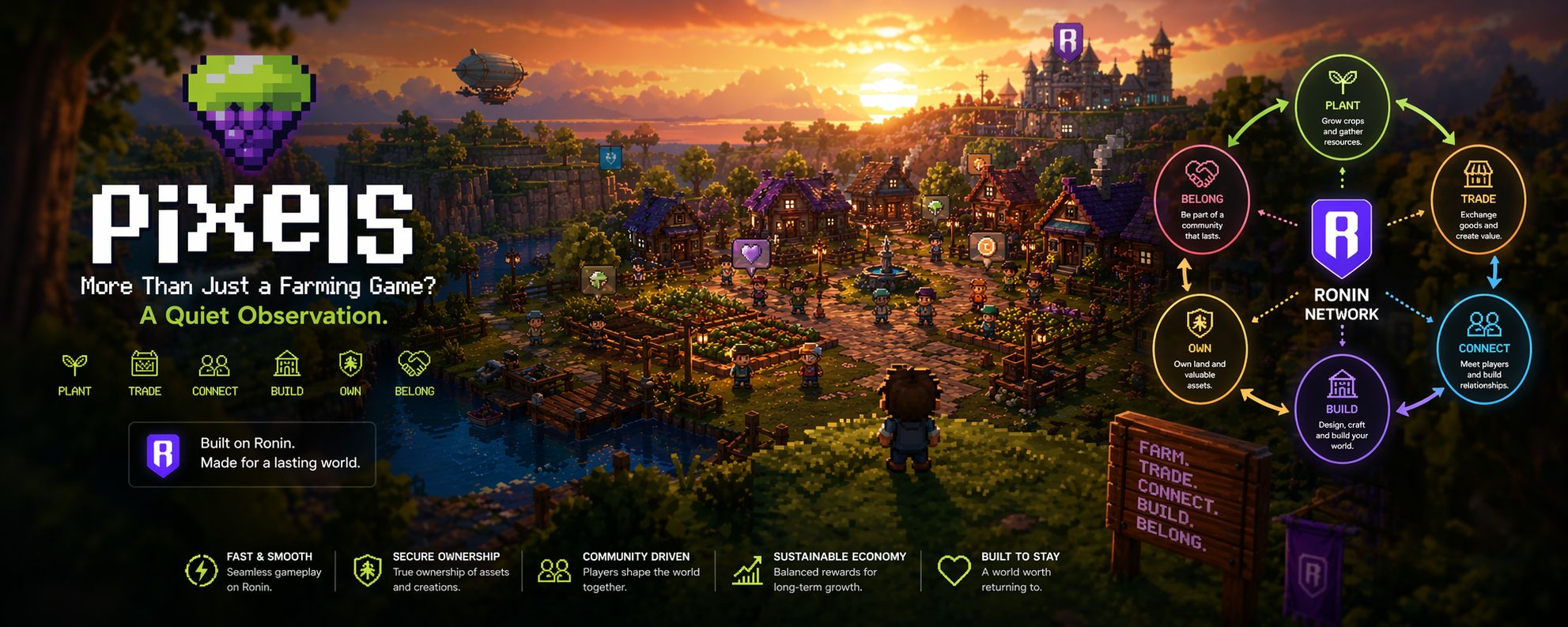

I spent a few quiet hours with Pixels. Not rushing through it. Not trying to earn anything. Just watching.
At first, it feels simple. You plant seeds. You walk around. You meet people. That’s it.
But after some time, something changes.
You start to notice small patterns. Who grows what. Who trades more. Who just stays in one place and builds. And I remember thinking—this doesn’t feel like a game people are trying to win. It feels like a place people are trying to stay in.
And that difference matters.
Most blockchain games had one big problem. They focused too much on rewards. People came in, collected what they could, and left. The system looked busy—but it was empty underneath.
Pixels tries to fix that. Not loudly. Not dramatically. Just… quietly.
Instead of asking, “How do we reward players?”
It asks, “What makes players stay?”
That shift changes everything.
When Pixels moved to the Ronin Network, it wasn’t just a technical update. At least, that’s not how it felt to me.
The game became smoother, yes. Faster too. But more than that—it started to feel stable. Like something you could return to without friction. And in systems like this, comfort is not a small thing. It builds trust.
You stop thinking about the system. You just use it.
One thing I noticed—and honestly, this surprised me—was how the game separates small actions from important ones.
Daily things like farming or crafting feel light. Easy. You don’t overthink them. But ownership—like land or valuable items—feels heavier. More permanent.
And that makes sense, right?
In real life, not every decision carries the same weight. Buying tea is not the same as buying land. Pixels follows that same logic. Simple actions stay simple. Important ones stay meaningful.
It sounds obvious. But many systems get this wrong.
There’s also something quietly social happening here.
At first, you think you’re playing alone. Then you notice—you’re not.
Some players focus on farming. Others trade. Some just build spaces where people gather. No one tells them to do this. It just… happens.
And I kept thinking—this is how real economies form. Not by force, but by behavior.
Recent updates haven’t tried to shock the system. No sudden changes. No big noise.
Instead, Pixels keeps improving what already exists. Better interaction. More shared activities. Stronger community layers.
It feels slow. But in a good way.
Like something being built carefully, not rushed.
Still, let’s be honest.
This kind of system is hard to balance.
If rewards are too high, people come only for profit.
If rewards are too low, people lose interest.
So where is the right point?
I’m not sure. And I don’t think the project is fully sure either. It’s still adjusting. Still learning from how people behave.
And maybe that’s okay.
There’s also a bigger question that stayed with me:
Do people actually enjoy being here… or are they just waiting for value?
Because in the long run, that question decides everything.
And here’s the thing.
The more time I spent with Pixels, the harder it became to describe it in a simple way.
It’s not just a game. But it’s not just a financial system either.
Honestly… it sits somewhere in between.
Like a quiet digital village.
Where small actions—planting, trading, talking—don’t feel important at first. But over time, they add up. Slowly. Almost invisibly.
And before you realize it, your time has turned into something that feels like value.
Not because you chased it.
But because you stayed.
