
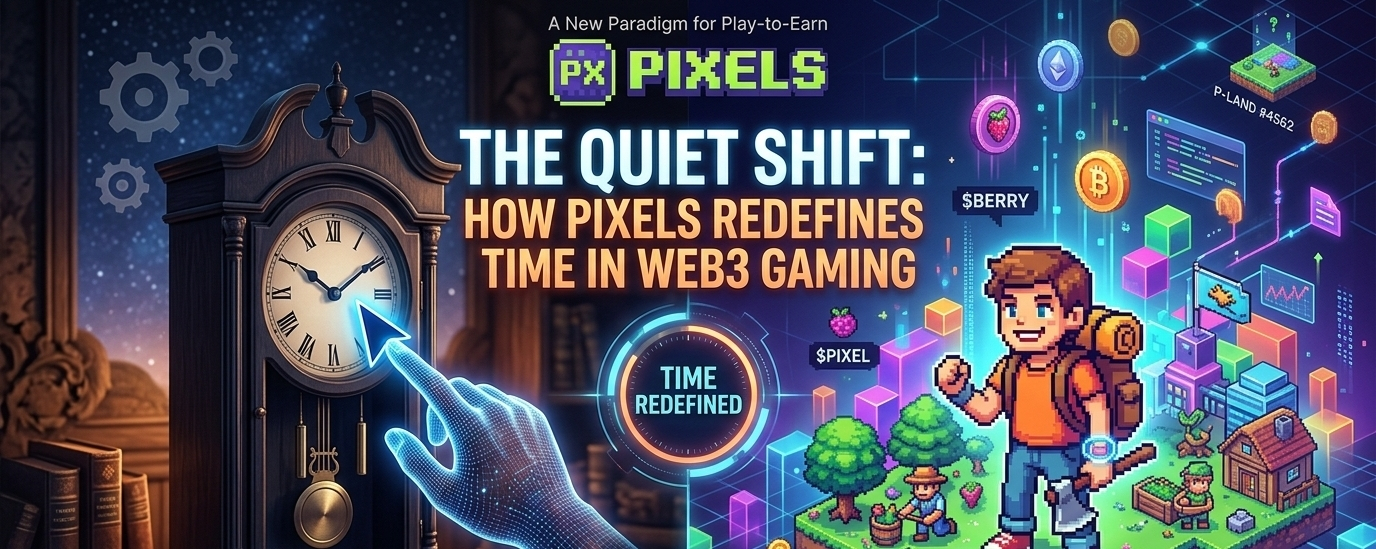
It’s hard to ignore how much of the current Web3 landscape feels like a loop of short term attention rather than long-term presence. People arrive quickly extract what they can and leave just as fast. The systems themselves often encourage this behavior reward spikes shallow interactions and little reason to stay once the novelty fades. After watching enough of these cycles the absence becomes obvious: there are very few environments where time spent actually compounds into something meaningful beyond tokens.
That’s the context in which Pixels begins to make sense not as a breakthrough but as a quiet correction. It doesn’t try to solve everything at once. Instead it leans into something deceptively simple: give people a place where showing up repeatedly matters even if nothing exciting happens in any single session. The farming loop the slow resource gathering the open-world wandering these are not accidental mechanics. They are constraints designed to filter out impatience.
Early users treated the system like every other Web3 game. They optimized immediately. They searched for yield paths, exploited inefficiencies and tried to compress time. What’s interesting is that the system didn’t fully reward that mindset. Efficiency existed but it plateaued quickly. The players who stayed weren’t necessarily the most aggressive optimizers they were the ones who adapted to the rhythm. Over time, behavior shifted from extraction to participation which is a subtle but important transition.
The decision to build on Ronin Network reflects a similar kind of discipline. It’s not about chasing the newest infrastructure; it’s about choosing an environment where transactions are cheap predictable, and largely invisible to the player. That invisibility matters. When users stop thinking about the underlying system they start focusing on the experience itself. And that’s where behavioral patterns become more honest.
One of the more revealing aspects of Pixels is how it handles progression. There’s no overwhelming pressure to rush. Progress accumulates in small increments, and those increments only feel valuable after enough time has passed. This creates a kind of delayed gratification that’s rare in Web3 systems. Players who leave early often miss the point entirely while those who stay begin to internalize the pacing. The system doesn’t force patience it quietly rewards it.
There’s also a noticeable difference between early adopters and later entrants. Early users were shaping the environment often tolerating rough edges and unclear mechanics. Their trust wasn’t given; it was built through observation watching how the system responded to stress how updates were handled and whether the core loop remained stable. Later users by contrast arrive into something that already feels coherent. They inherit a system that has been tested which changes their expectations. They’re less forgiving, but also less experimental.
This evolution creates an internal tension: how do you continue to iterate without disrupting the behaviors that made the system stable in the first place? Pixels seems to approach this by delaying features that would introduce volatility. Not everything that could be added is added. Some mechanics are intentionally kept simple even at the cost of depth because complexity can destabilize user behavior faster than it enhances it. This restraint is easy to overlook but difficult to maintain.
Risk management shows up in quieter ways too. The economy isn’t pushed to extremes. Resource generation sinks and rewards are balanced in a way that avoids dramatic swings. It doesn’t eliminate risk but it narrows the range of outcomes. That predictability allows users to plan not just in terms of gameplay but in terms of how they allocate their time.When a system becomes predictable it becomes something people can integrate into their routine.
The presence of the PIXEL token adds another layer, but its role is more about alignment than excitement. Tokens in Web3 often distort behavior by becoming the primary objective. In Pixels, the token exists, but it doesn’t dominate the experience unless the user chooses to focus on it. This separation is important. It allows different types of users to coexist those who care about the economy and those who simply enjoy the loop. Over time this reduces friction between speculative and non speculative participants.
Community trust in this context doesn’t come from announcements or incentives. It comes from watching how the system behaves under pressure. When updates don’t break core mechanics when rewards remain consistent when the game doesn’t suddenly pivot to chase trends these are the signals users pay attention to. Trust forms slowly almost reluctantly and once it forms it tends to be more durable.
Usage patterns reveal the real story. Retention isn’t driven by spikes; it’s driven by habit. Players log in not because they expect something new but because they expect something familiar. That familiarity when designed carefully becomes a kind of anchor. Integration quality also plays a role how smoothly different parts of the system connect how little friction there is between actions. These details don’t attract attention but they determine whether users stay.
What’s happening, quietly is a transition from experiment to infrastructure. Pixels is no longer just testing whether a Web3 farming game can work; it’s becoming a place where certain behaviors are normalized. Logging in daily tending to resources interacting with a persistent world these are no longer novel actions. They’re habits. And once habits form the system starts to resemble infrastructure more than a product.
There’s still uncertainty of course. Systems like this are fragile in ways that aren’t immediately visible. A few misaligned incentives an overcomplicated update or a shift in focus could disrupt the balance. The challenge isn’t building new features it’s maintaining coherence while the system grows. That requires a kind of discipline that doesn’t always align with the pace of the broader Web3 space.
If that discipline holds, Pixels could become something quietly significant. Not a headline grabbing success but a stable environment where time spent feels cumulative rather than extractive. In a space defined by volatility that kind of steadiness is rare. And over time rarity tends to matter more than noise.
