
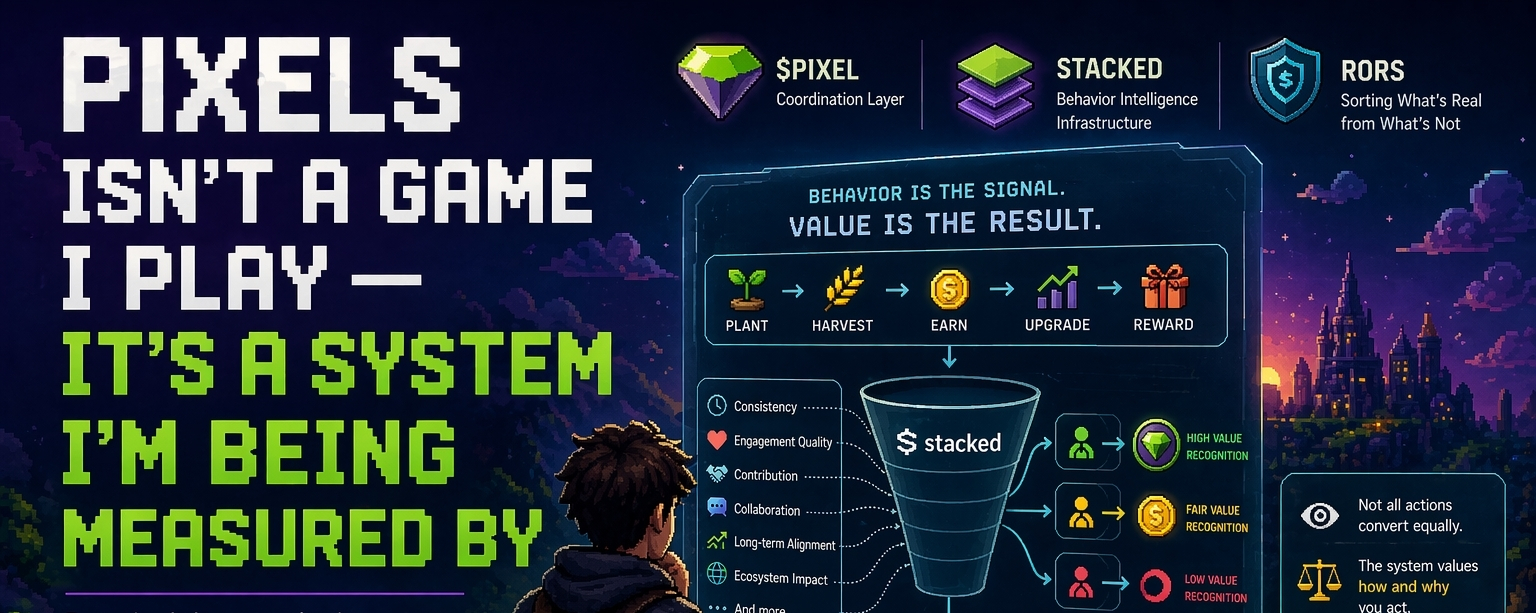
At first, I thought Pixels was just another loop waiting to be solved.
Plant, harvest, repeat. Earn, optimize, extract. I’ve seen this pattern too many times in GameFi systems that look alive at launch but quietly collapse once players figure them out. Not because they’re broken, but because they’re too predictable.
That’s where Pixels started for me. Familiar. Almost too clean.
But the longer I stayed, the less it behaved like a simple farming game and the more it felt like something underneath was watching, adjusting, learning.
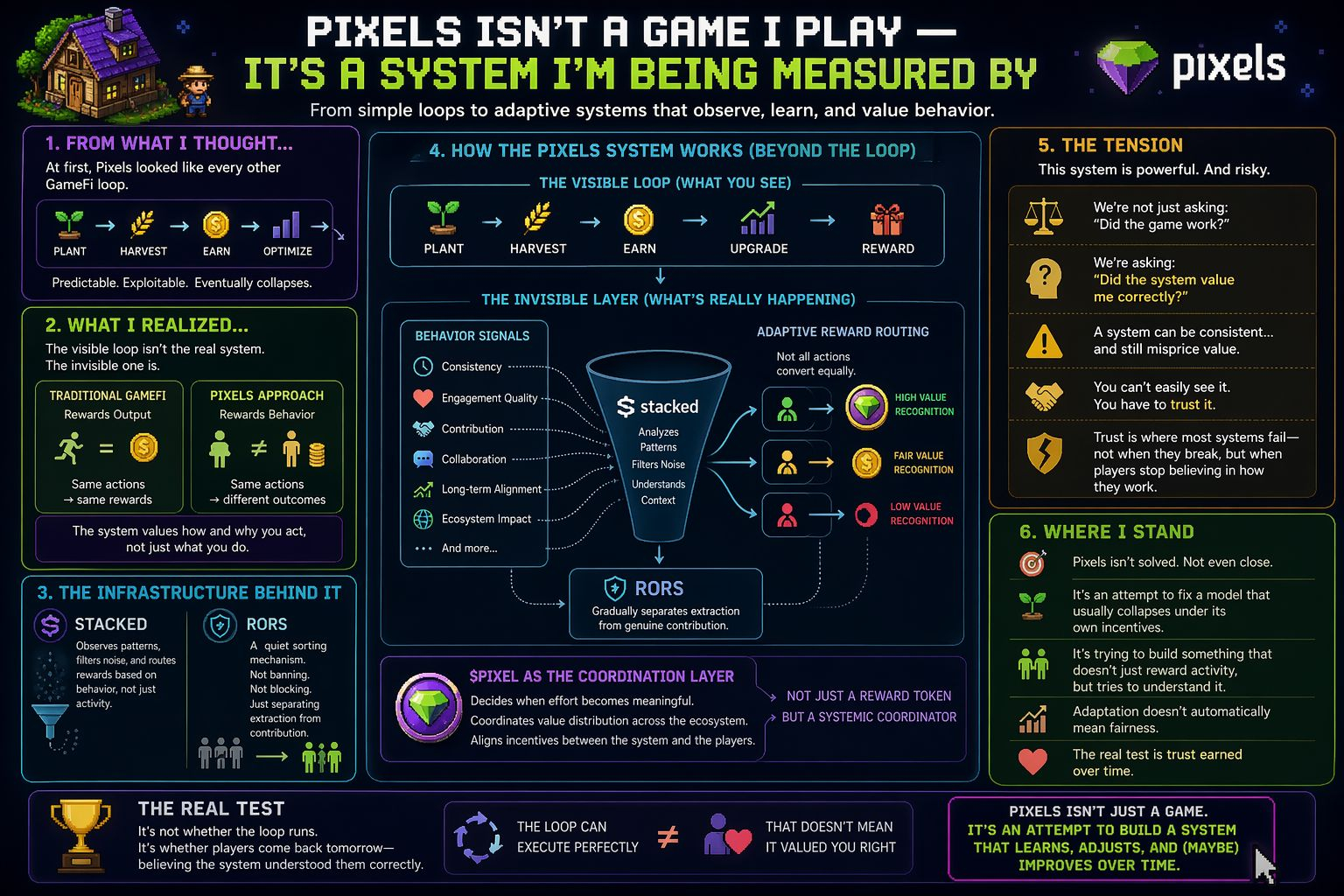
That’s when it clicked.
The visible loop isn’t the real system. The invisible one is.
Most GameFi economies reward output. Pixels feels like it’s trying to reward behavior.
That’s a very different idea.
Because once you stop rewarding raw activity, things get complicated. Two players can do the same actions and still end up with different outcomes. Not because one worked harder, but because the system values their behavior differently over time.
That’s where something like Stacked starts to make sense to me not as a feature, but as infrastructure. A layer that observes patterns, filters noise, and routes rewards based on more than just what you did… but how and why you did it.
And then there’s RORS which, whether fully visible or not, feels like a quiet sorting mechanism. Not banning players. Not blocking them. Just gradually separating extraction from contribution.
That’s powerful. And risky.
Because now we’re not just asking: “Did the game work?”
We’re asking: “Did the system value me correctly?”
That’s a much harder question.
$PIXEL, in that context, doesn’t feel like just another reward token. It feels more like a coordination layer something that decides when effort actually becomes meaningful inside the ecosystem. Not all actions convert equally. Not all players get the same economic attention.
And honestly, that’s where the tension sits for me.
Pixels might be one of the few systems trying to move beyond static rewards into something adaptive. A system that learns, adjusts, and maybe even improves over time.
But adaptation doesn’t automatically mean fairness.
A system can be consistent… and still misprice value.
That’s the part you can’t easily see. The part you have to trust.
And trust is where most systems fail not when they break, but when players stop believing in how they work.
So I don’t see Pixels as “solved.” Not even close.
I see it as an attempt.
An attempt to fix a model that usually collapses under its own incentives. An attempt to build something that doesn’t just reward activity, but tries to understand it.
The real test isn’t whether the loop runs.
It’s whether players come back tomorrow believing the system understood them correctly.
Because in the end, the loop can execute perfectly.
That doesn’t mean it valued you right.