
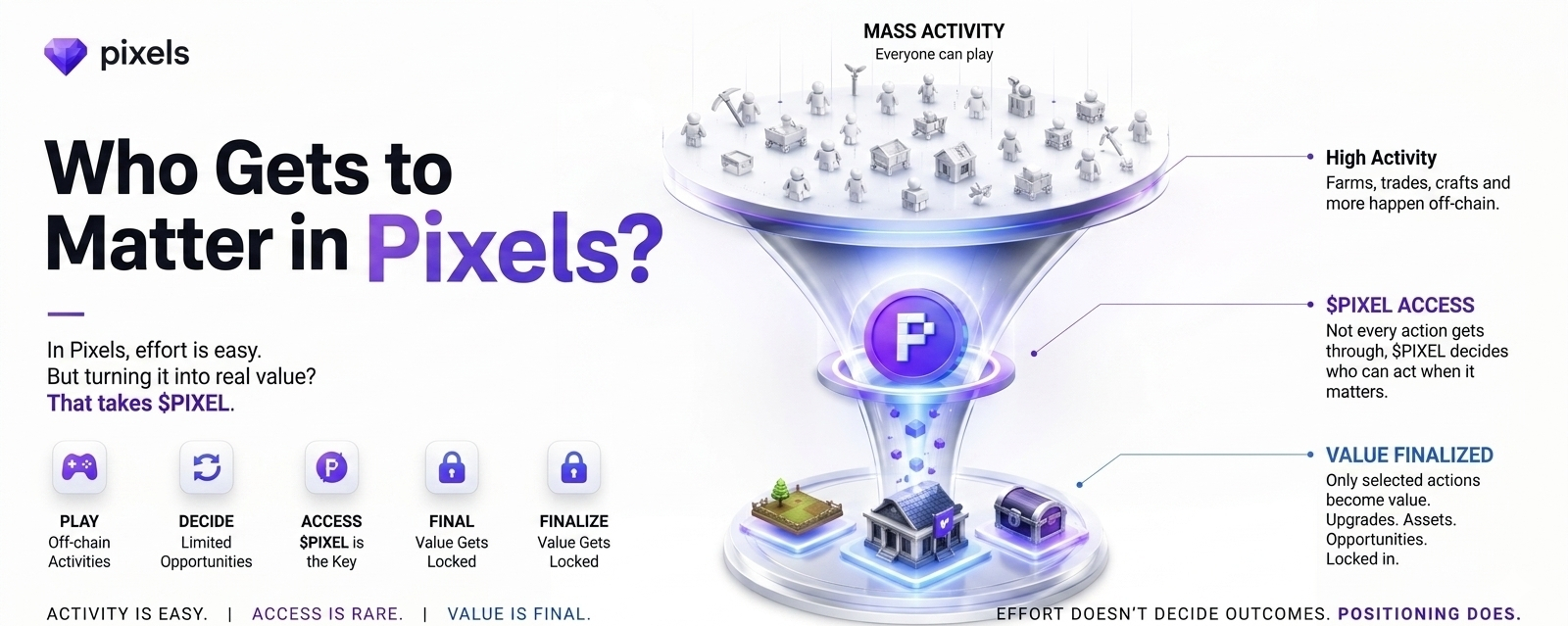
At first glance, Pixels feels familiar.
You enter a world that’s constantly in motion. Farms are producing, trades are happening, players are moving through routines that look efficient and repeatable. It gives off the impression of a healthy, active economy — the kind designed to keep players engaged over time. Nothing about it immediately feels restrictive. In fact, it feels open.
But that surface-level clarity starts to fade the longer you stay.
After spending enough time inside the system, a subtle pattern begins to emerge. It’s not obvious, and it’s definitely not broken. Everything works. Activity flows. Progress happens. Yet outcomes don’t always align with effort in the way you’d expect.
Two players can follow nearly identical paths — same loops, same time commitment, same level of engagement — and still end up in very different positions. One moves forward at key moments, capturing opportunities that seem to appear at just the right time. The other continues progressing, but without ever quite reaching those same turning points.
At first, it’s easy to explain this away. Timing plays a role. So does randomness. Maybe even experience. But over time, those explanations start to feel incomplete. The pattern repeats too consistently to be accidental.
That’s where the structure of the system becomes more interesting.
Pixels operates on a split model. Most of what players do happens off-chain. Farming, crafting, resource movement — all of it unfolds in a space that is fast, fluid, and inexpensive. This allows the world to scale. Players can act freely without worrying about cost or friction. It creates the sense of constant activity, which is essential for any game economy trying to feel alive.
But not everything stays in that layer.
At certain moments, actions cross a boundary. Upgrades are finalized. Assets are secured. Economic value is locked in. These moments are different. They’re slower, more deliberate, and often limited. And crucially, they require $PIXEL.
On paper, this structure makes perfect sense. Many systems separate low-cost activity from high-value execution. It’s efficient. It prevents overload. It introduces a necessary layer of control.
What’s less obvious is how much that boundary shapes outcomes.
Most of the time, players exist in a kind of background state. They’re active, productive, constantly contributing to the system. But their actions remain fluid, circulating without finality. Nothing forces urgency. Nothing demands immediate decision-making.
Then a moment appears.
A limited opportunity. A valuable upgrade. A time-sensitive interaction that actually determines progress.
Suddenly, the system changes.
The same open, frictionless environment tightens. What mattered before — consistency, repetition, effort — becomes secondary. What matters now is readiness. The ability to act instantly, without hesitation.
And that’s where Pixel takes on a different role.
It stops looking like a reward and starts behaving more like access.
If you already hold it, you move. The opportunity is yours to capture. If you don’t, the situation changes. You hesitate. You wait. Sometimes you miss the moment entirely. Not because you weren’t active, but because you weren’t positioned.
That distinction is small in isolation, but it compounds over time.
The same players begin to appear at the exact points where value is finalized. Not necessarily because they are more skilled or more engaged in that moment, but because they were prepared before the moment arrived. Their advantage isn’t effort in real-time. It’s positioning ahead of time.
This dynamic starts to resemble something outside of gaming.
In financial markets, access often matters more than participation. Traders with liquidity don’t just trade more frequently — they capture the moments that define outcomes. They are present when opportunities exist for seconds, sometimes less. Others are active, watching, even participating in a broader sense, but they aren’t positioned to act when it matters most.
Pixels is beginning to reflect a similar structure.
The system itself doesn’t explicitly present this idea. It still feels open. Anyone can enter, play, and contribute. And that’s true. But beneath that openness, there’s a quieter layer where not all actions are treated equally.
Some actions remain within the loop, continuously cycling through the system without ever becoming final. Others are elevated. They cross the boundary and become locked-in value. That transition is what ultimately defines progress.
Pixel appears to sit at that exact point of transition.
It doesn’t determine what players do. It determines whether what they’ve done is recognized at the level where outcomes are decided.
This introduces a different kind of scarcity.
Traditional game economies rely heavily on resource scarcity. Limited items, rare materials, constrained supply. But in Pixels, scarcity may be shifting away from resources and toward something less visible.
Attention, but not in the social sense.
System attention.
The system cannot finalize everything. It would be inefficient, expensive, and chaotic. So naturally, a filtering mechanism exists. Some actions pass through. Others remain in the background.
Once that filter exists, access to it becomes valuable. And once access is valuable, it needs to be priced.
That’s where $PIXEL fits in.
This design has clear advantages. It prevents the economy from collapsing under its own activity. It creates pacing. It ensures that not every action carries the same weight, which can actually preserve long-term structure.
But it also creates divergence.
Players adapt quickly. Over time, behavior shifts. The focus moves away from general activity and toward specific moments where value is converted. The game becomes less about continuous participation and more about being present at the right time with the right resources.
That shift changes the nature of competition.
Those who understand the system — and have the ability to act when needed — begin to accumulate advantages. Not through aggressive strategies, but through consistency at key moments. Meanwhile, new or less-prepared players continue contributing to the system, but their actions don’t always translate into the same level of economic visibility.
They are part of the economy, but not always part of its defining outcomes.
This gap is difficult to detect if you’re only looking at surface metrics. Player counts can grow. Activity can increase. The world can feel vibrant and alive. Yet the points where value is actually created remain selective.
Over time, they may become even more selective.
That raises an important question about how this system should be understood.
If $PIXEL is viewed purely as a reward token, much of this structure is easy to overlook. But if it’s seen as a coordination layer — something that sits between effort and outcome — then its role becomes much more significant.
It is no longer just part of the economy. It helps define how the economy functions.
The market, for now, still tends to focus on familiar signals. Growth, engagement, user numbers. These are important, but they may not capture the full picture if the system continues evolving in this direction.
The more telling signal might be harder to measure.
It’s not how many players are active, but which players consistently appear at the exact moments when activity transforms into value.
And which players don’t.
