
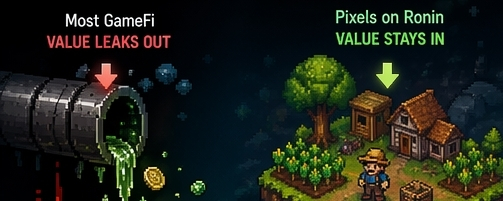
@Pixels #pixel
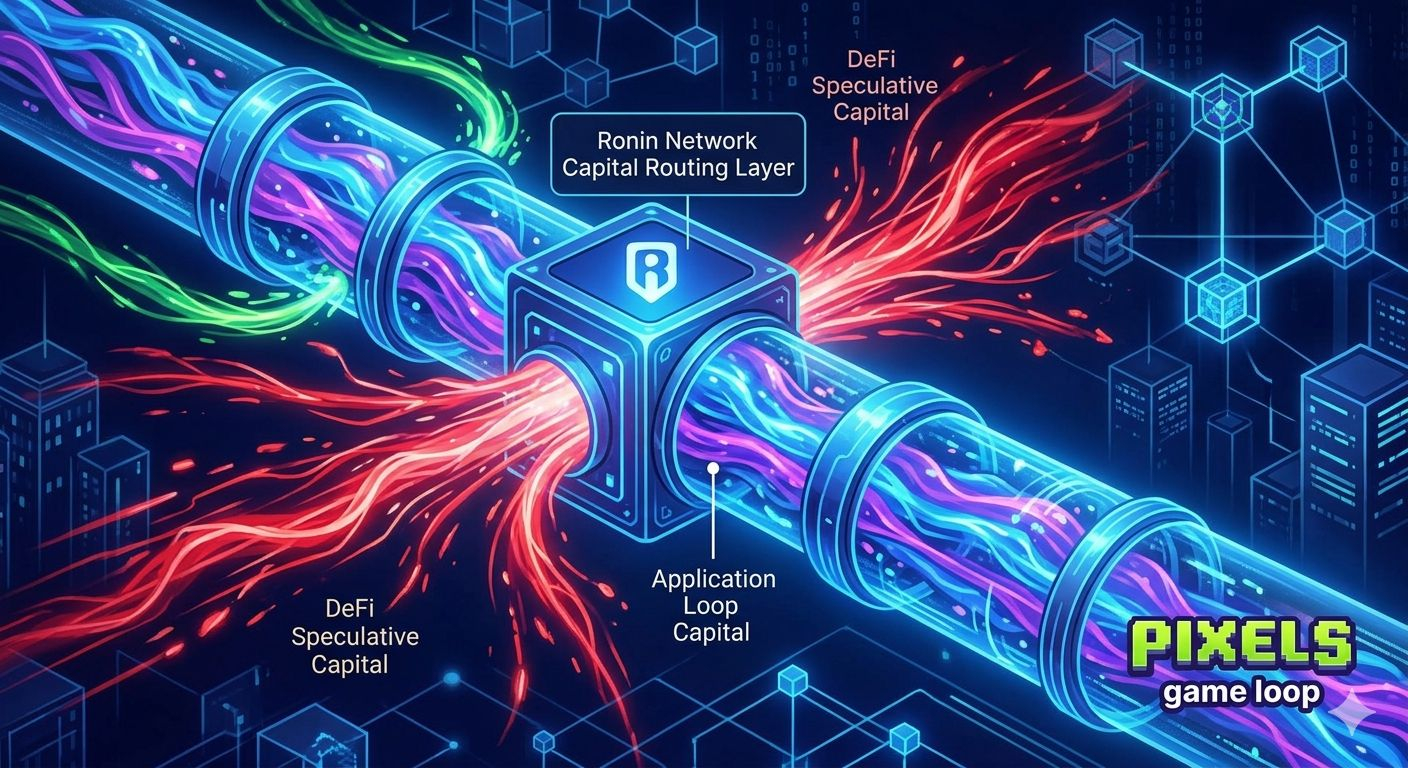
Most people look at Pixels (PIXEL) and see a casual farming game with a token attached. That’s the wrong lens. What actually matters is how it sits on Ronin Network—because Ronin isn’t just infrastructure here, it’s a capital routing layer. Liquidity that enters Ronin is already pre-filtered: it’s not random DeFi yield chasers, it’s users willing to sit inside an application loop.
That changes the behavior of capital entirely. It becomes slower, stickier, and far more sensitive to in-game sinks than external APRs.
What stands out immediately is that Pixels doesn’t rely on the typical “earn → dump → refill” loop that killed most GameFi cycles. Instead, the system quietly taxes inactivity. Not through explicit fees, but through opportunity decay. Crops, energy, land usage—these are time-bound mechanics
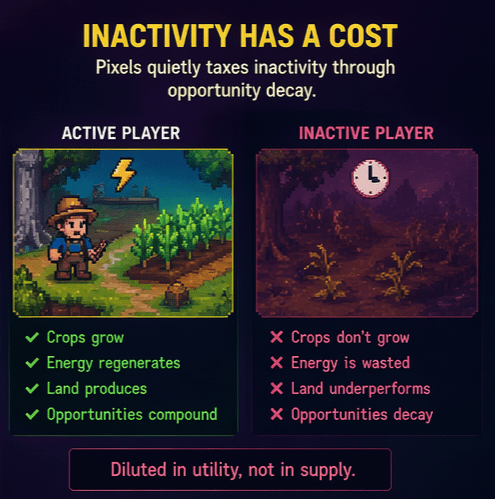
that turn idle capital into underperforming capital. On-chain, that translates into a subtle but important dynamic: token holders who don’t participate are effectively diluted in utility, not supply. That’s a very different kind of pressure compared to inflation-heavy models.
If you track wallet behavior rather than just token price, you’ll notice something unusual: retention wallets don’t behave like speculators. They behave like operators. They accumulate small balances, interact frequently, and rarely fully exit. This is closer to how liquidity providers behave in DeFi than how traders behave in altcoins. It suggests that PIXEL isn’t just circulating—it’s being cycled internally. That internal velocity reduces the reliance on external inflows to sustain activity, which is where most GameFi projects fail.
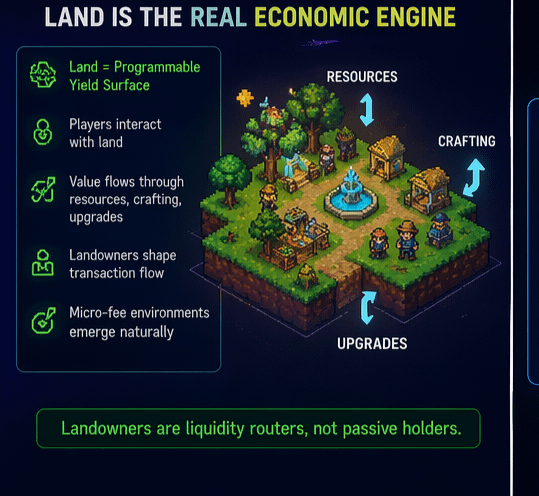
The real economic engine isn’t farming—it’s land. Land in Pixels functions less like an NFT and more like a programmable yield surface. Owners aren’t just holding assets; they’re shaping transaction flow. When players interact with land, they route value through it—resources, crafting, upgrades. That creates micro-fee environments without explicitly calling them fees. If you think in DeFi terms, landowners are closer to liquidity routers than passive NFT holders. That’s why land concentration matters more than token distribution.
There’s also a quiet asymmetry between new users and existing participants. New entrants inject fresh demand for resources and progression, but they don’t immediately extract value efficiently. Experienced players, on the other hand, have optimized loops. This creates a temporary imbalance where early-stage inefficiency subsidizes advanced users. It’s not obvious on the surface, but you can see it in how resource prices stabilize even when user growth spikes. The system absorbs new demand without immediate inflation shocks.
From a market perspective, PIXEL behaves like a hybrid between a utility token and an internal settlement layer. It’s not purely speculative, but it’s also not strictly required for every action. That partial dependency is intentional. Full dependency would create constant sell pressure; zero dependency would make the token irrelevant. Instead, PIXEL sits in a middle zone where it’s periodically required, creating episodic demand rather than continuous pressure. That leads to price structures that move in bursts, not trends.
Another overlooked detail is how Ronin’s low-friction environment changes user psychology. Cheap transactions don’t just reduce costs—they increase experimentation. Players try more strategies, interact more frequently, and optimize faster. That accelerates the discovery of dominant strategies, which in turn compresses margins inside the game economy. Over time, this forces the system to either introduce new sinks or watch profitability converge toward zero for average players. That’s a structural pressure point, not a temporary phase.
If you compare PIXEL to typical DeFi tokens, the key difference is where yield comes from. In DeFi, yield is often externalized—funded by emissions or new entrants. In Pixels, yield is internalized—generated through player interaction and inefficiency. That makes it more resilient in low-liquidity environments, but also caps upside. You don’t get explosive APYs, but you also don’t get instant collapse when emissions slow. It’s a slower, more controlled economic loop.
There’s also a subtle liquidity segmentation happening. Exchange liquidity and in-game liquidity are not perfectly interchangeable. Tokens held by active players are less likely to hit order books, while tokens held by speculators are more reactive. This creates a two-layer market: one that moves with gameplay activity, and one that moves with broader crypto sentiment. When those two layers diverge, you get price dislocations that don’t immediately resolve.
Looking forward, the biggest risk isn’t token inflation—it’s strategy saturation. As more players optimize their loops, the edge disappears. When that happens, the system needs to introduce new layers of complexity or new sinks to maintain engagement. If it fails to do that, activity can remain high while profitability drops, which eventually leads to silent attrition rather than a visible collapse.
The reason Pixels is worth paying attention to isn’t because it’s a game—it’s because it’s one of the few systems where user behavior, token flow, and infrastructure are tightly coupled. Most projects fake that connection. Here, it actually exists. And when those three layers align, you don’t just get a working product—you get an economy that can survive without constantly asking the outside market for liquidity.
And in this market, attention is just another form of liquidity waiting to be trapped.
