
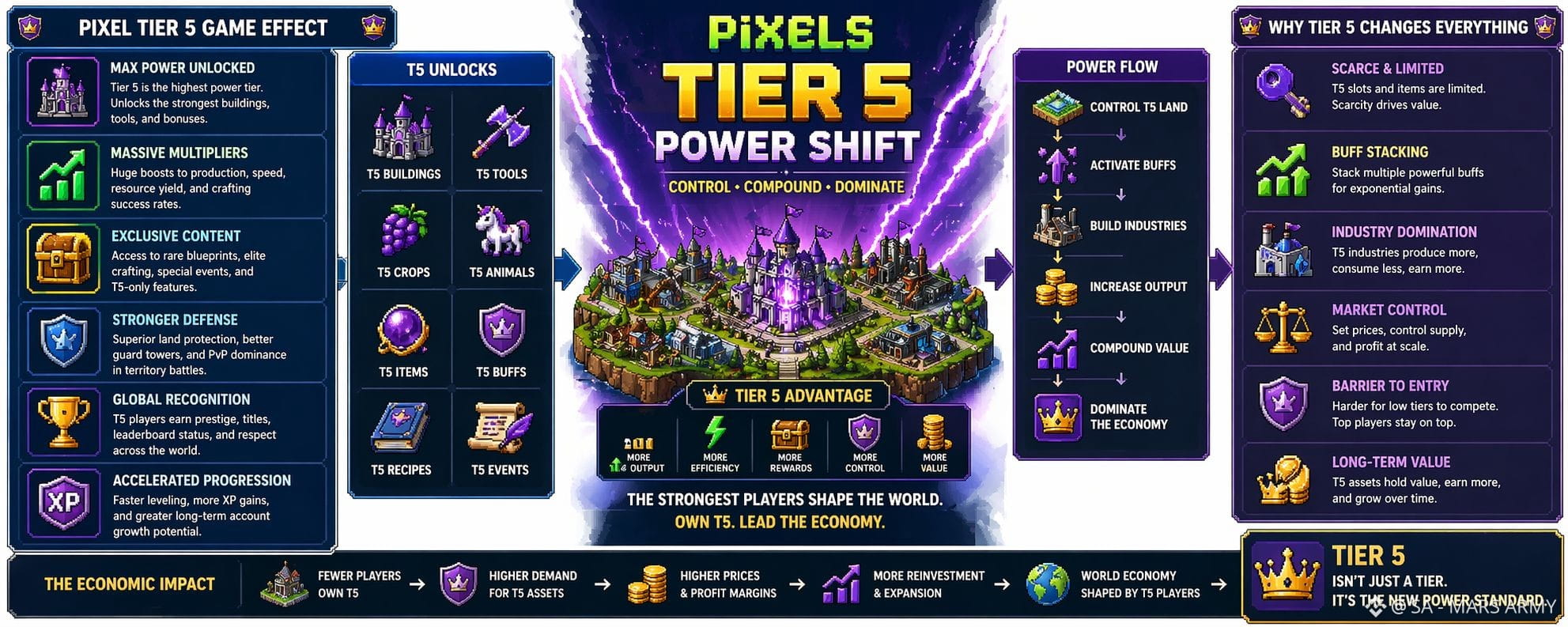
Moving from the steady routines of @Pixels Tier 4 into Tier 5 felt less like a normal upgrade and more like stepping into a different kind of game entirely. What used to be simple progression now demands constant awareness, where every decision carries weight and efficiency starts to matter as much as effort. When I first looked at Tier 5, it didn’t feel like just another stage of advancement. It felt like the game was quietly shifting its focus toward ownership, where access and control begin to matter just as much as growth.
On the surface, Tier 5 looks like what you’d expect from an endgame layer. Levels 80 to 100, better resources, 105 new recipes, nine new industries. That’s the visible part. Players grind, unlock, produce, and optimize. But underneath, the structure tells a different story. Access isn’t earned through time alone. It’s gated through NFT land ownership and something very specific called T5 Slot Deeds. Each deed unlocks 20 percent of a land parcel’s Tier 5 capacity, and it only lasts 30 days unless renewed.
That number matters more than it seems. Twenty percent means full efficiency requires five deeds running in parallel. If each one expires monthly, you’re not just managing production, you’re managing a recurring cost layer. The system introduces a steady drain that only high-efficiency players or capital-heavy landowners can sustain long term. It’s not just progression anymore. It’s upkeep.
Understanding that helps explain why Tier 5 doesn’t replace earlier tiers. It sits on top of them. The new industries are designed to complement T1 to T4, not overwrite them. That sounds like balance, but in practice it creates a dependency chain. Tier 5 outputs rely on lower-tier inputs, while generating surplus value on crafted items. So landowners aren’t just playing the game, they’re sitting at the center of a production network that pulls value upward.
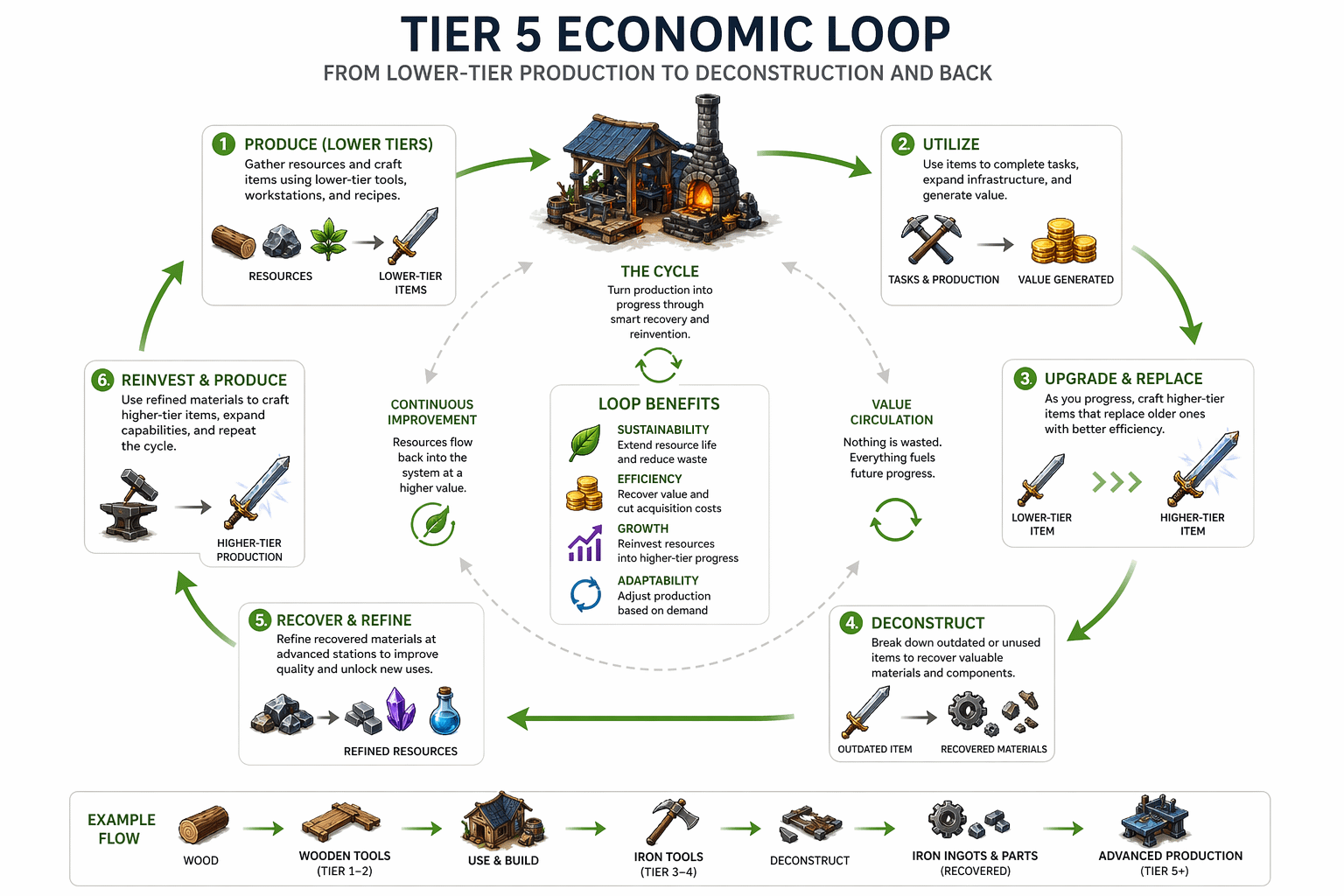
Then there’s the Deconstruction system, which looks simple at first glance. Break items down, get rare materials. But what’s really happening is a circular economy loop. Items crafted at lower tiers can now be recycled into Tier 5 inputs. That creates a floor for item value that didn’t exist before. Suddenly, nothing is truly waste. Even failed crafts or outdated gear carry latent worth because they can feed back into the system.
That loop introduces a subtle pressure. If Tier 5 crafting requires rare materials obtained through deconstruction, then the supply of those materials depends on how much the player base is willing to destroy. If too many players hoard, scarcity spikes. If too many break items down, prices collapse. It’s a player-driven balancing act, and early signs suggest volatility rather than stability.
Meanwhile, the new resources like Tier 5 trees, soy, and mines look like simple upgrades, but they’re actually throughput multipliers. Higher yield per action means faster production cycles, which feeds directly into those 105 new recipes. More recipes doesn’t just mean variety. It means specialization. No single player can efficiently cover all nine new industries, which nudges players toward trade or cooperative systems.
That’s where the exclusivity becomes more than a design choice. Limiting Tier 5 to NFT landowners effectively concentrates economic power. Taskboards, buffs to Forestry and Animal Care, and exclusive tasks aren’t just perks. They’re productivity accelerators layered on top of already privileged access. If a landowner produces 30 to 40 percent more output over the same time window because of buffs and better tools, that advantage compounds quickly.
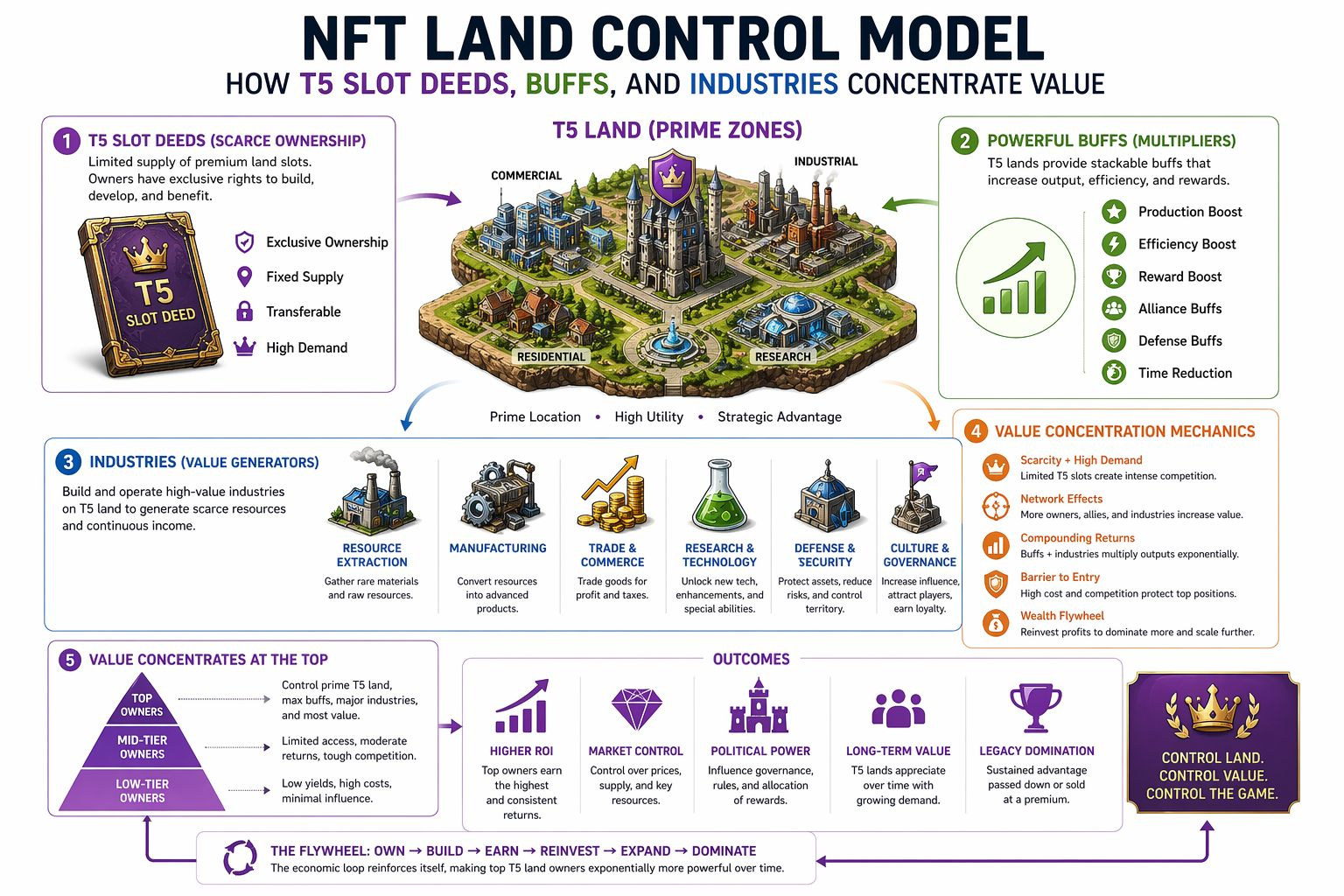
Of course, there’s an argument that this creates a healthy top layer for the economy. High-end players generate surplus, which trickles down through trade. That can work, but only if demand remains broad. If Tier 5 items become too dominant, lower-tier production risks becoming irrelevant except as input farming.
What struck me is how closely this mirrors what’s happening across the broader crypto gaming space right now. Ownership layers are getting tighter. Utility is being tied to time-limited assets. And systems are being built not just for play, but for sustained economic loops that reward capital positioning as much as skill.
If this holds, Tier 5 isn’t just an endgame. It’s a signal. Games are shifting from progression ladders to economic ecosystems where access, renewal costs, and production control matter more than grinding alone.
The quiet truth sitting underneath all of it is this: the real endgame isn’t reaching level 100, it’s securing your place in the system that decides what level 100 is worth.
