
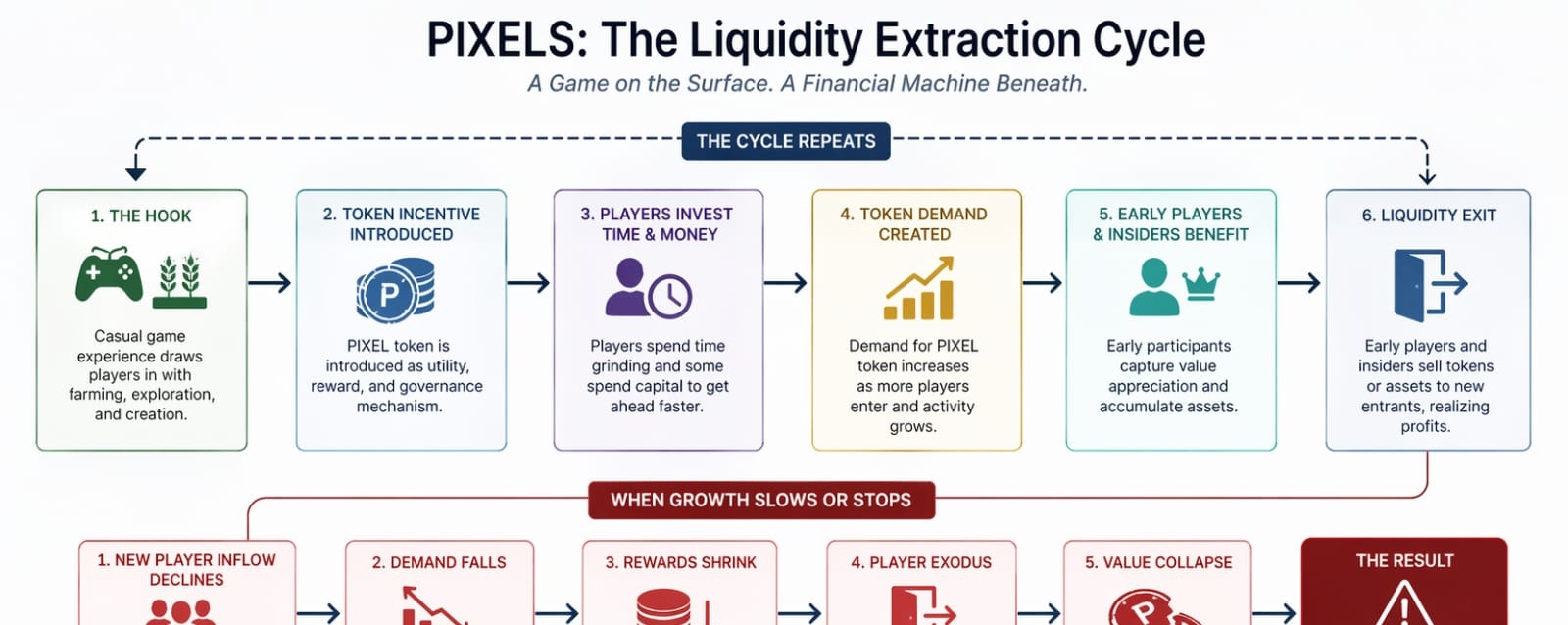
The Pastoral Lie Starts Immediately
Let’s not waste time.
PIXELS is not a farming game. It is a financial system wrapped in pixel art, built to look harmless while doing something far more familiar: extracting value from its own players.
We’ve seen this structure before. Dress it differently, soften the language, improve the onboarding—it doesn’t matter. Once you attach a tradable token to a game, the centre of gravity shifts. Play becomes secondary. Money becomes the point.
And when money becomes the point, the outcome is predictable.
Someone wins early. Most arrive too late.
---
Ronin Didn’t Learn — It Repackaged
Ronin is not starting from a clean slate. It is carrying baggage.
This is the same network that rode Axie Infinity into the ground after inflating a play-to-earn economy that could not sustain itself. The collapse wasn’t subtle. It was structural. The model depended on endless growth. Growth stalled. The system broke.
Now we are told PIXELS is different.
It isn’t.
It is quieter. Less aggressive in its promises. More “casual” in tone. But the underlying dependency remains untouched. The system still requires new participants to maintain value. It still leans on token demand to justify activity that has no intrinsic worth.
Call it evolution if you like. It looks more like cosmetic surgery.
---
Tokenomics That Only Work on Paper
The PIXEL token is framed as utility. Governance. Participation.
This is the standard language of the industry. It rarely survives contact with reality.
Strip it down and the function is obvious. The token creates a financial incentive where none naturally exists. Farming digital crops is not valuable. It becomes valuable only because someone else is willing to buy the output, or the token tied to it.
That willingness is not stable. It is speculative.
And speculation has a hierarchy. Early entrants benefit from price appreciation. Later entrants provide the liquidity that allows them to exit. The system flatters everyone at the start. It rewards only a minority in the end.
The token is not empowering players. It is sorting them.
---
“Play-and-Earn” Is Just Better Marketing
The industry learned one thing from its last collapse: language matters.
“Play-to-earn” became toxic once the losses became visible. So now we have “play-and-earn.” Softer. Less transactional. More palatable.
Nothing fundamental has changed.
Players are still nudged toward optimising returns. Time is still converted into output. Output is still tied to a token whose value depends on demand from others.
The grind hasn’t disappeared. It has been normalised.
This is not a redesign. It is a rebrand designed to keep the same machine running without triggering the same alarm bells.
---
Every System Needs a Buyer — That’s the Problem
Here is the part rarely stated plainly.
For players to earn, someone else must spend. There is no external revenue engine here. No underlying productivity. No independent cash flow. The system circulates value internally and relies on expansion to keep that circulation profitable.
When growth is strong, it works. Prices rise. Rewards look attractive. Participation increases.
When growth slows, the mechanism reverses. Prices fall. Rewards shrink. Engagement drops.
And then the truth surfaces. The “earnings” were conditional all along.
This is not a side effect. It is the core design.
---
Ownership Is the Most Overstated Promise
PIXELS leans heavily on the idea of ownership. Land. Assets. Control.
It sounds convincing until you examine it.
Players do not control the rules of the system. They do not control supply. They do not control the economic parameters that determine value. What they hold is exposure to a managed economy that can change at any moment.
That is not ownership. That is risk.
Worse, it is risk dressed up as empowerment. When participation increases, supply expands. When supply expands, value erodes. The more productive the player base becomes, the less each unit of production is worth.
It is a system that punishes its own success.
---
This Is Work — Just Poorly Paid
There is an uncomfortable truth running through all of this.
Players are not just playing. They are working.
They invest time. They perform repetitive tasks. They optimise for efficiency. They chase marginal gains. This is labour, whether the platform chooses to call it that or not.
And like most unregulated labour markets, the returns compress quickly. Early participants may see meaningful gains. Everyone else competes in an increasingly saturated environment where output is abundant and rewards are thin.
We have seen this dynamic before in previous GameFi cycles. It does not end well for the majority.
PIXELS does not remove that dynamic. It softens the optics.
---
Engagement Isn’t the Goal — Retention Is
The design is not accidental.
Reward loops, progression systems, and scarcity mechanics are standard tools in gaming. Add financial incentives and those tools become more potent. Progress is no longer just satisfying. It is monetised.
That changes behaviour.
Players stay longer. They invest more time. They hesitate to leave when returns dip because they have already committed effort that feels recoverable.
This is not just engagement. It is engineered stickiness with a financial hook.
And once money is involved, the psychological grip tightens.
---
The Sustainability Claim Doesn’t Hold
Every project in this space claims it has solved sustainability. None have demonstrated it.
The contradiction is straightforward. A game thrives on accessibility and enjoyment. An economy requires constraint and extraction. Combine the two, and one will eventually undermine the other.
In practice, it is usually the economy that wins in the short term and the game that deteriorates in the long term. Players shift from playing for enjoyment to playing for return. When returns weaken, so does interest.
The system becomes hollow.
PIXELS shows no clear evidence of escaping this pattern. It simply arrives at a later stage of the industry, with better messaging and a more cautious rollout.
That is not a structural solution.
---
Regulators Will Eventually Treat This for What It Is
For now, projects like PIXELS operate in ambiguity.
Game or financial product.
That ambiguity is useful. It delays scrutiny. It allows experimentation without immediate consequence.
It will not last.
As regulators turn their attention to tokenised ecosystems, the questions will become sharper. What exactly is being sold? Who benefits? Who bears the risk? Are these tokens functioning as unregistered securities?
When those questions are answered, the framing of “just a game” will not be enough.
And when the rules change, it will not be the developers absorbing the shock.
---
The Pattern Is Clear — The Ending Usually Is Too
Step back and the structure is familiar.
A system launches with strong incentives. Early participants accumulate assets. Growth accelerates. Prices rise. The narrative strengthens. More participants enter.
Then growth slows.
At that point, everything depends on whether new money continues to arrive. If it does not, the system compresses. Rewards fall. Assets lose value. Participation declines.
This is not hypothetical. It is a pattern that has already played out across multiple cycles.
PIXELS is not exempt from it. It is simply earlier in its timeline.
---
The Reality Beneath the Surface
Strip away the language, the design, and the branding, and the core remains unchanged.
PIXELS is not a game that happens to include an economy. It is an economy that requires a game to sustain itself.
And economies built like this do not collapse because people stop playing.
They collapse when there is no one left willing to buy what the players are trying to sell.