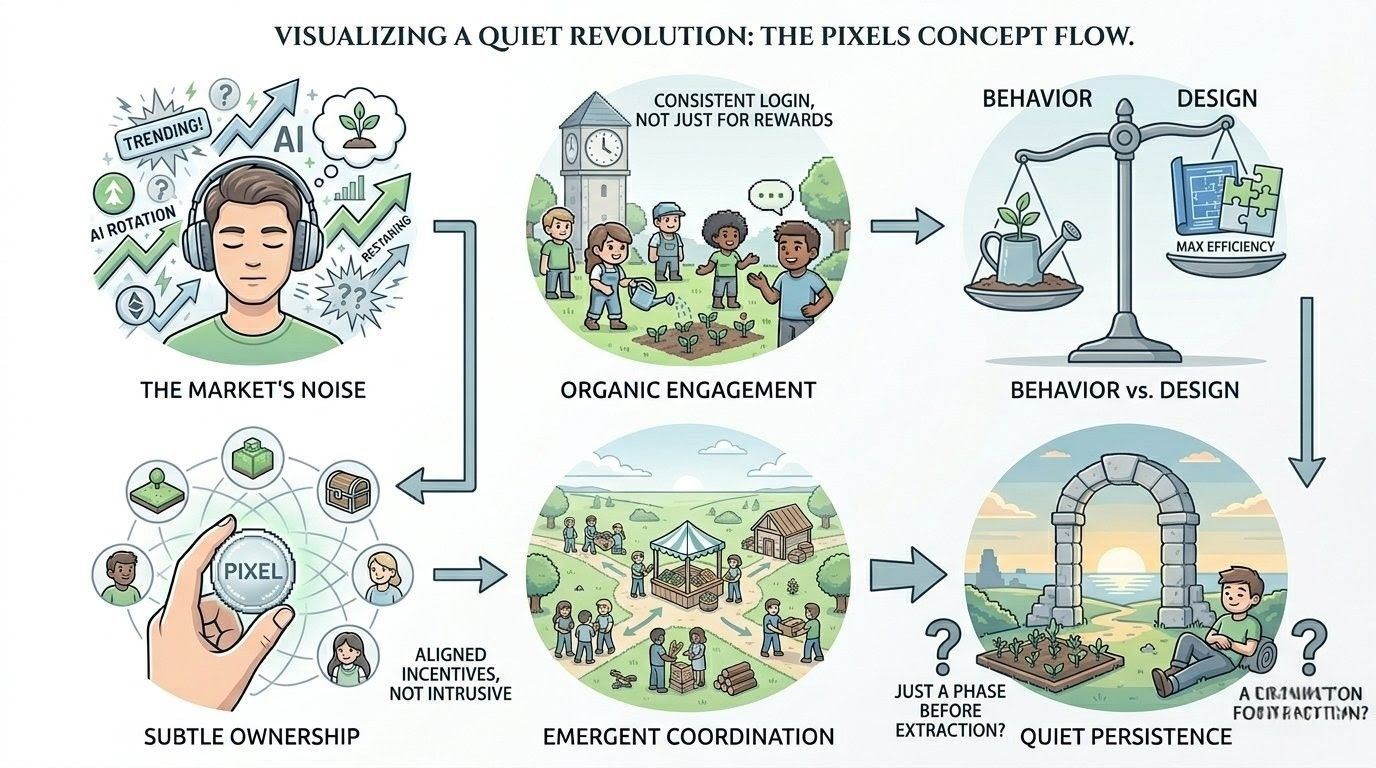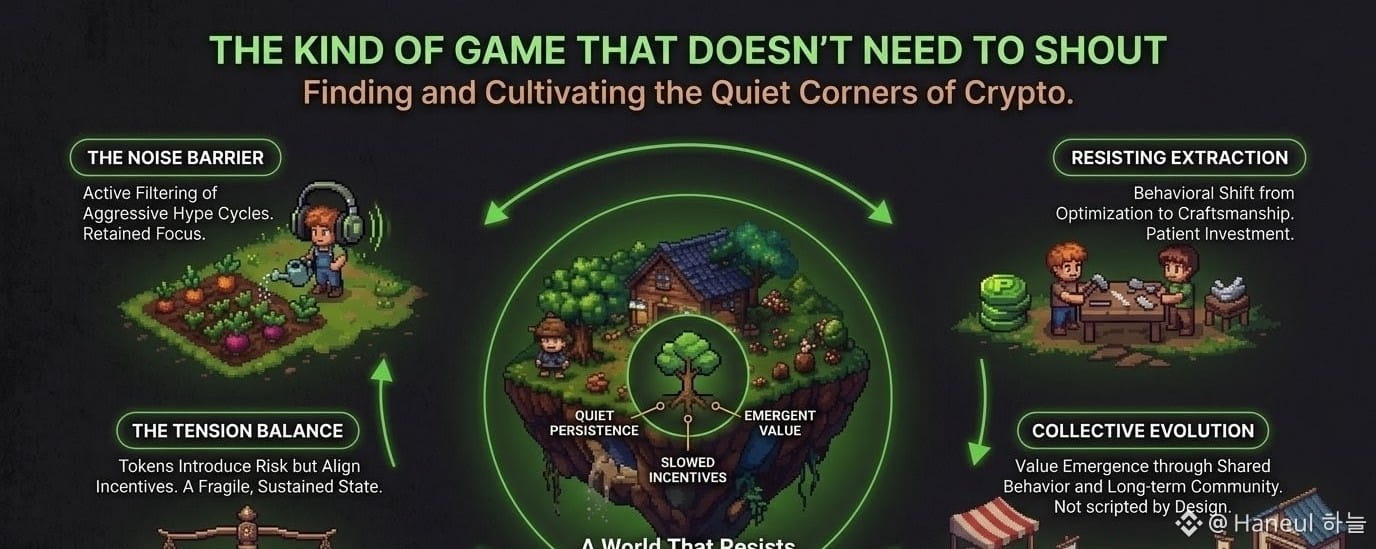
I found Pixels while I was actually looking at something completely different tracking where liquidity was thinning out after the last AI rotation cooled. You could feel the shift. The easy trades weren’t as obvious anymore. Narratives were still forming, but they weren’t sticking the same way. Even restaking, which had been absorbing attention for weeks, started to feel a bit crowded. Not dead, just saturated.
That’s usually when I start paying attention to the quieter corners.
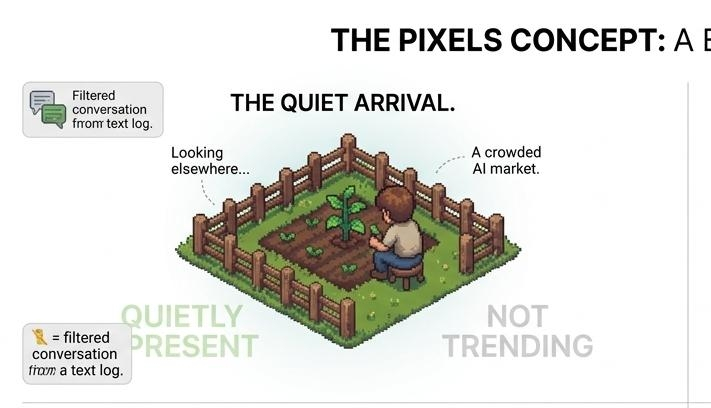
Pixels kept coming up in small ways. Not trending hard. Not pushed aggressively. Just showing up in conversations where people weren’t trying to sell anything. That alone was enough to make me look twice.
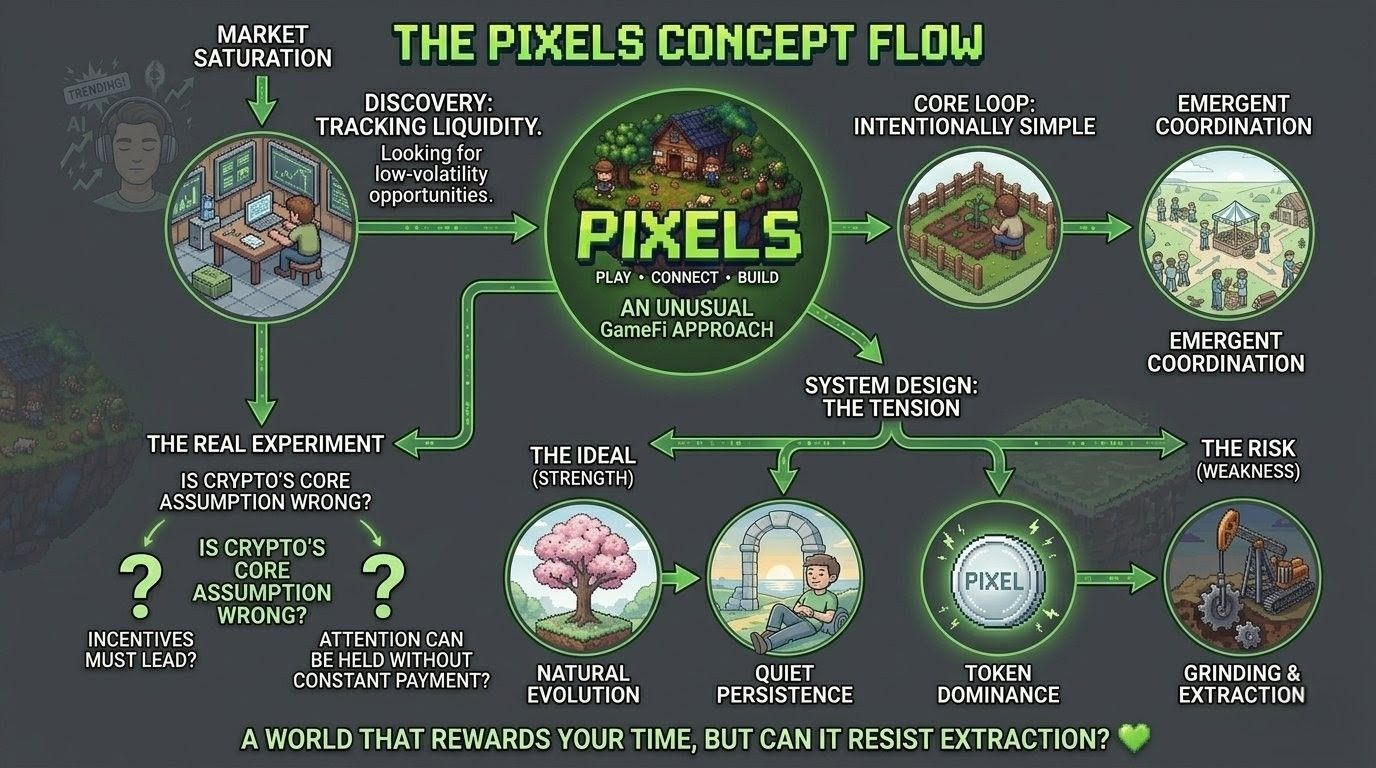
At first, I assumed I knew what it was. Another GameFi loop. We’ve all seen it bootstrap users with incentives, create a token sink, hope retention outlasts emissions. Sometimes it works for a while. Most of the time it doesn’t.
But this didn’t feel like that.
I didn’t start with the token. I started with the behavior.
People were logging in consistently, not just when rewards spiked. They weren’t rushing to extract value and leave. They were just there. Farming, moving around, interacting. It didn’t look like a system under pressure from mercenary capital. It looked more like a place people didn’t mind spending time in.
That distinction matters more than most people admit.
Because the real problem Pixels is trying to solve isn’t “how do we make a successful Web3 game.” It’s deeper than that. It’s asking whether you can build an on-chain system where incentives don’t immediately distort behavior.
Right now, most of crypto still struggles with that. We’re good at attracting attention. Not as good at holding it without constantly paying for it.
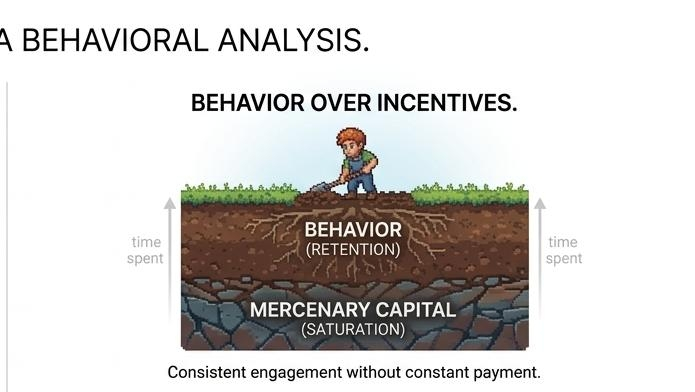
Pixels approaches this differently. The core loop is simple farming, gathering, exploring but it’s intentionally unremarkable. No aggressive optimization paths. No overwhelming mechanics pushing you toward “maximum efficiency.” It almost feels like the game is resisting you trying to break it.
And under that simplicity, there’s a structure quietly doing its job.
Everything runs on Ronin, which handles the transactional side fast, cheap, smooth enough that you don’t really think about it. Ownership is there, but it’s not constantly shoved in your face. You earn items, you trade, you interact with a shared world that isn’t controlled by a single entity in the traditional sense.
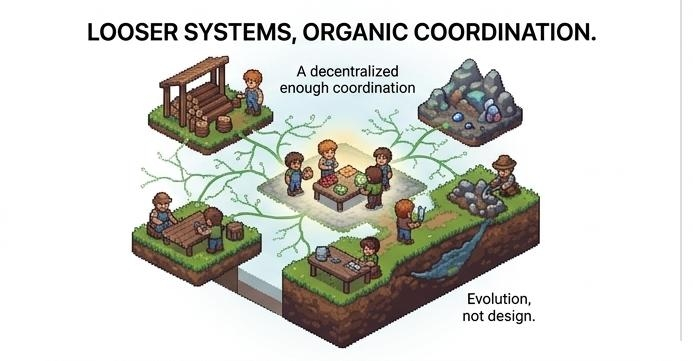
What’s interesting is how coordination emerges from that.
Resources have value because players give them value. The world evolves based on collective activity, not just developer updates. It’s not perfectly decentralized in the ideological sense, but it’s decentralized enough that behavior starts to matter more than design.
That’s a subtle shift, but an important one.
Compared to other GameFi projects, Pixels doesn’t feel like it’s trying to engineer outcomes too tightly. A lot of games tried to script their economies in advance set emission schedules, define optimal loops, guide users toward specific behaviors. It works until users figure out how to extract maximum value, and then the system collapses under its own incentives.
Pixels feels looser. Less controlled.
That could be its strength.
Or its weakness.
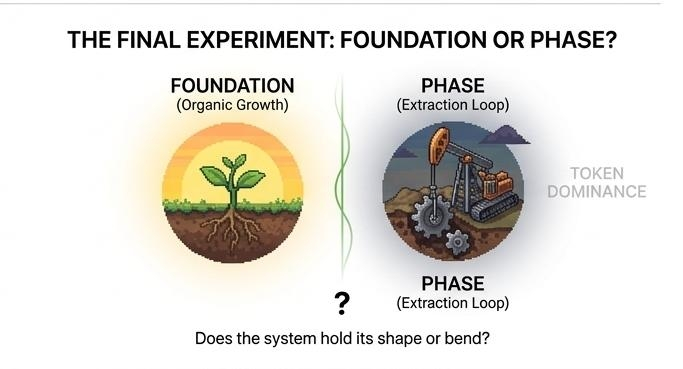
Because letting systems evolve naturally also means you don’t fully control where they go. If the token becomes too dominant in player motivation, the same problems could reappear. Farming turns into grinding. Grinding turns into extraction. And suddenly the quiet stability disappears.
The PIXEL token sits right in the middle of that tension. It needs to exist it aligns incentives, gives players a stake, creates an economy. But it also introduces the usual risks. Speculation can distort behavior quickly, especially if external liquidity flows in faster than the system can absorb it.
And that’s the part I keep coming back to.
Right now, the adoption feels organic. It doesn’t look like it’s being forced by incentives alone. That’s rare. But organic systems are fragile in their own way. They work until something external disrupts them capital inflows, narrative attention, sudden growth.
What happens then?
Does the system hold its shape, or does it bend toward extraction like everything else in this space eventually does?
There’s also a bigger context here that’s easy to overlook. Crypto right now is still obsessed with speed. Fast growth, fast narratives, fast returns. Pixels feels like it’s operating on a different timeline entirely. Slower. More patient. Almost indifferent to the usual cycles of attention.
That’s either a sign of strength or a misalignment with how this market actually behaves.
And here’s the thought that’s been sitting with me, the one that doesn’t get talked about enough: maybe the real experiment here isn’t about games at all. Maybe it’s about whether crypto can support systems that people engage with even when there’s no immediate financial urgency.
Because if that works, even in a small way, it challenges one of the core assumptions of this entire space that incentives always have to lead.
But if it doesn’t work, if the system eventually bends like everything else, then it just reinforces what we already know.
I’m still not sure which way this goes.
For now, Pixels just keeps running. Quietly. No urgency. No need to prove itself every day.
And in a market that constantly demands attention, that alone feels unusual.
The question is whether that quiet persistence is a foundation or just a phase before the same cycle repeats again.