

Something about it feels stable on the surface almost too stable
I kept watching the loops the planting the harvesting the small cycles of completion and reward and nothing seemed obviously broken In fact it all worked smoothly almost comfortably Yet that quiet smoothness started to feel less like good design and more like something carefully contained
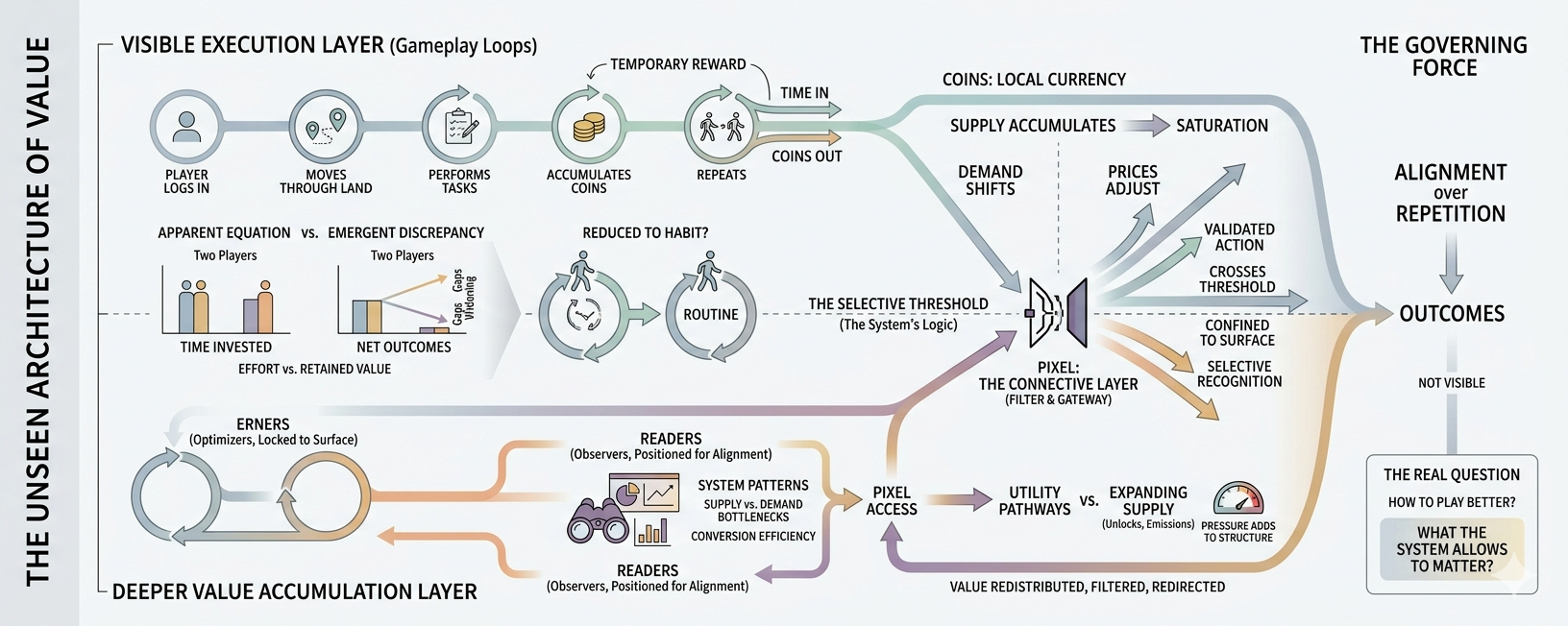
At first it is easy to accept what is visible A player logs in moves through land performs tasks accumulates Coins repeats There is a rhythm to it that feels familiar not very different from other systems that rely on repetition and gradual accumulation Time goes in rewards come out The relationship appears linear enough to not question
But after a while I started noticing that not all time behaves the same inside this environment Two players could move through similar routines spend similar hours complete similar visible objectives and still walk away with outcomes that do not quite match Not dramatically at first just slightly off enough to ignore But over time that gap does not close it widens
That is where the surface begins to crack not in a dramatic way but in a quiet persistent misalignment between effort and retained value It is not that effort is wasted It still produces something Coins items progression markers But there is a subtle sense that not all of it translates into something that lasts
It made me wonder whether what we see as gameplay is only one layer of a deeper structure A kind of execution layer where actions are processed but not necessarily finalized The farming the crafting the movement across space all of it feels like activity that exists within a contained loop producing local outcomes but not all of those outcomes seem to travel further
Somewhere beneath that there appears to be another layer one that decides what actually settles into persistent value The presence of PIXEL is the obvious signal of that deeper layer but it does not behave like a simple reward token It behaves more like a filter or a gateway Through it certain actions pass through and solidify while others remain confined to the surface
This creates a strange duality where the system is constantly active but only selectively meaningful Most actions do not fail they simply never qualify They exist they complete they even feel productive but they do not cross into that deeper layer where value accumulates in a more permanent way
I started to see players separating into different roles not by intention but by behavior Some continue to operate entirely within the visible loops They optimize their routines they increase efficiency they produce more within the same structure They are earners in the most direct sense They generate output consistently but remain largely tied to the execution layer
Others begin to step back from the loops not abandoning them but observing them differently They pay attention to when certain tasks matter more than others when certain outputs convert more effectively into PIXEL when supply begins to outweigh demand or when a bottleneck quietly forms These players are not necessarily more active but they are positioned differently They are reading the system rather than just moving through it
Over time the difference between these two approaches becomes more pronounced Not immediately but gradually The system does not reward visibility it rewards alignment And alignment is not something that can be achieved through repetition alone It requires an understanding of how value moves beneath the surface
This is where the economy begins to reveal itself not as a feature but as a governing force Supply accumulates in certain areas faster than it can be absorbed Demand shifts often without clear signals Prices adjust not through centralized control but through countless small decisions made in parallel Players begin undercutting each other not out of strategy but necessity And through all of this the system continues to appear calm from the outside
There is something almost deceptive about that calmness The loops remain intact the interface does not change dramatically the core actions feel the same But underneath there is constant movement value being redistributed filtered redirected Some players find themselves moving with that flow others remain stuck producing within loops that no longer connect to meaningful outcomes
Coins start to feel like a local currency something that facilitates movement within the surface layer but does not guarantee progression beyond it PIXEL on the other hand behaves more like a connective layer tying different parts of the system together acting as both a reward and a constraint It is not simply earned it is accessed and that access is uneven
This unevenness does not feel accidental It feels designed not in an unfair sense but in a selective one The system does not treat all actions equally Some behaviors are amplified given pathways into deeper value Others are absorbed remaining within cycles that never extend beyond themselves
That realization shifts the experience in a subtle but important way It no longer feels like playing a game in the traditional sense It begins to resemble participation in a system where activity is only one part of the equation and understanding carries increasing weight
The idea of progression changes with it It is no longer just about doing more but about doing things that the system recognizes as meaningful And that recognition is not always visible It has to be inferred through patterns through outcomes through small discrepancies that reveal themselves over time
There is also a tension building beneath all of this The supply of PIXEL continues to expand through unlocks and emissions while the pathways that give it utility do not always scale at the same pace If more value is being introduced than the system can effectively absorb then something has to adjust Either the value per unit declines or the system finds new ways to create demand
That adjustment is not immediate It unfolds slowly almost invisibly But it adds pressure to the entire structure Players who once operated comfortably within the loops begin to feel that their output does not carry the same weight The system readers adapt shifting their positioning finding new entry points into value Others continue as before unaware that the ground beneath them has shifted
At the same time there is another layer of behavior emerging one that has less to do with optimization and more to do with habit Some players remain not because the system is profitable but because it has become part of their routine The loops provide a sense of continuity a rhythm that extends beyond immediate outcomes
This raises a different kind of question whether the long term stability of the system depends more on those who treat it as a habit rather than an opportunity If participation becomes routine then the economy gains a form of resilience even if individual returns fluctuate But if participation is driven primarily by expectation of profit then the system remains sensitive to shifts in value
I find myself going back to that initial feeling that something is slightly off not in a broken sense but in a layered one The more I observe the less it feels like a single cohesive experience and more like a set of interconnected systems each operating with its own logic loosely aligned but not entirely transparent
It works in the sense that it continues to function players continue to engage value continues to circulate But alignment is uneven and outcomes are not always intuitive The system does not reward effort in isolation it rewards certain forms of effort at specific moments under specific conditions
And those conditions are not always visible they have to be sensed through observation through comparison through time
So the question keeps lingering not loudly but persistently
Maybe the real question is not how to play better but what the system is actually rewarding At some point it stops being about what you do and starts being about what the system allows to matter