
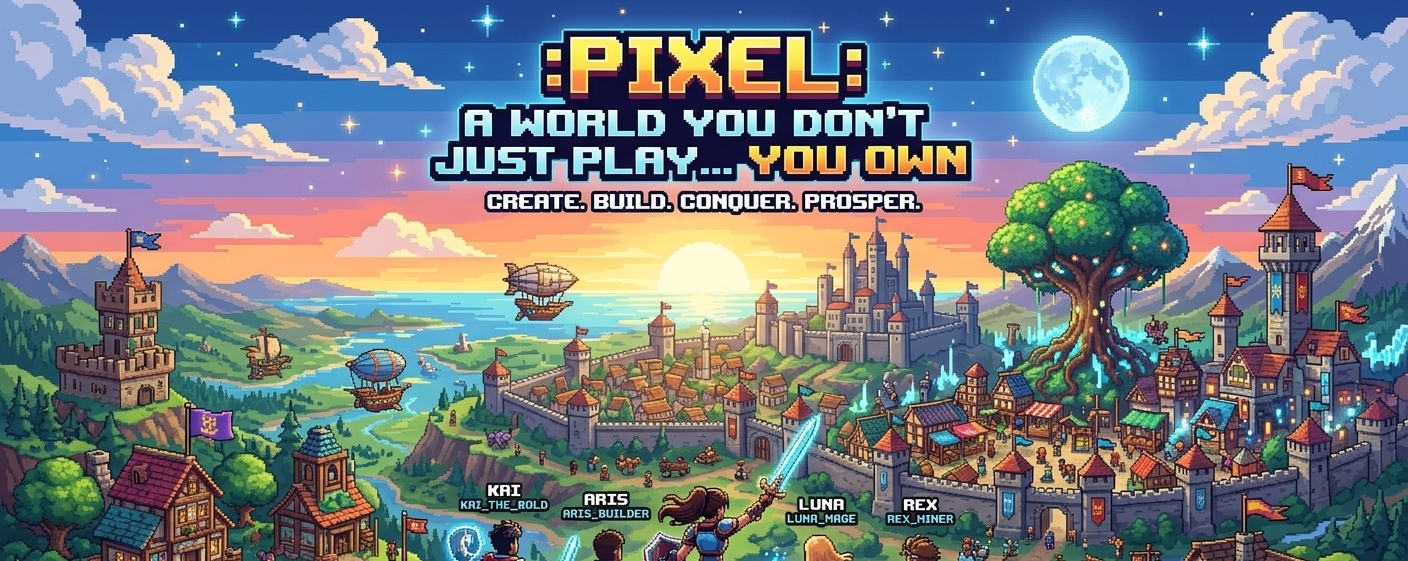
Pixels You log in, see a colorful pixel-style world, start planting crops, collecting items, and walking around talking to other players. It feels light, casual, and familiar. But the more time you spend inside it, the more you realize it’s not just a game — it’s quietly trying to build something much bigger.
At its core, Pixels is a social, open-world farming game built on the Ronin Network. This matters because most traditional games run on closed systems, where your progress stays inside the game and has no real-world connection. Pixels changes that by connecting gameplay to blockchain, meaning your items, land, and progress can actually be owned by you. You’re not just playing — you’re participating in a system that tracks and values your time.
What makes Pixels different is how it approaches value. Earlier Web3 games made the mistake of focusing too much on earning. They attracted players with rewards, but those rewards didn’t last because the systems weren’t sustainable. People came to extract value, not to stay. Pixels takes a slower, more thoughtful approach. It focuses on making the game enjoyable first — farming, exploring, crafting, interacting — and then builds an economy around those actions. It doesn’t push you to earn; it lets value emerge from what you naturally do.
The gameplay loop is simple but layered. You start by farming crops, gathering materials, and completing small tasks. Over time, you unlock more areas, interact with other players, and start understanding how resources flow. There’s a social element too — players share spaces, collaborate, and build small communities. This makes the world feel alive rather than isolated. Even though your actions feel small, they connect into a larger system where supply, demand, and player behavior slowly shape the economy.
A big part of how this system works comes from its dual-token structure. There is an in-game resource called BERRY, which is earned through gameplay and used for everyday actions like crafting and upgrading. Then there is PIXEL, which acts as the main token of the ecosystem. PIXEL is used for more important things like governance, premium features, and certain upgrades. This separation is important because it helps control inflation. Not everything is tied to one token, which reduces the risk of the economy collapsing under too much reward distribution.
Ownership is another key layer. Players can own land NFTs, which are not just cosmetic. Land owners can generate resources, host activities, or benefit from what happens on their land. This creates a system where players are not just participants but also stakeholders. Instead of everything being controlled by developers, parts of the economy are shaped by players themselves. This shift is subtle but powerful — it turns the game into something closer to a shared digital space.
The ecosystem around Pixels keeps expanding. It started as a simple farming experience, but it’s slowly adding more depth — crafting systems, resource management, quests, and social interactions. The idea is not to overwhelm players at the start, but to let complexity reveal itself over time. This is why many people underestimate it early on. It doesn’t try to impress you immediately. It grows on you.
Looking at its roadmap, Pixels is focused on long-term development rather than quick hype cycles. The team is working on improving gameplay depth, adding more utility to the PIXEL token, expanding social features, and strengthening the overall economy. There is also a strong focus on scaling the player base without breaking the system, which is one of the hardest challenges in Web3 gaming. Growth is good, but uncontrolled growth can destroy an in-game economy. Pixels seems aware of this and is moving carefully.
Still, it’s not without challenges. One of the biggest risks is maintaining balance between fun and financial value. If the game leans too much into earning, it risks repeating the mistakes of earlier GameFi projects. If it ignores value completely, it may lose the Web3 advantage. Finding that balance is not easy. Another challenge is keeping players engaged long-term. Farming and resource loops can become repetitive if not updated regularly. The team needs to keep introducing new mechanics without breaking the simplicity that makes the game appealing.
There’s also the broader challenge of perception. Many people still associate Web3 games with hype, speculation, and short-term profit. Pixels is trying to change that narrative, but it takes time. It needs to prove that a blockchain game can be sustainable, enjoyable, and meaningful without relying on aggressive reward systems.
What makes Pixels interesting is not just what it is today, but what it represents. It’s an experiment in whether a simple game can quietly build a real economy without forcing it. It’s testing whether players will stay for the experience, not just the rewards. And it’s exploring whether digital ownership can feel natural instead of complicated.
In the end, Pixels doesn’t try to overwhelm you with complexity or promise instant gains. It starts small, almost unnoticeable, and slowly reveals its depth. And that’s exactly what makes it different — it’s not trying to prove itself loudly, it’s letting the system speak over time.
