
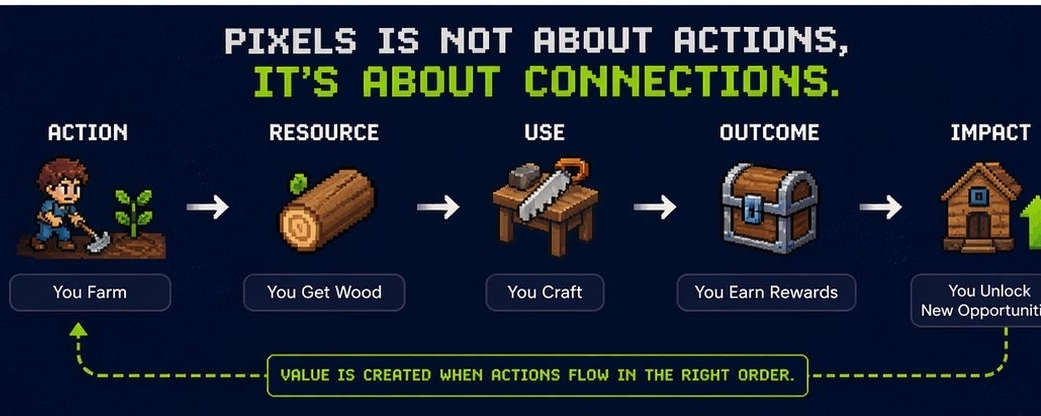

There was a moment where Pixels didn’t feel confusing anymore.
Not because it became simpler…
but because I started looking at it differently.
Early on, I played it the way most people do.
Follow the loop. Do tasks. Farm, craft, earn $PIXEL. Repeat.
It felt smooth. Predictable. Like the game was guiding me and all I had to do was keep moving.
And for a while, that worked.
But then something didn’t add up.
I could spend the same amount of time, do the same kind of actions… and still end up with different results. Some sessions felt efficient. Others felt like I was just busy without actually gaining anything.
That inconsistency stayed in the back of my mind.
So I stopped rushing.
I started observing.
Not just what gives rewards, but what those rewards actually turn into. What they unlock. What they delay. What they quietly affect later.
That’s when Pixels started to feel less like a game loop… and more like a system.
Because the value wasn’t in the action itself.
It was in how each action connects to the next.
That realization changed how I moved inside the game.
Resources stopped being “useful by default.”
They became situational.
Sometimes holding them made more sense than using them.
Sometimes waiting created more value than acting immediately.
That idea didn’t come from the game explaining anything.
It came from noticing patterns over time.
And once I saw it, I couldn’t unsee it.
I started paying attention to how different players behave.
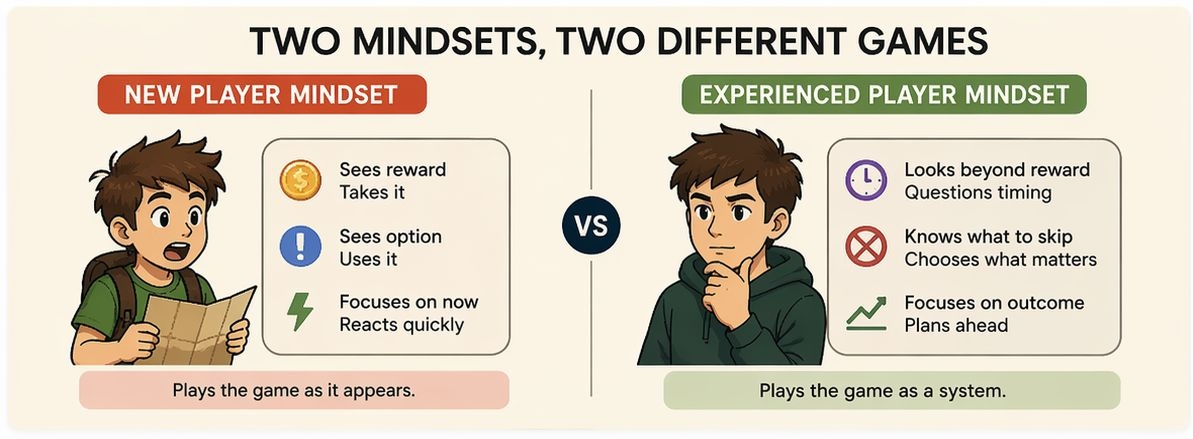
New players usually move on instinct. If something is available, they take it. If something pays, they repeat it. Their focus is on what’s happening right now.
Experienced players don’t move like that.
They slow down. They skip opportunities. They make decisions that don’t look efficient in the moment… but clearly serve a bigger plan.
That difference is subtle, but it’s everything.
Because it shows that Pixels has layers it never directly shows you.
You don’t get a clear roadmap.
You get outcomes — and you’re left to connect them yourself.
Over time, you realize:
Some actions only work in the right context.
Some resources lose impact if used too early.
Some decisions barely matter now… but define your position later.
That’s when my thinking shifted.
I stopped focusing on activity.
And started focusing on direction.
Not “What should I do next?”
But “What does this decision set up?”
That one change made the whole system feel clearer.
It even started to feel familiar in a strange way.
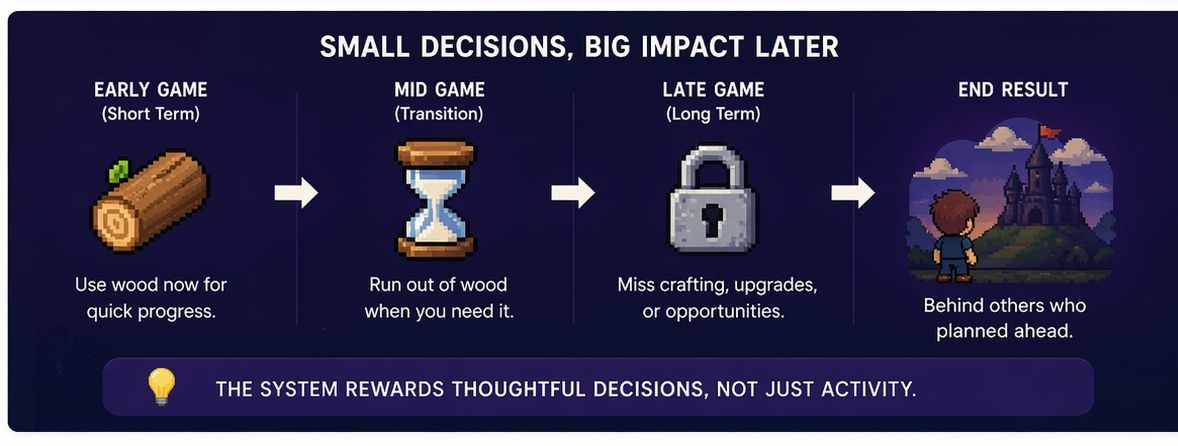
Like learning how to manage time or money. At first, you react. You do what feels right in the moment. But once patterns become visible, you stop reacting and start planning ahead.
Pixels creates that same transition.
You’re still playing, but you’re also adjusting, predicting, holding back when needed. Small mechanics start influencing bigger decisions.
And the gap between players becomes obvious.
Some are playing the surface.
Others are navigating the structure underneath.
Same game. Different mindset.
And maybe that’s the real design.
Maybe Pixels isn’t just about progression…
maybe it’s about shifting how you think while you progress.
Which leaves me with something I keep coming back to:
If progress comes more from understanding than from effort…
if waiting can be stronger than acting…
Then what am I really doing when I play?
Am I just moving through a game…
Or learning how to read systems without being told how?
