
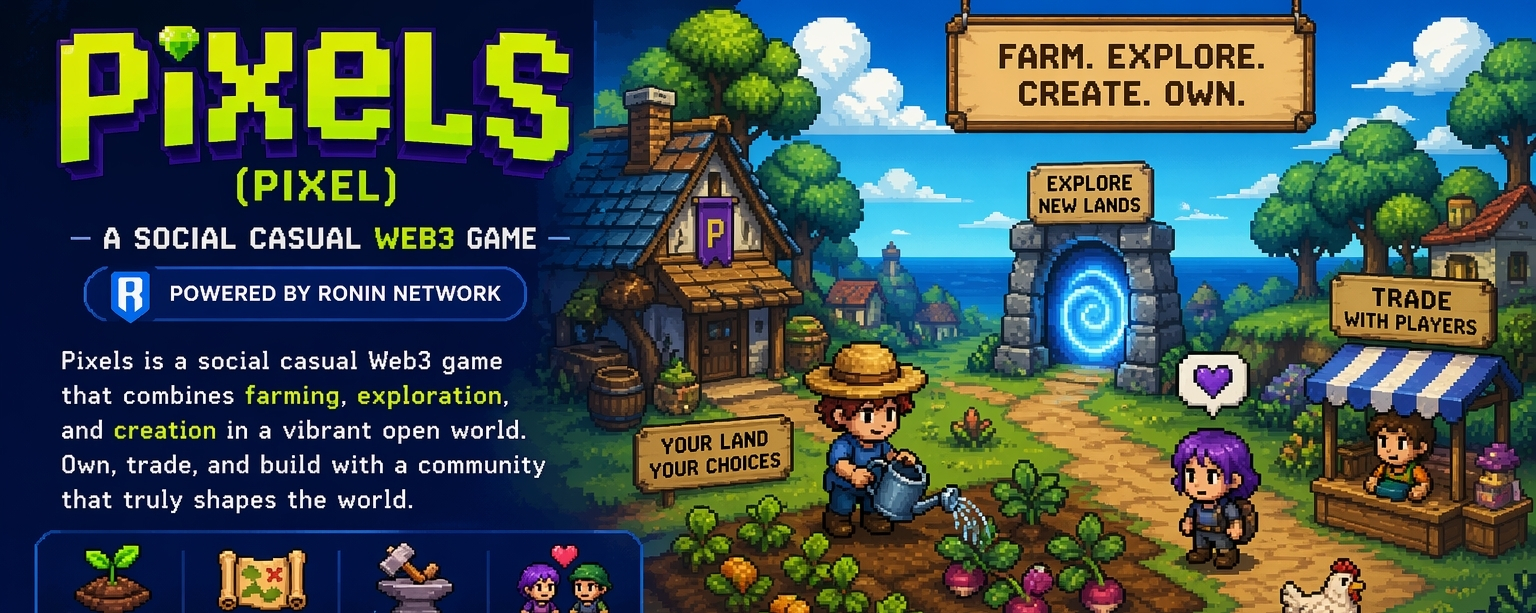

I’ve been around long enough in crypto to recognize the familiar rhythm of a new project pitch. There’s usually a grand narrative about ownership, a promise of community-driven economies, and some version of “this time it’s different.” So when I first stumbled across Pixels, a social, casual Web3 game built on the Ronin Network, I approached it the same way I approach most things in this space now—curious, but with a layer of skepticism that only comes from watching cycles repeat.
At first glance, Pixels doesn’t try to overwhelm you. It’s not pretending to be the next hyper-realistic metaverse or a AAA competitor to traditional gaming giants. Instead, it leans into something quieter: farming, exploration, crafting mechanics that feel almost nostalgic. That choice alone caught my attention. Most crypto games aim too high, chasing spectacle before substance. Pixels, at least on the surface, feels like it’s intentionally scaling down the ambition to something more manageable.
But then the question that always matters starts creeping in: is this restraint intentional design maturity, or just another iteration of limitations dressed up as minimalism?
As I spent more time exploring Pixels, what stood out wasn’t just the gameplay loop—it was the architecture sitting beneath it. Being powered by the Ronin Network is a deliberate decision. Ronin, originally designed to support Axie Infinity, has already gone through its own trial by fire: scaling issues, security breaches, and the slow rebuilding of trust. Choosing Ronin means Pixels is plugging into an ecosystem that has already confronted some of the core problems of blockchain gaming transaction costs, user onboarding friction, and throughput.
That matters more than it might seem at first. One of the biggest structural failures in Web3 gaming has always been the disconnect between gameplay and infrastructure. You can’t build a smooth, casual experience on top of a clunky, expensive transaction layer. Players won’t tolerate it, no matter how compelling the tokenomics look on paper. Pixels seems to understand this, or at least it’s trying to. The game feels designed with the assumption that users shouldn’t have to constantly think about the blockchain, even though it’s there underpinning everything.
That brings me to the core idea: Pixels isn’t really about farming. Or at least, farming is just the surface layer. What it’s actually experimenting with is digital ownership in a social environment that doesn’t feel overtly financialized. That’s a subtle but important distinction.
The “problem” Pixels claims to address isn’t new. It’s the same one nearly every Web3 game gestures toward: players spend time and effort in virtual worlds but don’t truly own what they create or earn. Traditional games lock assets into closed ecosystems. Web3 promises to unlock them.
On paper, that sounds compelling. In practice, it’s often been misinterpreted. The industry has a tendency to equate “ownership” with “financial speculation.” Instead of creating meaningful in game economies, many projects have turned assets into tradeable commodities first and gameplay elements second. That inversion has damaged trust, and honestly, it’s one of the reasons I approach every new project with caution.
Pixels feels like it’s trying to walk a different path, or at least a slightly adjusted one. The economy exists, but it doesn’t scream at you. You’re not immediately confronted with token charts or ROI calculations. You’re planting crops, interacting with other players, and slowly becoming aware that there’s a layer of ownership underneath those actions.
I find that approach interesting, though I’m not entirely convinced yet. There’s always a tension in these systems: if the financial layer is too subtle, it risks becoming irrelevant; if it’s too prominent, it distorts behavior. Pixels seems to be experimenting with that balance, but it’s a delicate equilibrium, and I’m not sure anyone in the industry has fully solved it yet.
What makes this more significant is the broader context. Web3 gaming has struggled to answer a fundamental question: are we building games that happen to use blockchain, or are we building financial systems disguised as games? Most projects, if we’re being honest, have leaned toward the latter. That’s why so many of them collapse when token incentives dry up—because the underlying gameplay wasn’t strong enough to stand on its own.
Pixels appears to be aware of this trap. The pacing, the art style, the mechanics—they all suggest a focus on retention through experience rather than extraction through incentives. But awareness alone isn’t enough. Execution is what ultimately determines whether this becomes a sustainable ecosystem or just another short-lived experiment.
As I moved through the world of Pixels, interacting with its systems and observing how players behave, I kept thinking about how much of crypto’s history is shaped by cycles of overcorrection. We go from extreme speculation to attempts at pure utility, then back again. Pixels feels like part of a phase where projects are trying to reintroduce simplicity and user experience after years of complexity and financialization.
There’s something almost philosophical about that shift. It suggests that the industry is slowly realizing that technology alone doesn’t create meaning—people do. And people don’t stick around for systems that feel transactional at their core. They stay for environments that feel alive, even if the mechanics themselves are simple.
That said, I can’t ignore the uncertainties. One of the biggest challenges Pixels faces is longevity. Casual games are notoriously difficult to sustain, even outside of Web3. They rely heavily on continuous engagement, content updates, and social dynamics. Adding a blockchain layer doesn’t automatically solve those challenges it can actually complicate them.
Then there’s the question of the token itself, PIXEL. Every time a token is introduced, it brings a new layer of expectations and risks. Tokens create alignment, but they also introduce speculation. No matter how carefully designed the system is, there’s always the possibility that market behavior will overshadow gameplay. I’ve seen it happen too many times to ignore.
Another thing I keep coming back to is onboarding. Pixels is more accessible than many Web3 games, but the broader issue still exists: how do you bring in players who don’t care about crypto at all? Because ultimately, that’s the real test. If a game only appeals to crypto-native users, it’s operating within a limited bubble. Breaking out of that bubble requires more than good design—it requires a shift in perception.
And perception is something the Web3 gaming space still struggles with. There’s a lingering skepticism, and not without reason. Too many projects have overpromised and underdelivered. Too many have prioritized short-term gains over long-term sustainability. Pixels is entering that landscape whether it wants to or not, and it has to contend with the baggage the industry carries.
Still, I can’t dismiss what it’s trying to do. There’s a certain humility in its design that feels refreshing. It’s not trying to redefine gaming overnight. It’s not making grand claims about revolutionizing the metaverse. Instead, it’s building something small, iterative, and—at least for now—coherent.
Maybe that’s the real takeaway for me. Not that Pixels is the answer, but that it represents a shift in approach. A recognition that progress in this space might come from incremental improvements rather than sweeping transformations.
As I step back and think about it, I realize my perspective hasn’t fully settled. Part of me is cautiously optimistic. Another part remains unconvinced, waiting to see how the system evolves under pressure—because that’s when the true nature of these projects reveals itself.
Crypto has a way of amplifying both strengths and weaknesses. If Pixels has built something genuinely engaging, the community will reinforce it. If there are cracks in the design, they’ll widen over time.
For now, it feels like walking through an early version of something that could go in multiple directions. And maybe that’s okay. Not every project needs to arrive fully formed. Sometimes the value lies in the attempt itself—in exploring new combinations of ideas, even if they don’t fully succeed.
I don’t think Pixels is trying to change the world. And oddly enough, that might be its strongest quality.
