
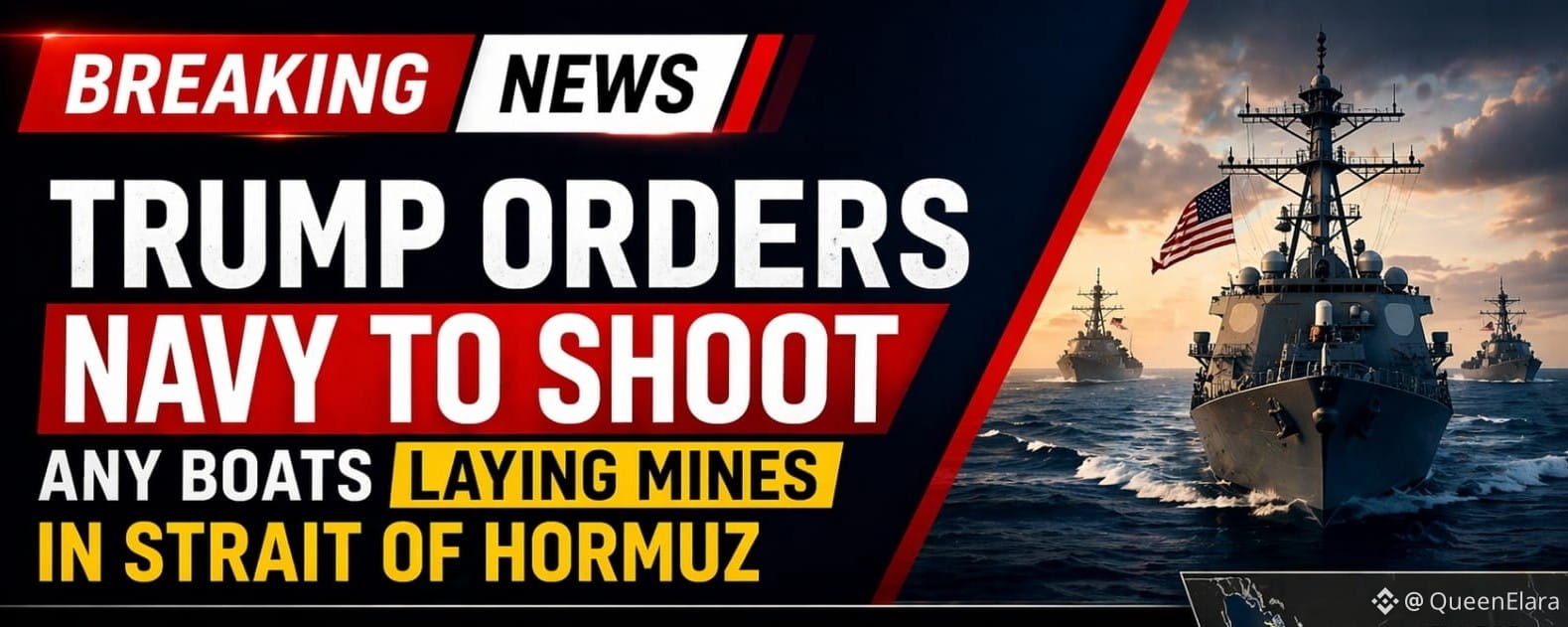
This doesn’t feel like a warning anymore—it feels like a line has been crossed. Donald Trump has now ordered the U.S. Navy to fire on any boats laying mines in the Strait of Hormuz, while ramping up mine-clearing operations to triple the previous level. From how I see it, this isn’t preparation—it’s execution.
The tone here is completely different from before. There’s no gray area left. If a vessel is identified as a threat, it becomes a target. That kind of clarity might reduce hesitation on the ground, but it also increases the chance that something escalates very quickly.
What really catches my attention is how fast things are moving. Just days ago, the focus was on negotiations and possible de-escalation. Now we’re looking at active military directives in one of the most sensitive chokepoints on the planet. That shift isn’t gradual—it’s immediate.
And this isn’t happening in isolation. The Strait of Hormuz is where global energy flows converge. Every tanker, every route, every delay—everything ties back to this narrow stretch of water. When military orders become this aggressive in that location, it doesn’t stay a regional issue.
Another angle I’m watching is how this changes behavior across the board. Shipping companies, insurers, traders—they all react to risk. And when risk becomes visible like this, decisions change fast. Routes shift, premiums spike, and uncertainty spreads.
For me, the bigger picture is clear:
This isn’t about guarding a route anymore.
It’s about controlling a situation that’s already slipping into confrontation.
And once that shift happens, things don’t move slowly.
They move fast, they react fast, and they escalate fast.
Right now, the question isn’t whether tensions are rising It’s how far they go from here.