

I used to treat missions in Pixels like small tasks you clear on the side. Something to do while you’re already playing. Complete, collect, move on.
That stopped making sense the moment I noticed two players doing the same mission and getting very different outcomes—not just in rewards, but in what they did next.
One stayed in the loop. The other disappeared after cashing out.
Same task. Same reward surface. Completely different result.
That’s when it hit me that missions in Pixels aren’t really tasks anymore. They’re decisions. And not simple ones.
Every mission is quietly answering a harder question: how much is this behavior worth, for this player, right now, inside this system.
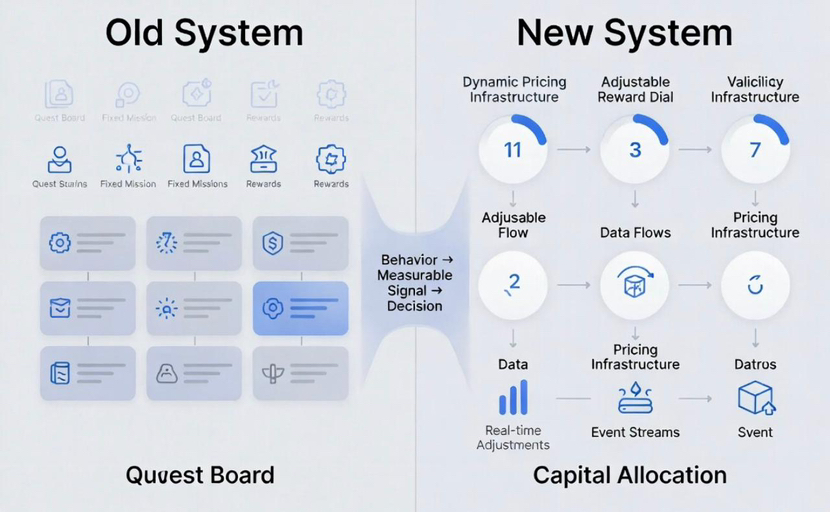
Once you see that, the whole thing stops looking like a quest board.
It starts looking like pricing infrastructure.
Stacked is where that shift becomes visible.
From the outside, it still feels familiar. You open one place, see missions, build streaks, earn across titles, and move rewards out. That part is intentionally simple.
Underneath, it’s doing something else entirely.
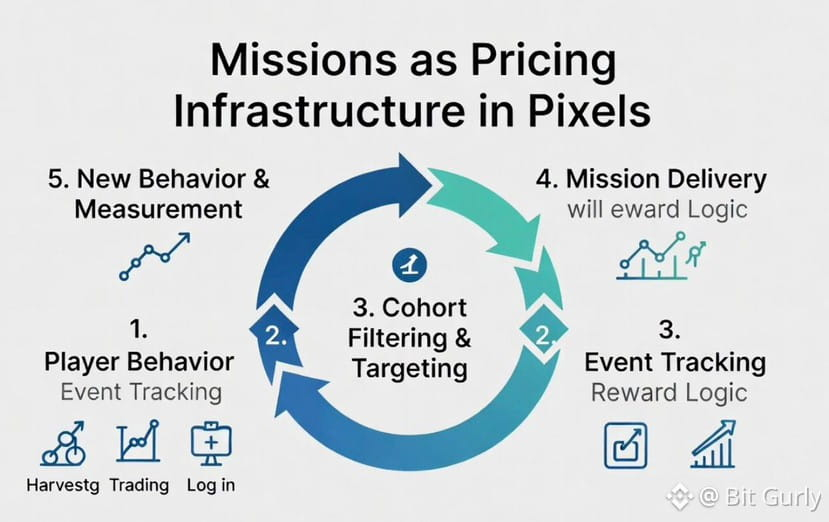
Every action you take—harvesting, trading, crafting, logging in at a certain time, coming back after a break—is being tracked as an event. Not just recorded, but structured in a way that can be acted on. That event data feeds into targeting logic, which decides who should see which missions. Then reward logic sits on top of that, deciding what form the payout should take and how much of it is justified.
And that’s before you even get to fraud controls, attribution, and testing.
So instead of a fixed mission system, you end up with something closer to a loop:
players generate behavior → behavior becomes events → events are filtered into cohorts → cohorts receive missions → missions produce new behavior → system measures what actually changed → reward logic adjusts again
That loop keeps running.
The important part is that nothing inside it is fixed.
Missions are not written once and deployed. They are constantly repositioned based on what the system is learning about player behavior.
This is where most older systems break.
They assume missions create behavior. So they design content first, attach rewards, and hope engagement follows. When it doesn’t, they increase rewards or add more missions.
Pixels seems to be doing the reverse.
It starts from behavior that already exists, then decides whether it’s worth reinforcing.
That changes how value moves through the system.
Instead of spending rewards to generate activity, the system is trying to identify which activity deserves to be paid for at all. And that’s where the idea of return on reward spend becomes real, not just a phrase.
If a mission brings players back but they leave right after collecting, that spend didn’t produce anything durable. If a mission pushes players into loops where they spend, interact, or stay longer, then it starts to justify itself.
Over time, the system begins to separate noise from signal.
And once that separation starts, missions stop being content and start becoming capital allocation.
That’s also why the slow rollout isn’t a weakness.
It’s actually necessary.
When you’re dealing with a system that reacts to behavior this quickly, scaling too early hides what’s actually happening. You get activity, but you don’t know why. And if you don’t know why, you can’t correct anything when it breaks.
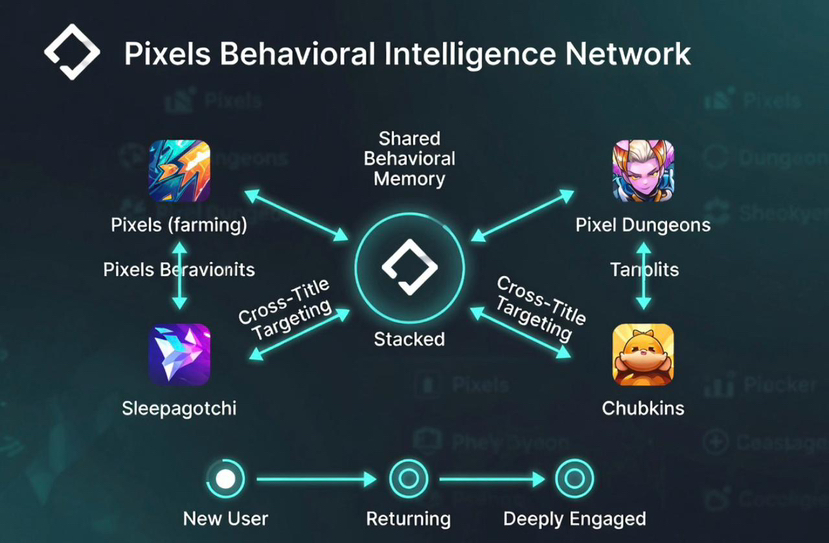
Starting with internal titles like Pixels, Pixel Dungeons, Sleepagotchi, and Chubkins gives the team something most projects don’t have: a controlled environment where they understand the loops deeply.
They know where players drop off. They know which mechanics get abused. They know where rewards inflate behavior that doesn’t last.
So when Stacked runs inside those environments, every result is easier to interpret. They’re not guessing what changed—they’re measuring against known patterns.
That’s how you turn experimentation into actual learning instead of just more data.
Another layer that doesn’t get enough attention is the reward mix.
In older systems, one token tries to do everything. It rewards players, attracts attention, holds speculative value, and supports liquidity. That usually works early, then breaks under pressure.
Here, different reward types carry different meanings.
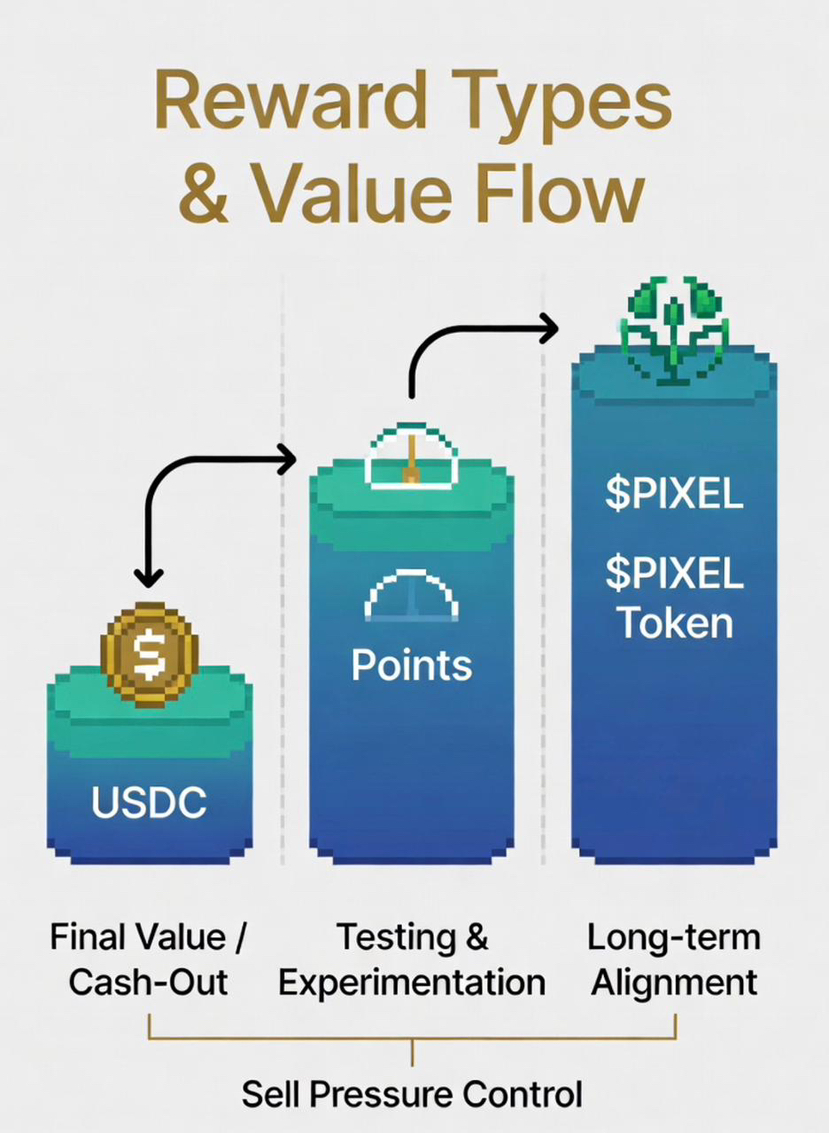
A stable reward like USDC feels final. It’s closer to cash. When a system pays in something stable, it’s making a strong statement: this behavior is worth real value right now.
A native token like $PIXEL does something else. It ties the reward back into the ecosystem. It can encourage longer-term participation, interaction across systems, or alignment with the project’s growth.
Points sit somewhere in between. They’re flexible. They can be used to test behaviors without immediately turning everything into liquid value.
Once you have these options, you’re no longer forced to treat every mission the same way.
You can reward high-value behaviors with stable payouts, experimental behaviors with points, and ecosystem-aligned actions with tokens. That reduces the pressure on any single asset and gives the system more control over how value flows.
It also changes sell pressure dynamics in a very practical way.
Not every reward needs to become immediate exit liquidity. Some can stay inside the system longer, some can be tested without market impact, and some can be paid out where it actually makes sense.
That’s where the idea of mission design becoming a science starts to feel real.
Because now you’re not just designing tasks. You’re tuning variables:
reward type reward size timing target cohort frequency expected behavioral change
Each mission becomes a small experiment with a measurable outcome.
And over time, those experiments stack into something more valuable than any single loop.
They build memory.
Not memory in the player sense, but system memory.
The system starts to “remember” what works for which type of player, under which conditions, at which stage of their lifecycle. It learns how new users behave differently from returning ones. It learns which incentives pull players deeper and which ones just extract value without building anything.
That memory doesn’t stay inside one game.
Once Stacked connects multiple titles, it starts moving across them.
A player who behaves a certain way in Pixels might be targeted differently in Pixel Dungeons. A retention pattern seen in Sleepagotchi might influence how missions are structured in Chubkins.
That’s when the project stops being a single game.
It becomes an ecosystem that shares behavioral intelligence.
And that’s also where things get more serious.
Because at that point, the challenge isn’t just building fun loops. It’s making sure the system doesn’t become too optimized for its own metrics.
If every mission is perfectly tuned for retention or spend, you risk creating something that feels mechanical instead of engaging. Players don’t experience systems as equations. They experience them as choices, friction, and reward.
So there’s always a balance.
Too loose, and rewards get wasted. Too tight, and the system starts to feel engineered instead of alive.
Pixels seems to be sitting right in the middle of that tension right now.
It has enough data to start treating missions as economic decisions, but it still has to translate those decisions into something players actually want to engage with.
That’s not an easy layer to build.
But it’s also what makes this direction more interesting than just another game update.
Because if this works, missions stop being repetitive tasks entirely.
They become a way for the system to continuously negotiate value with its own players.
And that’s probably the clearest way to read Pixels now.
Not as a farming game with a token. Not even as a LiveOps-driven game.
But as a system that is slowly turning player behavior into something measurable, comparable, and allocatable—then using that to decide where value should go next.
