
At first, I couldn’t really explain what felt off.
Nothing was broken. Nothing looked obviously unfair. It was just one of those small feelings you get when something doesn’t line up the way you expect. Not enough to stop you. Just enough to stay in the back of your mind.
I was moving through Pixels like everyone else. Farming a bit. Checking things. Coming back. Repeating the same small routines. The world felt active. People were everywhere. Everyone looked involved. And when a game feels that alive, you usually don’t question it too much. You just assume the system is working the way it looks.
But after a while, I started noticing something.
A lot of people were doing the same things.
Putting in time. Repeating the loop. Staying active. Showing up.
But the part where all that effort turned into something that actually mattered… that part didn’t seem to happen evenly.
That was the strange part.
Not because a few people were winning. That happens everywhere. It was more that the same kind of people always seemed to be there right when things became important. Right when effort stopped being effort and turned into something more final.
And they didn’t look special.
They weren’t louder. They weren’t obviously better. They didn’t even stand out that much at first.
They were just… there.
Consistently.
That’s what made me pause.
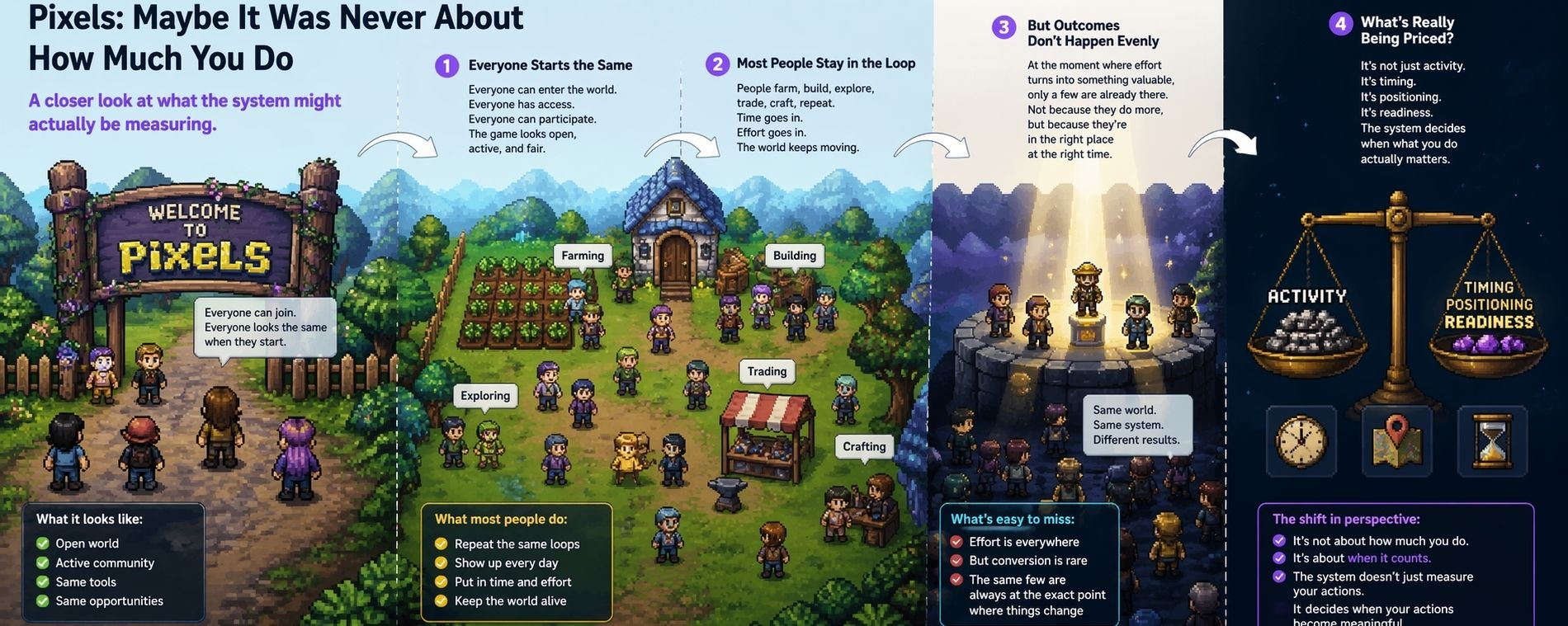
Because on the surface, Pixels looks like a game built around participation. Everyone is doing something. Farming, building, trading, exploring, checking in. So naturally, you start by thinking that participation is what the system values most.
But the longer I watched, the harder that was to believe.
Because if effort was the main thing being measured, the outcomes would feel different. Not equal. Just more connected to the amount of work people were actually putting in.
Instead, what stood out was repetition.
A lot of people kept repeating the same actions.
Only some seemed to reach the moment where those actions actually counted.
And once I noticed that, the whole thing started to feel a little different.
Still active. Still social. Still real.
But less open in the way it first seems.
Not because people can’t join. They clearly can. Not because people aren’t trying. They clearly are. But because not every kind of effort seems to carry the same weight.
Some effort keeps the world moving.
Some effort seems to arrive exactly when the world is ready to turn that effort into something valuable.
That difference is easy to miss when you’re only looking at activity.
But when you start watching behavior more closely, it shows up.
You see people grinding through the same loops again and again, hoping the repetition itself will eventually pay off. And then you see others who don’t seem more active, just more aligned with the moment something shifts.
Not smarter.
Not more deserving.
Just somehow closer to the point where things convert.
I think that’s the part I noticed late.
Not because it was hidden. Mostly because I wasn’t looking for it.
I was watching what people were doing.
I wasn’t watching when what they did actually started to matter.
And that changes how the whole system feels.
Because then it stops looking like a world that simply rewards participation.
It starts looking more like a world that filters participation. A world where being present is not always enough. Where effort alone doesn’t decide much unless it meets the right moment, the right position, maybe even the right kind of readiness.
You see this pattern in other places too. Not just games.
Systems where everyone can enter. Everyone can stay active. Everyone can help create the appearance of movement.
But only some people seem to arrive exactly where that movement becomes value.
That doesn’t mean the rest of the activity is fake.
It just means it may not be the thing the system is truly responding to.
And maybe that’s the better way to look at Pixels.
Not as a system that simply measures what people do.
But as one that decides when what they do actually matters.