

I just closed another tab about crypto games and I’m honestly not even surprised anymore. Same loop, same language, same “revolutionary ecosystem” claims that sound like they were generated by a marketing intern who’s been awake for 36 hours and told to “make it sound disruptive.”
Everything is always “redefining ownership” or “changing digital economies forever,” but when you actually sit down and look at what people are doing in these worlds, it’s usually farming tokens, watching numbers move up and down like a stressed heartbeat, and hoping the next update brings more players instead of just more acronyms.
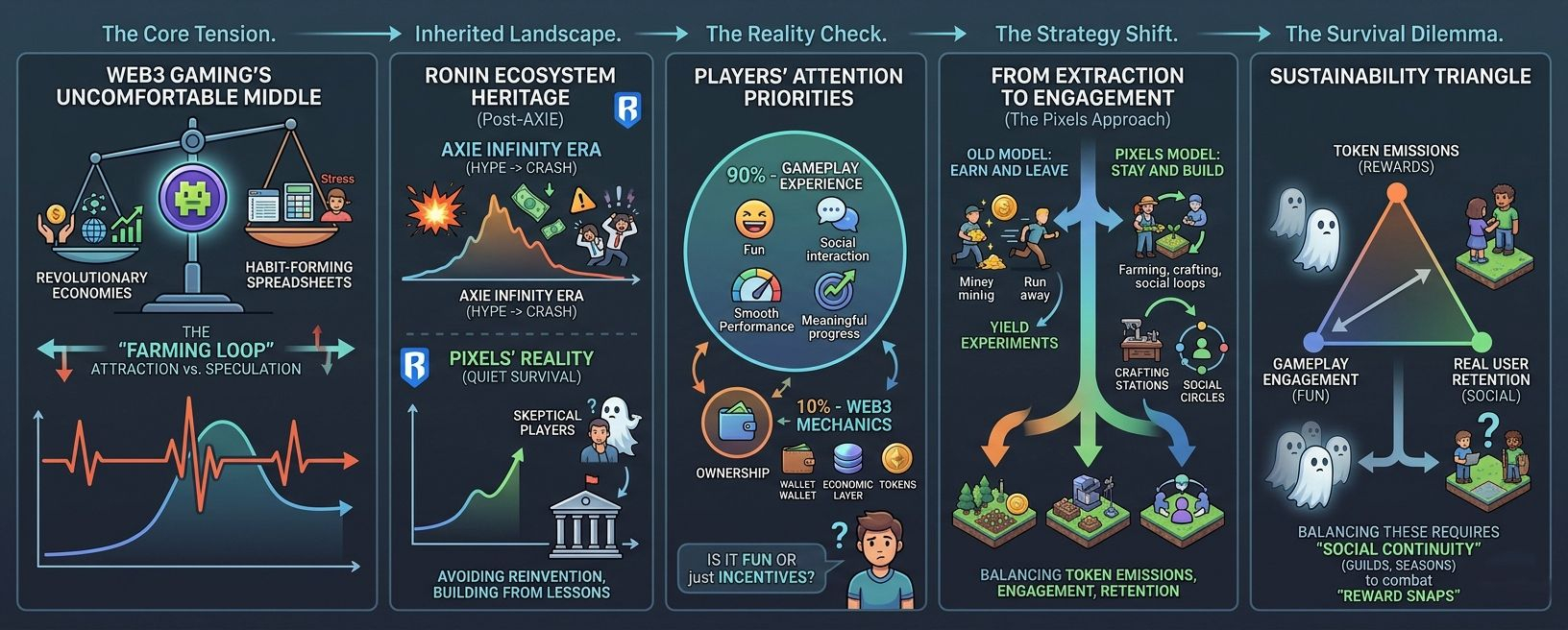
And I keep coming back to this weird tension in my head: crypto games are either the future of digital economies or just extremely expensive habit-forming spreadsheets with better graphics.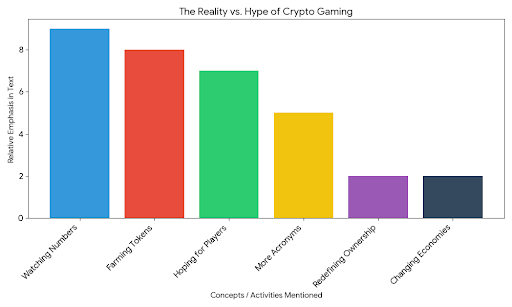
Pixels (PIXEL) is one of those projects that sits right in that uncomfortable middle where I can’t fully dismiss it, but I also can’t pretend it isn’t carrying the same baggage the whole sector has been dragging around for years.
It runs on the Ronin Network, which already tells you a lot about the kind of environment it’s trying to survive in. Ronin is basically the “we had to build our own lane because Ethereum gas fees made gaming impossible” story that came out of the Axie Infinity era. That alone is important because Pixels isn’t trying to reinvent blockchain gaming from scratch. It’s trying to live in an ecosystem that already had a massive boom, a massive crash, and a lot of skeptical users still hovering around like they’re waiting to see if the next wave is real or just another replay.
Pixels itself is a social casual Web3 game built around farming, exploration, and creation. On paper, that sounds almost intentionally safe. No hyper-competitive esports narrative. No high-stakes PvP economy obsession. Just a kind of digital life sim where people plant things, craft things, explore a world, and interact socially.
And I’ll be honest, that’s probably its smartest decision and also its biggest limitation.
Because “farming and creating in a cozy open world” is not new. That exists outside crypto already in countless forms. The difference, at least in theory, is ownership and economic participation. The idea is that time spent in the game isn’t just entertainment, it’s value creation. That’s the pitch that keeps Web3 gaming alive even when sentiment in the broader market turns cold.
But here’s where reality starts pulling at the edges of that pitch.
Most players don’t actually care about ownership mechanics at the level these systems assume they will. They care about whether the game is fun, whether it runs smoothly, whether their friends are online, and whether there’s something meaningful to do next. The economic layer only becomes important when it either breaks or becomes the only reason to play.
Pixels is trying to avoid that trap by leaning into accessibility. It’s designed to feel light, almost browser-friendly in spirit, even if the backend complexity is anything but simple. The Ronin integration helps reduce friction, which is one of the biggest real problems in blockchain gaming: onboarding people without forcing them through five wallets, three bridges, and a tutorial that feels like filing taxes.
Still, friction is only one part of the problem.
The bigger issue is attention.
Crypto games don’t usually die because the tech fails. They die because nobody stays long enough to form a stable economy. Liquidity dries up, players migrate to the next incentive cycle, and suddenly the world feels like it’s populated by ghosts who are only there because they’re waiting for a reward snapshot.
Pixels has been trying to solve that by building more social loops and progression systems rather than pure reward farming. Guild dynamics, crafting economies, land systems, seasonal updates, and expanding gameplay loops are all part of that direction. The idea is to slowly turn “earn and leave” behavior into “stay and build” behavior.
But that’s easier said than done in a market where users have been trained, over multiple cycles, to treat every crypto game like a short-term yield experiment.
I’ve seen the same pattern repeat across the space too many times. Early excitement, token launch energy, influencer coverage that sounds like discovery but is actually distribution, then a slow drift into reality where retention decides everything and hype stops being a renewable resource.
Pixels benefits from timing in a weird way. It didn’t launch into the absolute peak mania where expectations were irrationally high, but it also isn’t early enough to avoid comparison with everything that came before it. Especially Axie Infinity, which still casts a long shadow over anything built on Ronin. That history matters because it trained an entire audience to associate blockchain games with both opportunity and collapse in the same breath.
Now, I don’t think Pixels is pretending to be something it’s not. It clearly understands that sustainability in Web3 gaming comes from balancing token emissions, gameplay engagement, and real user retention. The problem is that these three things rarely want to cooperate at the same time.
If you reward too much, the economy inflates and players become extractive. If you reward too little, players leave because the “Web3 advantage” disappears. If you focus too heavily on gameplay without strong incentives, you risk becoming just another Web2 clone with a wallet connection stapled onto it.
And somewhere in that triangle is where most of these projects either stabilize or slowly fade out.
As for current momentum and updates, what I can say without pretending to have perfect real-time telemetry is that Pixels has been actively evolving rather than sitting still. The team has been pushing seasonal content updates, expanding crafting and land-based mechanics, and trying to refine the in-game economy to avoid the usual collapse pattern that hits token-driven ecosystems. There’s also been continued emphasis on social structures, which honestly feels like one of the more important directions because isolation kills retention faster than bad graphics ever could.
But even with ongoing updates, the same structural question remains: does expansion equal adoption, or just complexity?
More features don’t automatically mean more players. Sometimes it just means more systems that existing players stop fully understanding after a while.
The broader Ronin ecosystem adds another layer to this. It’s not just about Pixels in isolation. It’s about whether gaming-specific chains can actually sustain multiple long-lived economies without each one cannibalizing attention from the others. Because attention, not technology, is the real bottleneck now.
Infrastructure in Web3 gaming is honestly not the hardest problem anymore. We’ve solved a lot of the technical friction. What hasn’t been solved is human behavior at scale. People still behave like tourists in these worlds. They arrive, explore the incentives, optimize quickly, and leave when the next shiny environment appears.
And maybe that’s not even irrational. Maybe it’s just what happens when every ecosystem is competing for the same limited pool of attention with slightly different skins over the same underlying mechanics.
Pixels tries to stand out by being less aggressive about speculation and more focused on continuity. That might give it longer life than the average Web3 game, but it also means it has to actually survive the boring phase where hype fades and only systems that truly work keep users engaged.
That’s the phase most projects underestimate. The part where nobody is tweeting about you every hour, where token price movement isn’t enough to bring people back, and where “fun” stops being a buzzword and becomes the only metric that matters.
I don’t have a clean verdict on it.
On one hand, Pixels feels like a reasonable attempt at building something that doesn’t completely rely on speculative energy. On the other hand, I’ve seen enough cycles to know that good intentions don’t automatically translate into sustained economies.
Maybe it manages to slowly build a real social layer inside Web3 gaming, something that actually keeps people returning because they care about their progress, their land, their creations, or their community. That would already put it ahead of a lot of experiments that came before it.
Or maybe it ends up being another familiar story where early adoption looks promising, updates keep rolling out, but the long-term retention curve quietly flattens until only the most committed players remain, while everyone else moves on without even announcing their departure.
It might work. Or nobody shows up in the way it needs them to.