


There is whether it can build an economy that actually lasts.
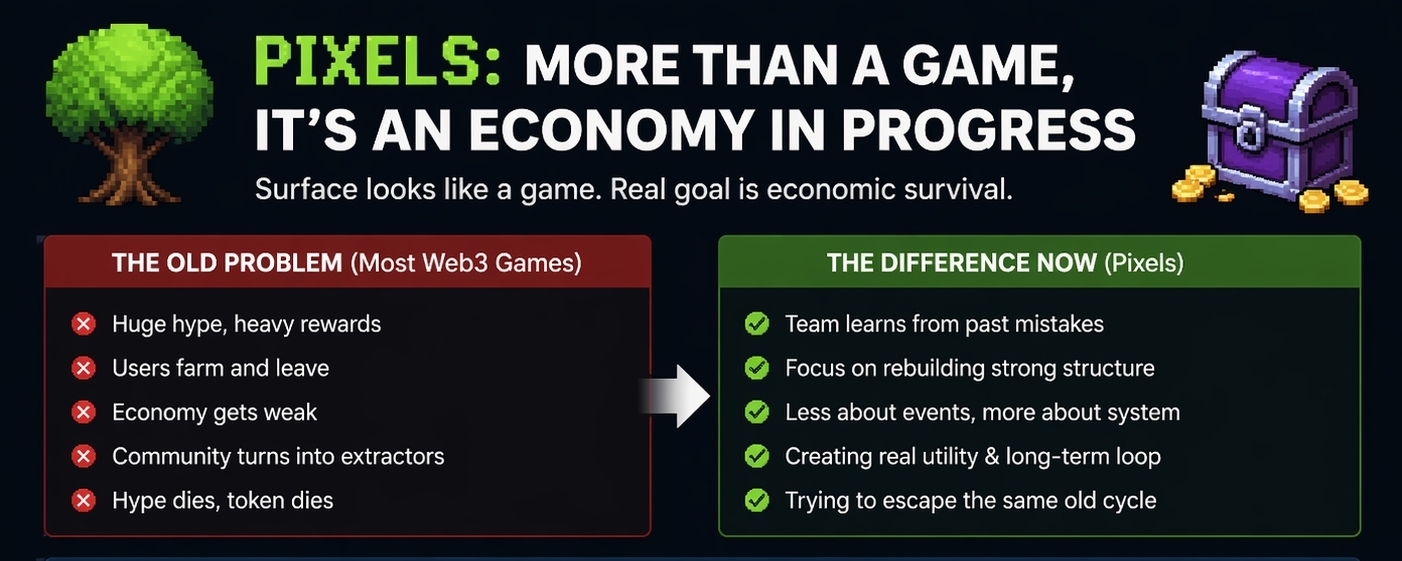
Too many Web3 games follow the same script: huge hype, rewards everywhere, fast growth… then the cracks show. Users farm and leave, tokens weaken, activity drops, and the “community” disappears overnight. We’ve all seen it.
What makes Pixels interesting now is that it doesn’t feel like a project pretending those mistakes never happened. It feels like a team trying to fix them in public. That matters more than any short-term event or reward campaign.
Most people still judge it like “just another game with incentives attached.” I don’t see it that way anymore. I see a project trying to move away from the old model of show up, click buttons, claim rewards, repeat.
Now it feels more focused on making the system itself stronger. Land has more importance. Production has more weight. Crafting matters. Resources matter. Timing matters. That doesn’t guarantee success… but it’s a smarter direction than blindly paying users to stay.
Because paying people to show up is easy. Building reasons for them to stay is hard.
And that’s where most crypto games fail. They can create traffic, but they can’t create depth. They can attract users, but not commitment. Once rewards slow down, everything falls apart.
Pixels at least looks aware of that trap.
That’s why I’m watching this phase closely. Not because every event is bullish. Most events are just noise. But repeated updates tied to a bigger economic design can tell you what a project is really becoming.
Right now, Pixels seems less focused on temporary excitement and more focused on creating a loop with actual stickiness. More friction, yes… but useful friction. The kind that makes players interact with systems instead of just extracting value and leaving.
That’s the real opportunity here. Not chasing the next reward drop. Not farming every campaign. But asking a better question:
Is the economy becoming real?
If yes, then early attention to mechanics matters more than timeline hype. The people studying utility flows, land value, crafting demand, and resource pressure could end up ahead of the crowd that only notices price moves later.
If no, then none of this matters. It’s just another polished grind with better branding.
I’m not blindly bullish. This market killed blind conviction a long time ago. But Pixels becomes far more interesting when you stop viewing it as a reward machine and start viewing it as a project trying to rebuild itself after learning hard lessons.
That process is messy. Slow. Sometimes ugly.
Still worth watching.
Because if they actually turn all this activity into a game economy with staying power… there may be something real here.
And if not?
Then it’s just another grind wearing a better skin.