
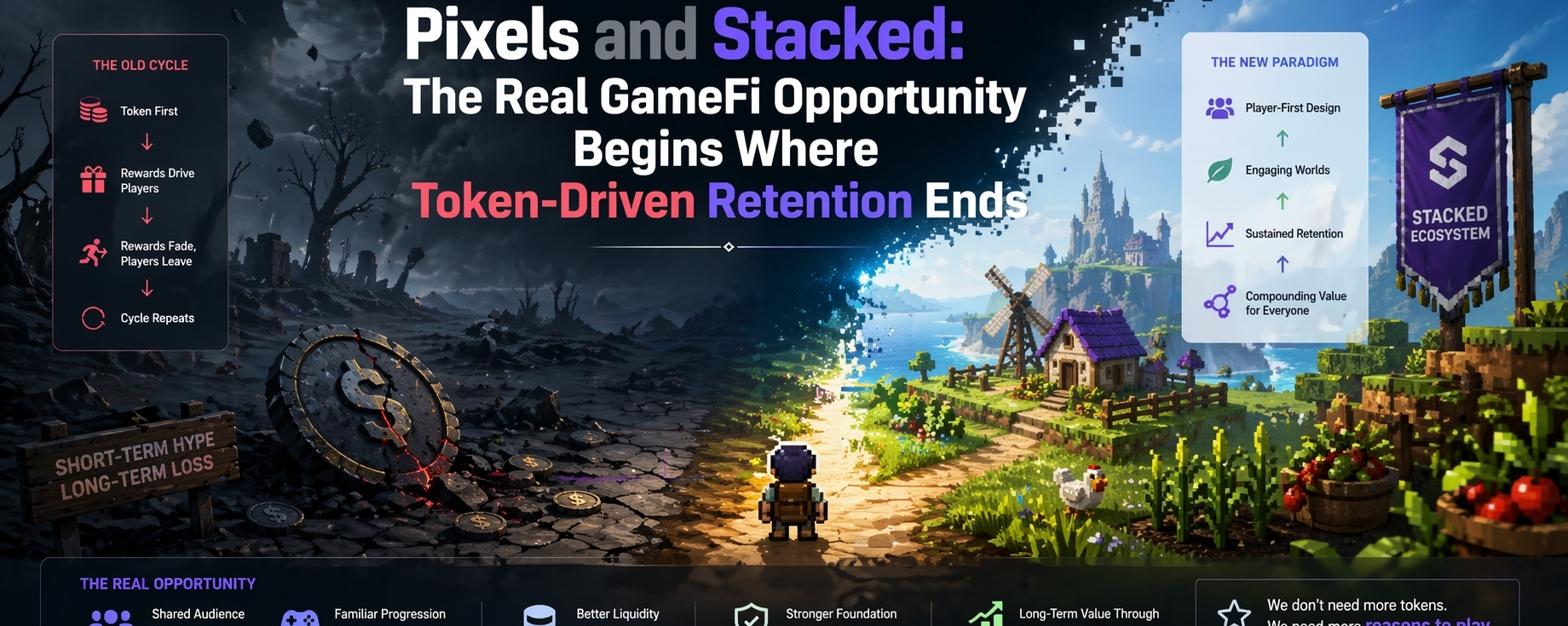

Over time, I’ve found myself becoming less interested in GameFi’s promises and more interested in its patterns. I’ve watched cycle after cycle unfold across the sector: new infrastructure, new token mechanics, new language around “opening platforms to developers,” and always the same expectation that better rails will somehow fix weak retention. After looking closely at enough of these systems, I’ve come to a different conclusion. GameFi has rarely had an infrastructure problem. What it has had, consistently, is a player-behavior problem.
That is exactly why Pixels has held my attention in a way most Web3 games haven’t. From my perspective, Pixels understood something fundamental much earlier than many projects did: players do not build long-term attachment to a game because it has a token attached to it. They stay because the game gives them a reason to return. As a social casual Web3 game built on the Ronin Network, with farming, exploration, and creation at the center of its open-world design, Pixels feels structurally different from the many projects that tried to financialize engagement before they had actually earned it. What made it stand out to me was never just the blockchain angle. It was the fact that the game seemed to generate repeat behavior first.
That distinction matters more than people sometimes admit. In my own reading and analysis of GameFi over the years, one of the clearest recurring mistakes has been the tendency to design rewards before designing attachment. Too many projects treated incentives as the core experience instead of as a layer that should sit on top of one. They optimized for extraction before immersion, for liquidity before loyalty. The result was almost always the same: players arrived because there was money to be made, not because there was a world worth inhabiting. The moment the economic upside softened, the audience disappeared just as quickly as it came. I’ve seen that pattern enough times that I no longer think of it as a flaw in execution alone. At this point, it feels like a structural habit across much of the category.
Pixels, at least in the way I interpret its trajectory, points in a more useful direction. When I look at the game’s growth and its place within Ronin, I do not just see another Web3 title that managed to attract attention. I see a project that demonstrated something far more important: that accessible design, recognizable identity, and strong player loops can create momentum before over-financialization starts to distort the experience. That is rare in this market. And once a game proves it can build that kind of behavioral gravity, the strategic question changes.
That is where Stacked starts to become genuinely interesting to me.
What catches my attention is not the usual headline version of the story, where a platform “opens up to outside studios” and the market immediately assumes that scale will follow. I’ve heard too many versions of that story already. What matters to me is the layer underneath that announcement. If Pixels is opening Stacked to external developers, then the real opportunity is not simply technical access. The real opportunity is the possibility that other games could plug into an environment where audience, progression logic, and ecosystem energy already exist. In GameFi, that is not a minor advantage. It may be one of the only advantages that actually matters.
One of the most expensive weaknesses I have seen across the sector is fragmentation. Every game launches as its own island. Every team has to rebuild attention from zero. Every economy begins in isolation. Every community has to be reassembled, reactivated, and re-incentivized. There is no compounding effect because nothing is truly shared in a durable way. Players do not carry enough forward. Studios do not inherit enough value. So the market keeps repeating the same wasteful pattern: more marketing, more incentives, more token pressure, more short-lived excitement, and then another reset.
When I think about Stacked through that lens, it feels less like another infrastructure layer and more like an attempt to address the reset problem directly. If external studios can build within a system that already has player familiarity and ecosystem momentum, then the starting conditions change. Instead of asking every new game to create demand from nothing, the ecosystem begins to offer continuity. Instead of isolated launches, there is at least the possibility of cumulative engagement. And to me, that is where the model starts to become strategically meaningful. The question is no longer just whether a new game can tokenize itself effectively. The better question is whether it can extend player time, identity, and value across multiple playable experiences.
That is a much more mature way to think about GameFi.
At the same time, I do not see this as an automatic solution. Shared infrastructure has never been enough on its own, and it will not be enough here either. I’ve spent enough time looking at this industry to know that weak games do not become strong just because they are connected. If the experiences built on top of a shared layer are shallow, then all that happens is weakness gets distributed more efficiently. If the economies are poorly balanced, interoperability can amplify extraction instead of retention. And if token utility grows faster than the actual reasons to play, then the same old pressure returns, only in a cleaner wrapper.
That is why I think the most important part of this conversation is still not the infrastructure itself. It is whether the system can preserve the thing Pixels seems to have understood from the beginning: player-first design has to come before economic design. The game has to function as a game before the ecosystem can function as an economy. In my experience, that is the dividing line between projects that create temporary traffic and projects that create durable behavior.
What makes Stacked worth paying attention to, in my view, is that it appears to be organized around the right underlying insight. Not that GameFi needs more tools, but that it needs environments where player attention can actually compound. Pixels already showed that a socially legible, casual, open-world experience can keep players engaged at scale. If outside studios are able to build on top of that foundation without stripping away the player-first logic that made it work, then this could represent something more meaningful than expansion. It could represent a structural shift.
And for me, that is the real opportunity here. Not another promise that infrastructure will save the category. Not another polished framework for developers to admire from a distance. But the possibility that GameFi might finally start building around the one thing it should have centered all along: reasons for players to keep showing up after the financial incentive becomes less exciting. That has always been the real test. It still is. And that is why this moment around Pixels and Stacked feels more important than it may look on the surface.
